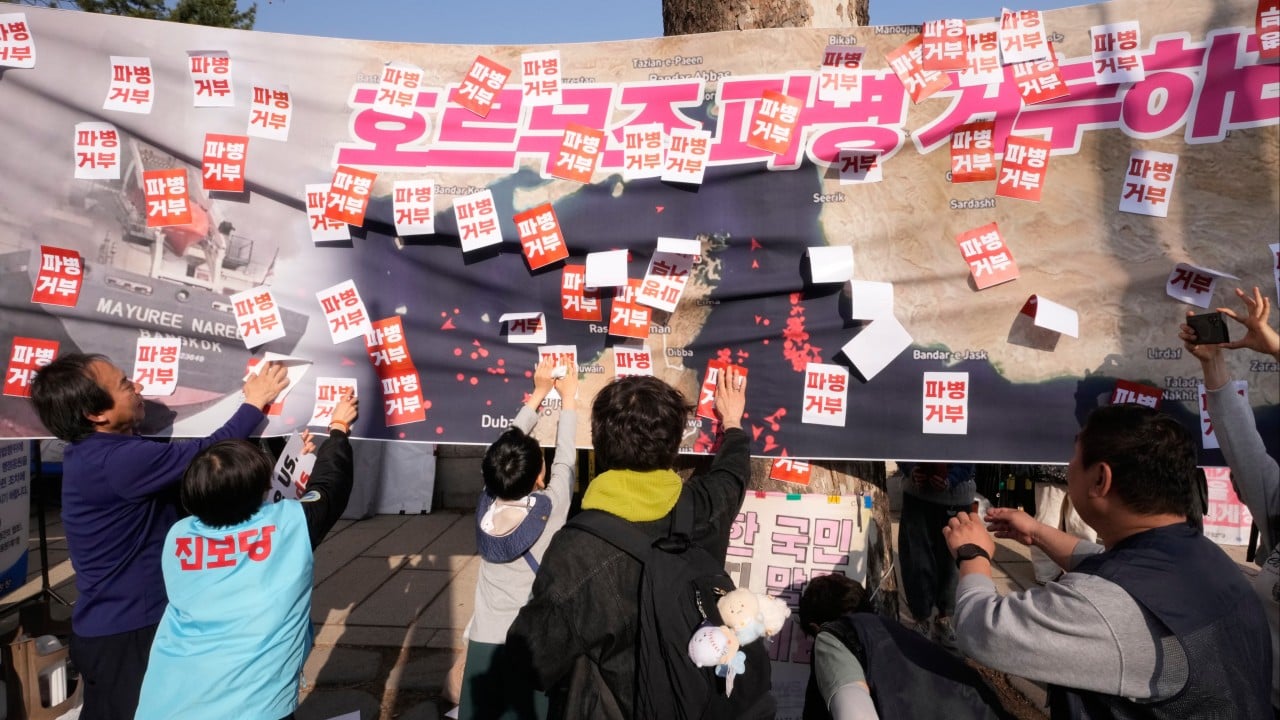
Rain slicked the pavement outside the Blue House in Seoul, a cold gray mist that seemed to mirror the quiet anxiety vibrating through the South Korean capital. Inside, the air likely tasted of expensive coffee and the sharp, metallic tang of high-stakes tension. This wasn't about a simple line item in a budget. It was about a price tag being placed on a friendship that had survived trenches, frozen winters, and decades of shared watch-fires.
When the news broke that the White House had again signaled a "rebuke" regarding the Strait of Hormuz—hinting that South Korea wasn't pulling its weight in protecting the world’s most vital oil artery—the reaction in Washington was a series of analytical shrugs. To the beltway, it was a tactical nudge. To a small business owner in Incheon or a logistics manager at a Samsung plant, it felt like the floor was tilting.
Consider a man like Min-jun. He doesn’t work in the Ministry of Foreign Affairs. He manages a small fleet of delivery trucks that run on diesel. To Min-jun, the Strait of Hormuz is not a geopolitical "theater." It is the reason his fuel costs stay predictable enough to keep his children in school. When the U.S. President suggests that the alliance is a lopsided deal, Min-jun doesn’t see a policy debate. He sees a threat to the very stability that has allowed his country to rise from the ashes of a civil war to become a global tech giant.
The Geography of Fear
The Strait of Hormuz is a narrow choke point, a throat that breathes for the world economy. Twenty percent of the world’s liquid petroleum passes through that tiny gap. For South Korea, the dependency is even more acute. Nearly 70% of their crude oil and a massive chunk of their liquefied natural gas come through those waters.
When the U.S. calls for "burden sharing," they are talking about ships and sailors. They are asking Seoul to send its own destroyers to patrol those sun-scorched waves. On the surface, it sounds fair. Why shouldn't a wealthy nation protect its own supply lines? But the reality is a thicket of thorns. Sending a fleet to Hormuz isn't just about fuel; it’s about the delicate dance South Korea must perform with Iran, a major trading partner, and the looming shadow of North Korea, which requires every ounce of Seoul’s military focus at home.
The alliance between Washington and Seoul is often described as "ironclad." It is a word favored by diplomats because iron is strong. They forget that iron can also be brittle. It can rust if left out in the rain of constant transactional demands.
The Cost of a Handshake
For decades, the deal was simple. The U.S. provided a nuclear umbrella and 28,500 troops on the ground. In exchange, South Korea provided a strategic foothold in Northeast Asia and a loyal partner in trade and regional stability. It was a symbiotic relationship built on blood spilled in the 1950s.
But the rhetoric changed. The alliance started being discussed in the language of a protection racket.
- $5 Billion: The rumored annual price tag the U.S. demanded for keeping its troops on the peninsula.
- 1/10th: The fraction of that cost South Korea was originally paying.
- Zero: The number of allies who feel comfortable when their security is treated like a subscription service.
The rebuke over Hormuz was another brick in this wall of "pay-to-play" diplomacy. Yet, if you look beneath the headlines, the alliance isn't actually crumbling. It’s changing shape.
The U.S. military presence in Korea isn't a gift. It is a strategic necessity for American interests. If those troops weren't there, the U.S. would lose its front-row seat to the rise of China and the volatile unpredictability of Pyongyang. Washington knows this. Seoul knows this. The "rebuke" is a performance, a loud negotiation tactic meant to squeeze a few more coins out of a partner, but it stops short of actually burning the bridge.
The Invisible Stakes
Imagine a young lieutenant on a South Korean destroyer, the ROKS Wang Geon. He is 24 years old. His parents remember when South Korea was a developing nation. He grew up in the neon glow of a hyper-modern Seoul. Now, he is being told his ship might be sent thousands of miles away to the Middle East to appease a frustrated ally.
If he goes, he risks drawing South Korea into a conflict with Iran that they didn't start and don't want. If he stays, he risks being part of the generation that saw the "Great Alliance" fracture. This is the human weight of "geopolitical maneuvering." It isn't just a chess move; it’s the career and safety of a young man who just wants to defend his home.
The irony is that South Korea is already one of the most generous hosts for U.S. forces in the world. They paid for 90% of the construction of Camp Humphreys, a massive $11 billion base that is essentially a small American city transplanted into the Korean countryside. They buy billions of dollars in American hardware—F-35s, Aegis destroyers, Apache helicopters.
The alliance is not a charity case. It is a massive, multi-generational investment.
The Ghost in the Room
We cannot talk about the U.S.-South Korea alliance without acknowledging the specter that haunts every dinner table in Seoul: the North.
For an American politician, North Korea is a problem to be "solved" or "managed" via Twitter or summits. For a South Korean, North Korea is a brother with a knife who lives in the basement. Every time the U.S. wavers on its commitment, every time a "rebuke" is issued over a distant strait in the Middle East, the knife feels a little sharper.
The "very strong" nature of the alliance that diplomats keep citing isn't based on a shared love of democracy alone. It’s based on the sheer, terrifying reality that neither side can afford for it to fail. If the U.S. pulls out, it cedes the Pacific. If South Korea loses the U.S., it faces an existential threat without a shield.
They are like two mountain climbers roped together on a sheer cliff. They might be screaming at each other. One might be complaining that the other isn't carrying enough gear. But neither is going to cut the rope.
Beyond the Transaction
The danger of the "Hormuz rebuke" isn't that it will end the alliance. It won't. The danger is that it changes the spirit of the alliance.
When you treat a partner like a customer, you lose their loyalty the moment a better deal comes along. For seventy years, South Koreans have viewed Americans as "Katchi Kapshida"—We Go Together. It’s a slogan you see on patches and posters across the country. It implies a shared destiny.
When the conversation shifts to "What have you done for me lately?" that shared destiny begins to look like a contract. Contracts can be broken. Destinies cannot.
The real story isn't the friction. It’s the resilience. Despite the public spats, the military exercises continue. The intelligence sharing remains deep. The economic ties are so intertwined that uncoupling them would be like trying to remove the flour from a baked loaf of bread.
But there is a fatigue setting in.
Younger South Koreans, those who didn't grow up on stories of American GIs handing out chocolate bars during the war, look at these rebukes differently. They see a country that is increasingly inward-looking and transactional. They see a partner that might leave them if the "return on investment" isn't high enough this quarter.
The alliance will survive this president, and the next, and the one after that. The geography of the peninsula demands it. But the warmth is being drained out of the room. The alliance is becoming a business arrangement, cold and calculated.
In a quiet corner of a Seoul office, a policy analyst watches the news from the Persian Gulf. He sees the reports of tankers being harassed and the American demands for more Korean involvement. He sighs and goes back to work. He knows the ships will eventually go, or the money will eventually be paid. The anchor will hold.
But he also knows that every time the rope is strained this hard, a few more strands snap. Eventually, you're not held together by a bond of iron. You're held together by a thread of habit, waiting for the one storm that finally proves too much.
The sun sets over the Han River, the light reflecting off the skyscrapers of a nation that built itself on the promise of a permanent friend. The lights stay on. The factories keep humming. For now, the cost of the anchor is a price everyone is still willing to pay.