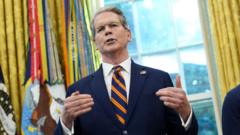
Scott Bessent is talking about a 15% global tariff hike as if it’s a guillotine drop. The markets are flinching. Analysts are dusting off their 1930s history books to scream about Smoot-Hawley. They are all looking at the wrong map.
A 15% baseline tariff isn’t an economic end-state. It is a massive, long-overdue price discovery mechanism for a global supply chain that has lived on subsidized borrowed time for three decades. The "lazy consensus" says that tariffs are a direct tax on the consumer that kills growth. That is a freshman-year textbook simplification that ignores how modern currency manipulation and industrial subsidies actually function.
If you think a 15% tax at the border translates to a 15% price hike at the register, you don’t understand margin compression or the desperate need for capital to find a home that isn't tied to a single, hostile geography.
The Myth of the Efficient Supply Chain
For years, we’ve been told that "Just-in-Time" manufacturing and global sourcing were the peak of human economic achievement. In reality, it was a fragile system built on the assumption that geopolitics would stay frozen forever. It wasn’t efficiency; it was an addiction to low-cost labor and ignored environmental externalities.
A 15% tariff doesn't "break" the supply chain. It exposes the fact that the chain was already broken. I’ve watched companies burn through millions in "savings" by sourcing from overseas, only to lose it all during a single shipping delay or a sudden regulatory shift in a distant capital. The cost of "cheap" has always been hidden. Tariffs simply move that cost to the front of the invoice where it belongs.
We are moving from an era of Efficiency at All Costs to an era of Resilience at Any Cost. The 15% figure is a signal to every C-suite executive: the era of the free lunch in the Far East is over. If your business model can't survive a 15% shift in COGS (Cost of Goods Sold), you didn't have a business; you had a carry trade on labor arbitrage.
Why 15% is Actually the "Goldilocks" Number
Bessent’s 15% proposal is being framed as an escalation. It’s actually a stabilization.
In the current mess of targeted duties, anti-dumping penalties, and sector-specific bans, the average importer is navigating a labyrinth. A flat, universal tariff actually reduces the cognitive load and the legal overhead of international trade. It creates a predictable floor.
- Logic Check: If every competitor faces the same 15% hurdle, the competitive advantage shifts back to the company with the best product, not the one with the best customs lawyers.
- The Currency Offset: When a country faces a 15% tariff, their currency typically devalues against the dollar. If the Yuan or the Euro drops by 5-8%, half the "tax" is already eaten by the exchange rate before a single crate hits a US port.
People ask, "Won't this cause hyper-inflation?" No. It causes a reshuffling. Inflation is too much money chasing too few goods. A tariff regime encourages the production of more goods within a protected trade zone. It’s a supply-side shock that eventually leads to a supply-side expansion.
The Re-Industrialization Lie
Let’s be brutally honest: 15% tariffs will not bring back the 1950s assembly line. If you’re waiting for a resurgence of manual labor jobs in the Midwest, you’re dreaming.
What a 15% tariff does do is make the math for high-end automation work. When labor is $2 an hour in a distant country, you don't buy a $500,000 robotic arm. When that labor is taxed and delayed, the robotic arm becomes the cheapest employee you ever hired.
The real winners of the Bessent era aren't the factory workers of old; they are the systems integrators, the software engineers, and the regional logistics hubs. We aren't bringing back the past; we are funding the transition to a localized, automated future.
The "Retaliation" Boogeyman
The most common critique is that other nations will retaliate. "They’ll tax our tech! They’ll tax our corn!"
Of course they will. But here is the nuance the "free trade" crowd misses: The United States is the world's largest consumer. We are the prize. In a trade war, the entity with the largest trade deficit has the most leverage. If you buy $500 billion more than you sell, you have $500 billion worth of "bullets" in a tariff fight.
Imagine a scenario where the EU raises tariffs on American software in response to 15% on their cars. Who loses? The European companies that rely on that software to function. In a localized world, the person who controls the consumption controls the terms of the peace treaty.
The Brutal Reality for Investors
Stop looking at the S&P 500 as a monolith. A 15% global tariff environment creates a massive divergence between "Old Globalists" and "New Localists."
- Avoid the Middlemen: Companies that buy finished goods and simply slap a brand on them (think fast fashion or low-end electronics) are going to get slaughtered. Their margins are too thin to absorb a 15% hit, and they don't own the means of production to pivot.
- Bet on the Vertical: Companies that own their entire stack—from raw materials to the final mile—can optimize around the tax.
- The Commodity Pivot: If global trade slows, domestic commodities become the ultimate hedge.
I’ve seen portfolios wiped out because they were "diversified" across 50 companies that all shared the same single point of failure: a shipping lane in the South China Sea. A 15% tariff is the market's way of telling you to diversify your geography, not just your tickers.
Dismantling the "Cost to the Average Family" Stat
You’ll see the headlines: "Tariffs will cost the average family $2,000 a year."
This is a static analysis that assumes nobody changes their behavior. It’s the same flawed logic used to predict that a $20 minimum wage will make a burger cost $25. It doesn't happen because the market adapts.
Consumers switch to domestic alternatives. Manufacturers find efficiencies. Retailers eat some of the margin to keep foot traffic. Most importantly, the revenue generated by these tariffs—estimated in the hundreds of billions—can be used to offset personal income taxes or fund domestic infrastructure.
If we replace a tax on work (income tax) with a tax on consumption (tariffs), the average family doesn't lose $2,000. They gain the ability to choose whether or not they pay the tax based on what they buy. That is the definition of economic freedom.
The End of the "Lazy Consensus"
The panic over Bessent’s comments isn't about economics; it's about the end of a comfortable, lazy era for the financial elite. It’s much easier to manage a spreadsheet when you can assume the world is a flat, frictionless plane.
The world is actually jagged, mountainous, and increasingly tribal. A 15% tariff is simply the financial world catching up to the physical reality. It isn't a "tax on the poor"; it is a premium paid for national security and economic sovereignty.
Stop asking when we’ll go back to "normal." This is the new normal. The 15% baseline is the first step in a total rewiring of how value is created and captured. You can either whine about the price of imported trinkets or you can position yourself for the greatest capital reallocation in a century.
Pick a side. The middle of the road is where you get run over.