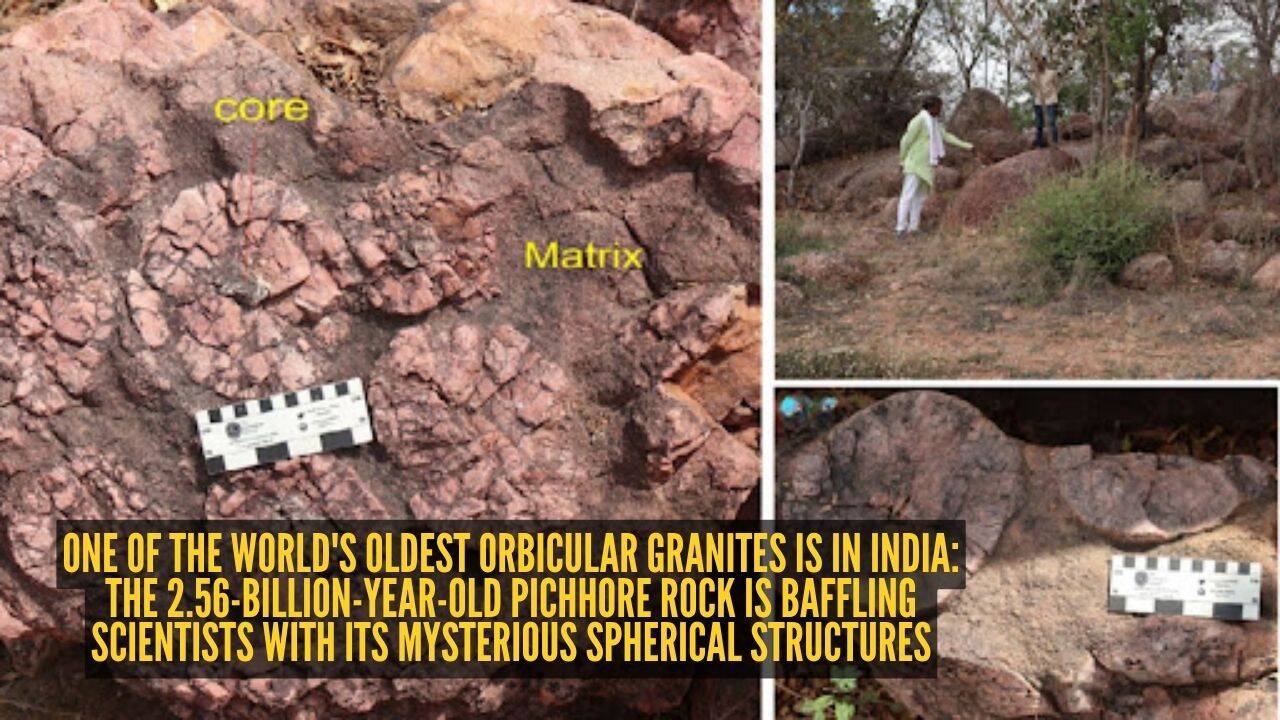
Geologists in central India have pinpointed the exact origins of the Pichhore granite, dating the massive formation to roughly 2.56 billion years ago. This discovery provides crucial evidence regarding how Earth’s continental crust stabilized during the Neoarchean era. Located within the Bundelkhand Craton, the rock formation serves as an open-air laboratory. It reveals the exact thermal and chemical conditions that allowed young, molten landmasses to cool into permanent continental foundations.
For decades, the formation of early continental crust remained a subject of intense debate among geoscientists. Earth during the Neoarchean era was fundamentally hotter than it is today. Radioactive decay within the mantle generated immense heat, creating rapid tectonic movement and frequent volcanic activity. Under these volatile conditions, crustal material usually recycled back into the mantle rather than remaining intact on the surface. The survival of the Pichhore granite offers clear proof of a key transition point where crustal melting shifted from unstable, short-lived pulses to enduring continental shields.
Deep Beneath the Bundelkhand Craton
To understand why the Pichhore granite matters, one must examine the structure of a craton. Cratons are the ancient, stable cores of continents that have survived hundreds of millions of years of tectonic collision, erosion, and mantle movement. The Bundelkhand Craton in central India contains some of the oldest rock units on the planet, but its precise assembly timeline has long contained major gaps.
The Pichhore granite represents a specific class of intrusive igneous rocks known as sanukitoids and high-K (potassium) granites. These are not ordinary magma flows that reached the surface and cooled quickly. Instead, they formed miles underground where mantle-derived fluids mixed with existing crustal rocks.
Chemical analysis of these granites shows high concentrations of potassium, rubidium, and thorium. This specific geochemical signature proves that older crustal material melted down and re-crystallized at high temperatures, a process necessary to make the upper crust buoyant and resistant to subduction.
Without this chemical differentiation, early landmasses lacked the buoyancy required to float on the denser mantle below. They simply sank back down. The injection of potassium-rich magmas like those found at Pichhore effectively hardened the craton, giving central India a permanent geological anchor.
Geochemical Fingerprints and the Magma Recipe
The extraction of precise age data from rock samples relies heavily on isotopic analysis. Geoscientists collect samples of zircon crystals locked within the granite matrix. Zircon is exceptionally durable, capable of surviving intense heat, pressure, and weathering without altering its core chemical structure.
When zircon crystals form inside cooling magma, they incorporate uranium atoms into their crystal lattice but reject lead. Over deep time, that uranium decays into lead at a fixed, known rate. By measuring the ratio of uranium to lead isotopes inside the Pichhore zircon grains using mass spectrometry, researchers calculate the exact moment the rock solidified.
The Thermal Threshold of Early Earth
- Mantle Temperatures: Ambient mantle temperatures 2.56 billion years ago ran roughly 200 degrees Celsius hotter than modern averages.
- Partial Melting: Heat driven by mantle plumes forced the overlying oceanic and proto-continental crust to melt at depths exceeding 30 kilometers.
- Fluid Fluxing: Water and volatile compounds trapped in subducting slabs lowered the melting point of the surrounding rock, generating potassic magma chambers.
- Crustal Thickening: Repeated intrusions of these magmas piled layers of granite beneath the surface, thickening the continental plate.
This specific chain of events marks a massive shift in how the planet cooled itself. Early in Earth's lifespan, heat escaped through chaotic, hyper-active volcanism. By 2.56 billion years ago, that localized cooling gave way to large-scale crustal differentiation, where heat drove internal melting that built thick, permanent continental plates instead of surface lava flows.
What Competitor Accounts Overlook
Standard reports on geological discoveries often frame rock formations as isolated historical artifacts. They treat a granite deposit like a museum piece, noting its age and location without explaining the systemic mechanics behind its creation. That approach misses the bigger picture entirely.
The Pichhore discovery does not merely add another entry to a database of old rocks. It actively challenges older models of plate tectonics. For years, one major school of thought held that modern-style plate tectonics operated continuously since the early Hadean or Archean eons. A competing view argued that early Earth operated under a single, stagnant lid where magma occasionally broke through a stationary outer shell.
The geochemistry of the Pichhore granite points directly to an intermediate mechanism. It demonstrates that while horizontal plate motion was starting to occur, mantle plumes still dominated the thermal budget of the planet. The high potassium content in the Pichhore rocks requires a specific two-stage melting process: first, mantle material melted to form basaltic crust, and second, that basaltic crust re-melted alongside water-rich fluids at the base of a thickening continental block.
This two-stage process requires both horizontal movement to carry water-rich crust deep into the earth and vertical mantle upwelling to supply the necessary heat. It shows that 2.56 billion years ago was not defined by modern plate tectonics or a stagnant lid, but by a hybrid tectonic regime unique to that specific era of planetary cooling.
Mineral Security and Economic Implications
Understanding ancient cratons is not solely an academic exercise. The deep geological processes that formed the Pichhore granite directly influenced how valuable economic minerals concentrated within the Earth's crust.
Granite intrusions of this age act as massive heat engines that drive hydrothermal fluids through surrounding rock fractures. As these mineral-laden fluids cool, they precipitate heavy metals and rare elements into concentrated veins.
| Mineral / Element Type | Geological Formation Mechanism | Economic Significance |
|---|---|---|
| Pegmatite Veins | Late-stage crystallization of potassic magma | Primary source of lithium, tantalum, and cesium |
| Hydrothermal Gold | Fluid circulation driven by granite cooling | Orogenic gold deposits found along craton margins |
| Rare Earth Elements (REEs) | Fractional crystallization in alkalic granites | Essential inputs for electronics and modern energy tech |
| Banded Iron Formations | Basin deposition adjacent to stabilizing cratons | Major global sources of high-grade iron ore |
When geologists map the boundaries and age profiles of granitic bodies like Pichhore, they build predictive models for resource exploration. Knowing that a specific region underwent potassic granite intrusion 2.56 billion years ago tells exploration geologists exactly where to look for pegmatite fields and associated rare-metal deposits.
Mapping the Archean Transition
The preservation of the Pichhore granite offers a rare structural window into the Neoarchean transition, the precise interval when Earth transformed from a ocean-covered world of volcanic chains into a planet dominated by large, emergent continents.
Prior to this interval, most crustal material was mafic—dense, iron-rich, and dark, similar to modern oceanic basalt. Felsic rocks like granite, which are rich in silica, aluminum, and potassium, were rare. Because mafic crust is dense, it sits low in the mantle, allowing oceans to cover almost the entire globe.
Felsic granite, however, possesses a much lower mass density. When vast volumes of potassic magma intruded into the Bundelkhand region 2.56 billion years ago, they created lightweight crustal blocks that rose high above the surrounding mantle. This buoyancy pushed the rock above sea level, driving the first massive emergence of dry land.
As these granite domes rose out of the global ocean, they immediately encountered atmospheric weathering. Rain, carbon dioxide, and atmospheric gases began breaking down the fresh granite, washing sodium, potassium, and calcium ions into the oceans for the very first time. This chemical flux fundamentally changed ocean chemistry, creating the precise nutrient conditions that allowed early photosynthetic microbial life to flourish and eventually oxygenate the atmosphere.
The Pichhore granite is not just a passive block of stone residing in central India. It is a physical remnant of the engine that built the continents, altered the oceans, and permanently altered the atmosphere of the planet.