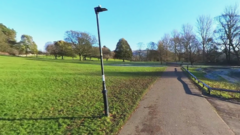
The afternoon light in a public park is rarely gentle. It cuts through the metal frames of empty swings, slants across worn paths, and pools in the patches of dead grass where the soccer goals used to stand. At three in the afternoon, the air smells of old asphalt and damp earth. It is the hour when the world splits in two: the official world of bells, chalkboards, and adults who pretend safety is a permanent architectural feature, and the shadow world that teenagers inhabit.
We remember our own afternoons. The weight of a backpack heavy with algebra books that felt like lead. The absurd confidence of being fourteen years old, invincible and fragile all at once. You walk with your friends. You talk about nothing. You laugh too loudly because the silence feels heavier than it should.
Then the geometry of the space shifts.
Consider what happens next: a shift in weight, a narrowing of eyes, a step off the paved path.
This is not a story about strangers in the dark. That is the comforting myth we tell ourselves to sleep better at night. We imagine crime as an external monster, something that leaps from an unlit alleyway with a jagged blade and a snarling face. We lock our front doors and check our deadbolts because we believe the threat wears a mask.
It does not.
The threat wears a school uniform. It carries the same faded canvas backpack with a brand logo drawn in white correction fluid. It knows your locker combination. It sits three rows away during third-period history, chewing on the end of a blue plastic pen while the teacher drones on about trade routes.
When a teenager is cornered and robbed at knifepoint by classmates in a neighborhood park, the physical theft of a mobile phone or a twenty-dollar bill is merely the punctuation mark at the end of a much longer, darker sentence. The real stolen property is something far more irreplaceable. It is the naive assumption of safety. It is the belief that the social contract applies to everyone, everywhere, all the time.
I have walked those parks. Not that specific park, perhaps, but its identical twin in a dozen other towns. The gravel path that crunches under worn sneakers. The concrete picnic table with initials carved into the green paint with a compass tip. I know the exact angle of the sun when the shadows stretch long enough to hide intention.
When young people turn on each other with blades bought online or pulled from a kitchen drawer, they are acting out a tragedy of proximity. They live in the same zip code. They share the same Wi-Fi networks. They watch the same algorithmic feeds that reward cruelty with views and validation.
Let us be precise about the mechanics of this violence. It rarely begins with a knife. It begins with a glance that lingers too long. It begins with a whispered insult in the hallway that goes uncorrected by bystanders. It festers in group chats where humiliation is packaged as entertainment, sliced into short videos, and broadcast to an audience of peers who are too terrified of becoming the next target to press the stop button.
By the time the metal clears leather—or worse, a cheap stainless-steel folding knife bought for ten dollars at a gas station—the social machinery has already failed utterly.
Parents look at their children and ask a desperate, hollow question: How could this happen?
The answer is terrifyingly simple. It happens because we have built a culture that isolates our children while pretending to connect them. We hand them glowing rectangles that strip away empathy, replacing the awkward, beautiful difficulty of face-to-face negotiation with the flat, frictionless cruelty of digital disdain. When that disdain spills offline, it carries the weight of a video game come to life. Except there are no extra lives. There is only the cold pressure of steel against a winter jacket and the smell of fear that lingers long after the police cruiser's blue lights have stopped flashing against the brick walls of the community center.
We need to talk about the anatomy of betrayal.
When an adult is robbed, the violation is criminal. When a child is robbed by a classmate, the violation is existential. The playground is no longer a neutral zone. The walk home from school becomes a minefield of hypervigilance. Every rustle of leaves in the bushes sounds like footsteps. Every group of teenagers laughing by the bus stop triggers an involuntary spike of adrenaline that floods the bloodstream with cortisol.
This is what trauma looks like at fifteen years old. It is not cinematic. It does not arrive with a grand orchestral score. It is quiet. It is staring at the ceiling at two in the morning, listening to the hum of the refrigerator, wondering why the world suddenly feels so thin.
Behavioral patterns in adolescent crime have shifted over the past decade. The data tells us that youth violence is increasingly decentralized. It happens in broad daylight. It happens in spaces designed for recreation. The perpetrators are rarely criminal masterminds; they are children drowning in status anxiety, emotional illiteracy, and a desperate, clawing need for power in a world where they feel utterly powerless.
When you strip away a teenager's agency through poverty, academic failure, or systemic neglect, they look for shortcuts to dominance. And nothing grants instant dominance quite like a weapon.
We must stop treating these incidents as isolated anomalies. They are symptoms of a fever.
Consider the response of the institutional machinery. The school issues a statement about counseling resources. The police increase patrols around the perimeter for a week. The local news runs a thirty-second segment during the evening broadcast, sandwiched between a human-interest piece on a local baker and the weather forecast. Then the news cycle turns. The patrol car disappears. The children go back to the park.
Nothing has changed.
The underlying rot remains untouched because we refuse to look at the mirror it holds up to our society. We want to believe that bad kids come from bad places, as if geography were a moral destiny. But cruelty does not check property values. It breeds just as easily in manicured suburbs with pristine lawns as it does in concrete housing complexes. It feeds on the silence of institutions that are more concerned with liability than healing.
Listen to the silence that follows an incident like this. It is a heavy, suffocating thing. It is the sound of a community holding its breath, hoping against hope that the storm passes over their house and strikes someone else's roof.
Recovery requires more than justice. The juvenile justice system, in its current iteration, is a blunt instrument. It either throws children into a pipeline of institutional hardening or waves away their actions with a bureaucratic slap on the wrist, treating the event as a youthful indiscretion rather than the violent assault it actually was. Neither approach heals the victim. Neither approach rehabilitates the offender. Both simply sweep the broken pieces under the rug and pretend the floor is clean.
True safety is not the absence of danger. It is the presence of connection.
It is the teacher who notices when a student stops speaking. It is the coach who stays ten minutes late to listen to a stammered explanation of why someone is afraid to walk home. It is the difficult, unglamorous work of rebuilding community bonds in a culture that commodifies isolation.
The sun dips lower behind the trees at the edge of the park. The streetlights flicker on, casting a jaundiced, buzzing glow over the empty slide. Somewhere nearby, a front door opens. Footsteps echo on pavement. The world keeps turning, indifferent to the invisible fractures running through its foundation, waiting to see who will be brave enough to look down and name the crack before it splits entirely open.