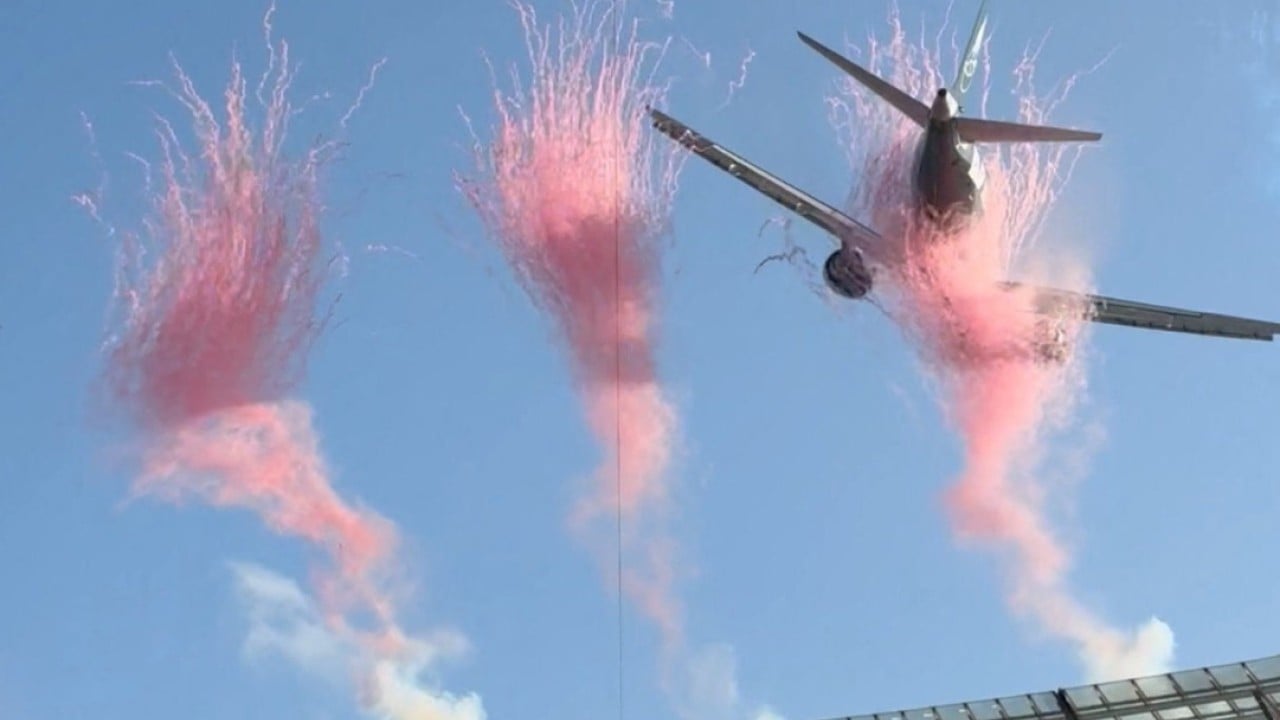
Two regional passenger jets cleared the roof of Cape Town Stadium by barely fifty feet during a pre-match rugby spectacle, triggering an urgent regulatory investigation and exposing a dangerous collision between crowd-pleasing traditions and commercial aviation protocols.
The low-altitude maneuver, executed by two Airlink Embraer E-jets ahead of a high-stakes match between South Africa and New Zealand, electrified fifty-six thousand spectators inside the arena. It also horrified veteran pilots worldwide. Flight-tracking data and observer footage revealed the aircraft skimming past the curved architectural structure at roughly 150 knots, slicing through pyrotechnic smoke with margins of error that left zero room for mechanical failure, wind shear, or bird strikes.
While local aviation authorities initially granted permits for the special event under strict guidelines, public outcry and pressure from international aviation experts forced a rapid about-face. The South African Civil Aviation Authority (SACAA) launched an exhaustive compliance review, and the airline subsequently withdrew its applications for subsequent stadium flypasts, officially citing unfavorable weather forecasts while quietly handing over digital flight data recorder black-box logs for forensic examination.
The Anatomy of a High-Stakes Spectacle
Stadium flyovers are practically woven into the DNA of South African sporting culture. The tradition traces its roots back to the 1995 Rugby World Cup final at Ellis Park, when a massive Boeing 747 thundered over the turf in a moment that became a powerful symbol of national unity. That historic sweep occurred at a different altitude, in a different era of aviation oversight, and with an aircraft scale that commanded a wide berth.
Replicating that emotional resonance with modern regional twin-jets required an entirely different geometry. Modern commercial airliners are engineered for efficient point-to-point transit, high-altitude cruise performance, and sterile instrument approaches. They are not built for urban contour flying or low-level airshows.
Airlink defended the operation by highlighting the immense human capital deployed in the cockpit. Each jet carried three senior captains, dividing responsibilities among a commander, a co-pilot, and a safety or technical officer. The flight plan underwent simulator rehearsals, and the crew adhered to pre-approved speed envelopes.
Yet pedigree and preparation do not rewrite the laws of physics. At fifty feet above a stadium rim, a sudden downdraft caused by urban heat islands or stadium architecture creates immediate peril. A dual-engine commercial transport at 150 knots covers eighty feet every single second. If an engine ingests debris or a localized gust disrupts lift at that elevation, the transition from aerial pageantry to catastrophic structural impact happens faster than human neural processing can counter.
When Tradition Collides With Risk Management
The incident exposed a stark philosophical fracture between marketing departments and safety management systems. Major airline sponsorships thrive on visibility, and a branded aircraft roaring over a sold-out stadium broadcasts dominance across global television feeds. But aviation safety culture is explicitly built on risk mitigation, redundancy, and the elimination of unnecessary variables.
Introducing heavy passenger equipment into a congested urban bowl surrounded by steel structures, lighting rigs, and dense crowds violates core risk assessment principles. Commercial pilots train extensively for engine failures on takeoff and landing, where altitude profiles provide precious seconds for recovery or controlled descent. At stadium roof height, low-level flight profiles convert minor anomalies into absolute emergencies.
Independent aviation analysts pointed out the dangerous precedent established by the stunt. When commercial operators push regulatory boundaries to deliver entertainment value, other carriers face commercial pressure to match the spectacle. Aviation safety records are built on conservative margins, not dramatic visual payoffs.
The Regulatory Reckoning
The decision by the SACAA to scrutinize the digital flight data downloads represents a crucial test for South Africa's otherwise stellar aviation safety standing. The country maintains an enviable zero fatal-accident record in scheduled commercial operations spanning decades, ranking near the top of international oversight audits. Protecting that institutional credibility requires holding commercial operators to uncompromising standards, regardless of public nostalgia or broadcast partnerships.
By voluntarily submitting flight recorder metrics, Airlink attempted to demonstrate transparency, pointing out that parameters remained within the letter of the special event permit. However, proving compliance with a flawed regulatory framework does not validate the underlying safety of the action. Regulators now face the task of rewriting the parameters for special public events, drawing a hard line between airshow acrobatic boxes and populated urban stadiums.
The cancellation of subsequent planned flyovers signals a quiet recognition that the spectacle outgrew its safety buffer. The true cost of aviation safety is rarely measured by the accidents that happen, but by the dangerous normalization of risk that is successfully intercepted before catastrophe strikes.