Imagine stepping back inside your home, locking the heavy front door, and suddenly hearing a tiny, sharp clink.
You look down. A piece of black plastic, no larger than a fingernail, is resting on the floorboards. You recognize it instantly. It is the tip of the deadbolt. Without it, the mechanism is completely trapped in the locked position. There is no other door. There are no windows. And in this particular scenario, your house is floating 238,900 miles away in the silent, freezing vacuum of space.
This was the terrifying reality facing Neil Armstrong and Buzz Aldrin on July 21, 1969.
They had just completed the most historic walk in human history. The adrenaline was wearing off, replaced by the heavy, leaden exhaustion that only comes from exerting oneself in a pressurized suit under one-sixth gravity. They crawled back into the cramped, metallic cabin of the Lunar Module, Eagle, eager for a few hours of fitful sleep before the journey home.
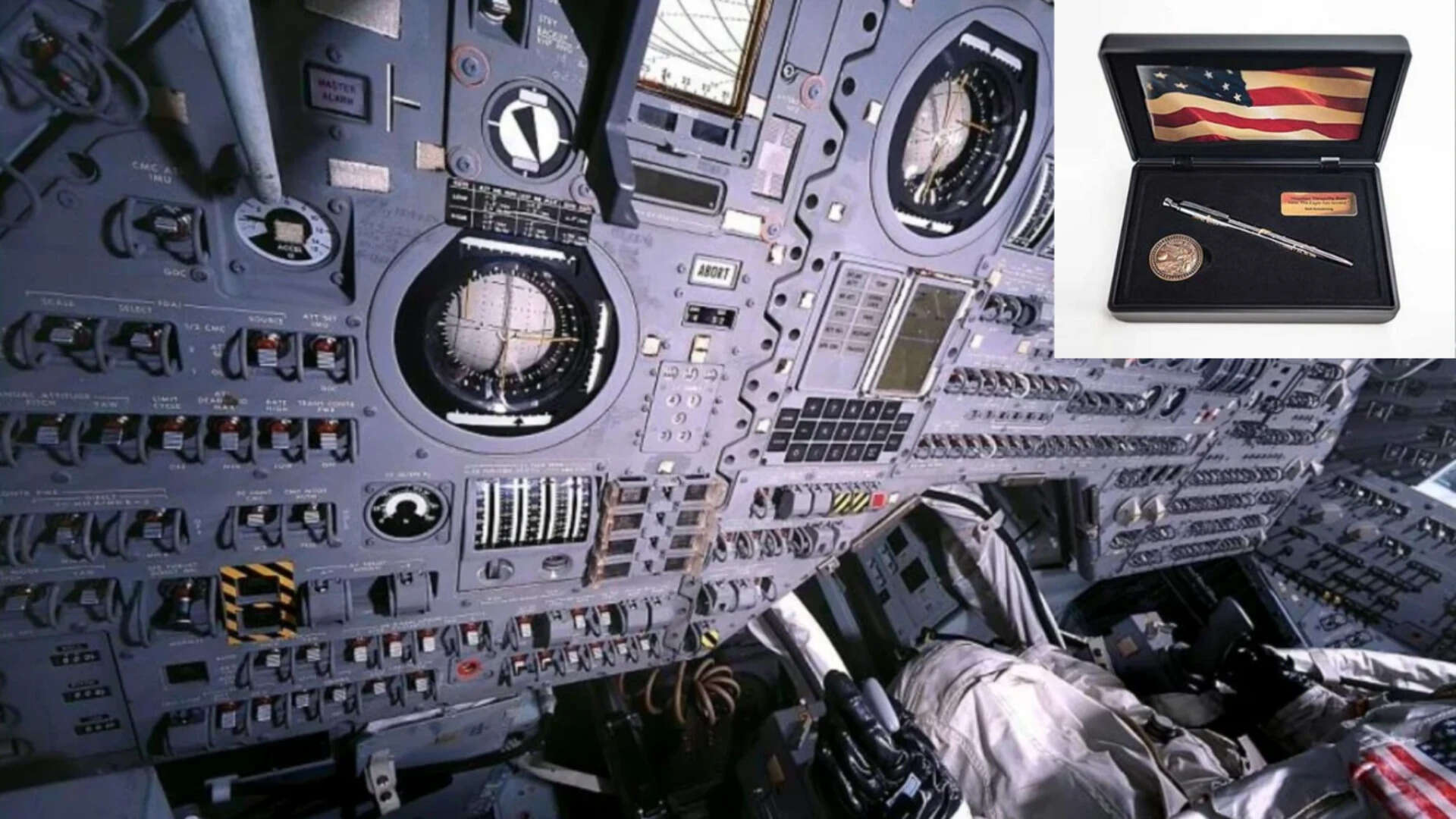
But as Aldrin shifted his bulky suit in the cabin, which was roughly the size of a closet, his backpack brushed against the control panel.
A quiet snap echoed through the cabin.
On the floor lay a small black button. Aldrin leaned down, his heart skipping a beat. He looked at the instrument panel, then at the piece of plastic in his hand. It was the plastic tip of the Engine Arm circuit breaker.
This was not just any switch. It was the literal gatekeeper to their survival. Without arming this specific circuit, the ascent engine—the solitary rocket engine designed to lift the top half of the Eagle off the lunar surface—could not ignite.
The equation was brutal in its simplicity: no switch, no engine. No engine, no home.
The Weight of Silence
If you have ever felt the cold spike of panic when your car engine clicks instead of roaring to life in a dark parking lot, multiply that by an infinite void.
Up in lunar orbit, Michael Collins was circling the Moon alone inside the Command Module, Columbia. He was entirely powerless to help them. If the engine did not fire, Neil and Buzz would simply run out of oxygen while the world watched on live television, helpless.
The astronauts contacted Mission Control in Houston. They explained the situation with the characteristic, forced calm of test pilots. For hours, the brightest minds on Earth huddled in backrooms, analyzing diagrams and wiring schematics. The engineers on the ground tried to simulate the issue, but no immediate, foolproof solution materialized from the telemetry.
The pressure was suffocating. Under the glare of fluorescent lights in Texas and the pitch-black sky of the Moon, time was ticking away, measured by the slow hiss of life support systems.
Aldrin knew he couldn't just shove his finger into the hole where the switch had been. The circuit was live. The human body is an excellent conductor of electricity, and a sudden jolt of current could easily electrocute him or short-circuit the entire lunar module's fragile electrical network. He needed something narrow, sturdy, and completely non-conductive.
He searched his spacesuit pockets. He bypassed metal tools, keys, and coins.
Then, his fingers brushed against a cheap, everyday object tucked into his shoulder pocket. It was a Duro "Rocket" felt-tip pen.
The $857,600 Workaround
The pen was nothing special. It was a standard, brushed aluminum writing instrument, about five and a half inches long. It had a little Velcro strip glued to the side so it wouldn’t float away in zero gravity, and a simple black plastic cap. It was the kind of pen you might find rolling around in the bottom of a desk drawer or left behind at a bank teller's station.
But it had one priceless feature: a non-conductive, plastic tip.
       [====== Duro "Rocket" Pen ======]  <-- The Non-Conductive Savior
                      ||
                      \/
               [============]
               | [Broken]   |             <-- The Recessed Engine Arm
               | [Switch]   |                 Circuit Breaker
               [============]
Aldrin carefully lined up the plastic end of the pen with the tiny, recessed opening of the broken circuit breaker. He took a breath, holding the fate of the space program in his gloved hand, and pushed.
Click.
The breaker engaged. The circuit armed.
A few hours later, the ascent engine fired flawlessly, lifting the Eagle back into the stars to rendezvous with Collins and begin the long journey home. A catastrophe that would have redefined the space age was averted by a pocket marker.
The Price of Survival
Decades later, the physical remnants of that terrifying night emerged from the private collection of the Buzz Aldrin Family Trust to cross the auction block at Sotheby’s.
Offered together as a single lot, the tiny, jagged piece of broken black plastic and the dented silver Duro pen became the subjects of a fierce, five-way bidding war. When the hammer finally fell, the winning phone bidder agreed to pay an astonishing $857,600 to own them.
It is easy to look at that figure and see the madness of the high-end art and memorabilia market. After all, it is nearly a million dollars for a dried-up marker and a scrap of broken plastic.
But to look only at the price tag is to miss the point entirely.
This pen represents the exact intersection of human vulnerability and brilliant, seat-of-the-pants improvisation. It is a physical monument to the truth that no matter how many billions of dollars we spend on cutting-edge engineering, humanity's greatest survival tool will always be our capacity to look at a desperate situation, reach into our pockets, and find a way forward.
The buyer did not just purchase a writing instrument. They bought the physical proof that sometimes, the only thing standing between a historic triumph and a quiet tragedy is a five-inch piece of plastic and the courage to push it into the dark.