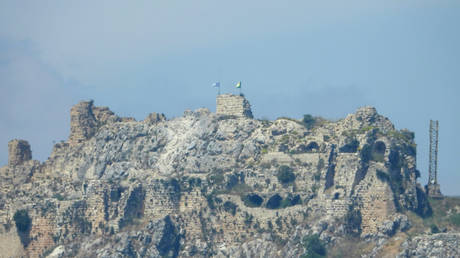
The seizure of Beaufort Castle by the Israel Defense Forces (IDF) marks the deepest ground incursion into Lebanese territory in 26 years, signaling a profound shift from a localized border containment policy to an expansive, high-altitude operational doctrine. While popular analysis frames the capture of the 900-year-old Crusader fortress through historical and symbolic lenses, the operational reality is driven strictly by geography, tactical optics, and regional leverage. By pushing beyond the Litani River toward the Zahrani River, the IDF has effectively reclassified southern Lebanon into a expanded combat zone, establishing a permanent high-ground vantage point that alters the mechanics of the conflict with Hezbollah and its primary state sponsor, Iran.
To evaluate the strategic weight of this offensive, the operation must be dismantled into three core drivers: structural geographic dominance, the breakdown of diplomatic leverage windows, and the shifting tactical equilibrium between low-altitude drone saturation and traditional hardpoint occupation.
The Geography of Dominance: The Beaufort Ridge Vector
The capture of Beaufort Castle (Qalaat al-Shaqif) is not a pursuit of historical trophies but an execution of high-ground topography. Perched on a sheer cliff approximately 700 meters above sea level, the Beaufort Ridge serves as a natural observation deck over the Litani River valley, the city of Nabatiyeh, and the northern Galilee basin of Israel.
Control of this specific coordinates yields two distinct military advantages:
- Line-of-Sight Telemetry: The elevation allows for uninterrupted optical and electronic surveillance over a multi-kilometer radius. In a conflict increasingly defined by precision-guided munitions, holding the ridge optimizes the deployment of counter-battery radar and laser-designation systems, stripping Hezbollah of the terrain camouflage it relies on in the valleys below.
- Encirclement Vector: Positioned roughly 5 kilometers from Nabatiyeh, the ridge forms the eastern anchor of a potential encirclement maneuver. By dominating this high ground, the IDF can interdict supply lines and monitor tactical movements between Nabatiyeh and peripheral logistics hubs like Choukine, Yohmor, and Zawtar al-Sharqiyah.
[Israel Border] ---> [Litani River Valley] ---> [Beaufort Ridge (700m)] ---> [Nabatiyeh Corridor]
This geographic progression explains why the IDF extended its operational limits from the Litani River to the Zahrani River, an expansion of roughly six miles northward. The movement establishes a deeper buffer, effectively pushing Hezbollah’s short-range rocket systems further back from northern Israeli communities. However, this deeper footprint creates an exponential expansion of the defensive perimeter that the IDF must secure.
The Attrition Mechanism and the Asymmetric Conflict
The current escalation dismantles the nominal United States-brokered ceasefire implemented on April 17, exposing a fundamental flaw in the truce's structural logic. The ceasefire was treated by both factions not as a permanent resolution, but as a dynamic pause to recalibrate assets.
The breakdown can be analyzed through a predictable sequence of escalation:
[Hezbollah Fiber-Optic Drone Salvos]
               │
               ▼
[Degradation of Israeli Air Defenses/Northern Communities]
               │
               ▼
[IDF Shift to High-Density Ground Offensive]
               │
               ▼
[Capture of Dominant Hardpoints (Beaufort)]
The primary tactical catalyst for the ground expansion was Hezbollah's deployment of hard-to-detect fiber-optic drones. These low-altitude, wire-guided munitions bypass standard radio-frequency jamming and radar detection arrays, inflicting steady casualties on IDF personnel and degrading infrastructure within northern Israel. Because electronic warfare assets could not reliably sever the command links of these drones, the IDF shifted its defensive posture to a physical degradation strategy: capturing and leveling the launch zones and infrastructure embedded in the towns flanking the Beaufort Ridge.
The cost function of this strategy is severe. The human and infrastructural toll in southern Lebanon includes over 3,370 fatalities reported by the Lebanese Ministry of Public Health, alongside the displacement of more than 1.2 million civilians. The administrative response from Lebanese Prime Minister Nawaf Salam characterizes this as a "scorched-earth policy." From a clinical military framework, the widespread demolition of structures within the combat zone is designed to systematically eliminate the covered firing positions, underground bunkers, and urban launch sites that form Hezbollah’s defensive infrastructure.
Diplomatic Timing and the Washington Leverage Window
The operational timing of this advance is closely tied to the diplomatic calendar. With direct bilateral negotiations between Israeli and Lebanese delegations scheduled to resume in Washington, the capture of Beaufort Castle serves as a real-time modification of the geopolitical ledger.
This maneuver operates on two distinct diplomatic levels:
The Positional Leverage Play
In state-level negotiations, territory held at the time of a conference dictates the baseline of enforcement terms. By holding a dominant position north of the Litani River, Israel alters the enforcement parameters of any future security zone. The territory acts as a structural bargaining chip: Israel can offer a conditional withdrawal from the Beaufort Ridge in exchange for verifiable, international guarantees regarding the disarmament and exclusion of Hezbollah forces from the entire zone south of the Litani.
The Tripartite Geopolitical Friction
The offensive intersects directly with parallel negotiations between Washington and Tehran. Iran’s diplomatic position requires that any broader regional arrangement must include an immediate cessation of hostilities in Lebanon, preserving Hezbollah as its primary forward deterrence asset. Conversely, Israeli military planners and far-right cabinet elements view this window as a brief period of operational freedom. The strategic objective is to inflict maximum structural damage on Hezbollah's command apparatus before international pressure or a formalized US-Iran agreement imposes hard legal limits on further incursions.
Tactical Realities and Systemic Vulnerabilities
Despite the optical value of hoisting the Golani Brigade flag over a medieval fortress, modern military analysts question whether old fortification architectures translate into modern strategic success. Critics of the operation, including civil-military experts within Israel, note that holding fixed, high-profile physical structures can introduce new operational risks.
- Static Asset Vulnerability: A historic fortress is a fixed coordinate. In an environment saturated with loitering munitions, anti-tank guided missiles (ATGMs), and high-angle mortar fire, a permanent position on a ridge can quickly turn from an observation post into a highly targeted landmark.
- The Logistics Tail: Extending ground forces to the Zahrani River requires a secure supply corridor stretching back across the Litani River into northern Israel. Securing these narrow supply lines against decentralized ambush squads, improvised explosive devices (IEDs), and drone strikes demands significant manpower, pulling infantry units away from offensive tasks to handle security along the routes.
- The Counter-Insurgency Trap: Historical data from Israel's previous 18-year occupation of this exact ridge (1982–2000) shows that static security zones often face high rates of attrition from guerrilla warfare. While an armored push can easily seize high ground, holding it against an entrenched local actor requires continuous defensive output.
The Immediate Strategic Playbook
The battlefield dynamics indicate that the IDF will not treat Beaufort Castle as a final stop, but as a fire-support base for the next phase of the campaign. The immediate operational path points toward the systemic isolation of Nabatiyeh. By combining the high-ground oversight from the Beaufort Ridge with sweeping evacuation demands down to the Zahrani River, the military is attempting to drain the civilian population from the area, creating a simplified, low-collateral combat zone.
Hezbollah’s likely response will avoid large-scale, symmetrical counter-attacks to retake the castle walls. Instead, the group can be expected to use decentralized attrition tactics, launching low-altitude drone strikes and anti-tank missiles from peripheral valleys like Wadi al-Saluki and towns like Bayada. This approach aims to make the logistical cost of holding the ridge unsustainable for the IDF over time.
The success of this territorial expansion depends on whether the IDF can convert its current geographical advantage into a durable security framework before the diplomatic talks in Washington lock the political borders in place.
Israel seizes strategic castle in Lebanon as ground offensive expands
This broadcast outlines the immediate details of the IDF ground advance into the Beaufort Ridge and its implications on the collapsing ceasefire.