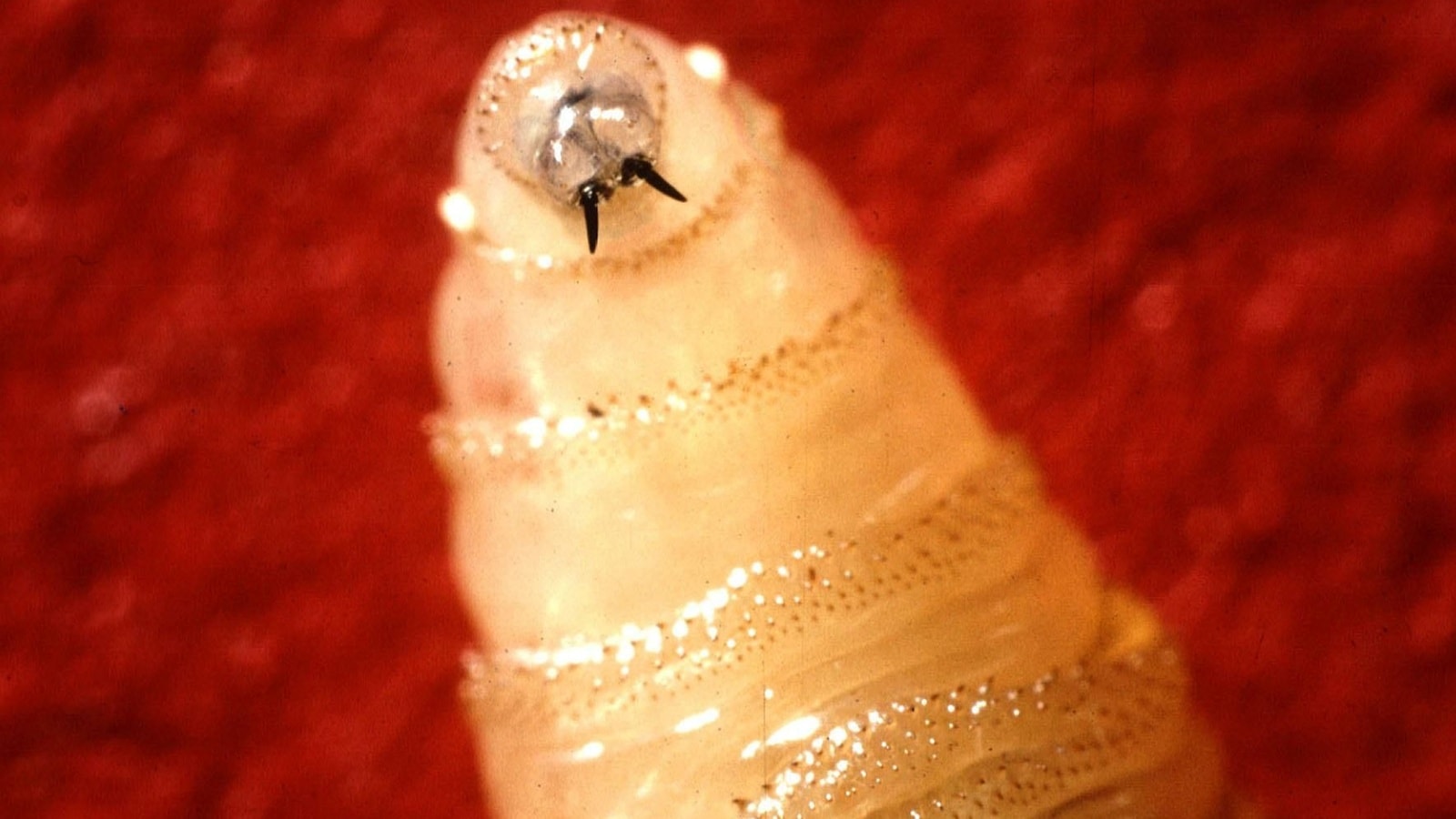
The confirmation of a New World screwworm (Cochliomyia hominivorax) infestation in a three-week-old calf in Zavala County, Texas, exposes a critical vulnerability in continental biosecurity. This case represents the first domestic detection of the flesh-eating parasite in a livestock herd since the mid-1970s, shattering a sixty-year narrative of permanent eradication. While public health authorities emphasize that the parasite poses no direct threat to food safety—given that the larvae feed strictly on living tissue and do not contaminate processed meat—the economic and operational threat to the macro-economy is profound. Modeling by the United States Department of Agriculture estimates potential localized shocks at $1.8 billion for the Texas economy alone. Because the domestic beef herd sits at its lowest inventory since 1951 at 86.2 million head, an uncontrolled biological outbreak introduces a severe supply-side constraint that will accelerate already elevated consumer protein prices.
To evaluate the trajectory of this biosecurity failure, analysts must look past the immediate clinical symptoms of the host animal and instead dissect the underlying logistical, biological, and structural breakdowns that allowed a eradicated parasite to breach a multibillion-dollar containment barrier.
The Core Biological Mechanism and the Multiplier Effect
The destructive capacity of Cochliomyia hominivorax stems from an obligate parasitic life cycle that targets living mammalian tissue. Unlike typical blowflies that subserve an ecological role by consuming necrotic matter, the female New World screwworm fly identifies minute epidermal breaches—such as tick bites, shearing nicks, branding marks, or the unhealed navels of newborn livestock—to deposit its genetic payload.
[Gravid Female Fly] ---> Locates Epidermal Breach (e.g., Newborn Navel)
                             |
                             v
                 [Lays 200–300 Eggs per Clutch]
                             |
                             v (12–24 Hours)
                 [Larvae Hatch & Instantiate Larval Strike]
                             |
                             v (Feeding Frenzy: 7 Days)
                 [Burrow Vertically into Living Tissue via Chitinous Mandibles]
                             |
                             v
                 [Larvae Drop to Soil to Pupate] ---> [Adult Emergence]
The reproductive math dictates the velocity of an outbreak:
- Clutch Density: A single gravid female deposits 200 to 300 eggs in a single wound matrix.
- Lifetime Output: Over a brief 10- to 30-day adult lifespan, a single female can execute multiple matings and deposits, yielding up to 3,000 eggs.
- Incubation Velocity: Eggs hatch within 12 to 24 hours, instantiating a localized "larval strike."
Once hatched, the larvae utilize specialized chitinous mandibles to burrow vertically into the host's healthy muscular tissue, rather than horizontally across the surface. This mechanical boring behavior creates deep, pocketed lesions that emit distinct volatile organic compounds. These chemical markers act as a beacon for secondary gravid females, inducing an exponential compounding effect known as a feeding frenzy. If unmanaged, the cumulative tissue destruction and associated secondary bacterial infections result in systemic shock, sepsis, and a 100% mortality rate for the host within seven to ten days.
The Three Pillars of Containment Failure
The reappearance of the parasite in South Texas is not an isolated random mutation; it is the mathematical consequence of a structural failure across a three-part geopolitical and biological barrier that successfully insulated North America for six decades.
+-------------------------------------------------------------------------+
|                  THE THREE PILLARS OF CONTAINMENT FAILURE               |
+-------------------------------------------------------------------------+
|  PILLAR 1: Ecological Breach                                            |
|  - 2021: Breakdown of the Darien Gap biological barrier in Panama.     |
+-------------------------------------------------------------------------+
|  PILLAR 2: Vector Acceleration via Transport                            |
|  - Rapid northward progression via illegal/untracked livestock shipping. |
|  - Outpaced the 10–30 day natural flight velocity of adult flies.       |
+-------------------------------------------------------------------------+
|  PILLAR 3: Institutional Interregnum                                    |
|  - 18-month gap: Domestic sterile-fly facility non-operational till 2027|
|  - Relying on stopgap manual ground chambers and aerial imports.        |
+-------------------------------------------------------------------------+
The Breakdown of the Darien Gap Barrier
The primary biological anchor was the Darien Gap—a dense, mountainous rainforest bridge spanning the border of Colombia and Panama. This inhospitable geography served as a natural geographic choke point. By maintaining a continuous aerial drop of factory-sterilized male flies across this narrow strip, a permanent regional barrier was established. This wall collapsed in 2021 when the parasite breached the zone, establishing an active breeding foothold in Panama that expanded aggressively through Central America by 2023.
Vector Acceleration via Transport Networks
The velocity of the northward advance across Mexico in 2024 and 2025 exceeded the biological flight capacity of the adult fly, which typically ranges from a few kilometers to a maximum of 300 kilometers under extreme wind assistance. Epidemiological tracing reveals that the primary vector for geographical acceleration was the informal or illicit transport of asymptomatic or sub-clinically infested livestock across regional borders. By moving hosts through commercial transport networks faster than the 7-day larval maturation cycle, human logistics effectively bypassed traditional geographical barriers, positioning the parasite just 25 miles from the US border by late May 2026.
The Institutional Interregnum
The final failure mode is an infrastructure bottleneck within domestic biosecurity. Following historical eradication, the United States decommissioned its domestic mass-rearing facilities, consolidating continental sterile-insect technique production into a single facility in Pacora, Panama. While a new $750 million sterile-fly production facility was commissioned at Moore Air Base in Edinburg, Texas, capital construction schedules dictate that this facility will not achieve operational output until late 2027. Consequently, domestic agricultural defense faces an 18-month capacity gap, leaving authorities dependent on long-distance logistics to import sterile flies from Panama or relying on static, less efficient ground-release chambers.
The Econometrics of an Outbreak: The Cost Function of Myiasis
The insertion of Cochliomyia hominivorax into the modern US agricultural economy triggers a cascading cost function ($C_{\text{total}}$) that extends far beyond the value of the individual lost calf. The true financial liability is modeled across four distinct, interacting economic variables:
$$C_{\text{total}} = C_{\text{labor}} + C_{\text{yield}} + C_{\text{logistics}} + C_{\text{trade}}$$
The Labor Premium ($C_{\text{labor}}$)
Modern cattle ranching relies on low labor-to-head ratios, enabled by extensive grazing systems where herds are inspected infrequently. Managing a screwworm threat requires a fundamental shift to intensive animal husbandry. Because a larval strike can transition from an open tick bite to a fatal infestation within a week, producers must institute mandatory 48-hour physical inspection protocols for all animals. The labor overhead required to round up, restrain, and visually examine thousands of head of cattle—particularly during peak calving seasons when unhealed umbilical sites are abundant—represents a severe operational tax that will erode the margins of cow-calf operations.
The Yield Penalty ($C_{\text{yield}}$)
Sub-lethal infestations inflict a heavy toll on herd productivity. Animals suffering from active myiasis experience high metabolic stress, leading to a rapid reduction in dry matter intake. In dairy configurations, this systemic stress induces an immediate drop in milk volume. In beef production, the biological toll manifests as rapid weight loss and a protracted reduction in reproductive efficiency, suppressing calving rates in subsequent seasons.
The Containment and Treatment Overhead ($C_{\text{logistics}}$)
The immediate deployment of a 20-kilometer quarantine zone around the index case in Zavala County imposes strict biosecurity mandates. Every warm-blooded animal moving across the perimeter must undergo physical inspection at designated check points, backed by veterinary certification. The direct costs include chemical intervention materials—such as organophosphate or macrocyclic lactone larvicides applied topically to wounds—and the operational expenses of running the Screwworm Adult Suppression System (SWASS), which pairs chemical attractants with localized insecticides.
Global Trade Restrictions ($C_{\text{trade}}$)
The long-term threat is geopolitical market exclusion. International trading partners maintain zero-tolerance thresholds for exotic parasitic pests. If the USDA fails to prove definitive containment within a localized geographic boundary via strict regionalization agreements, export markets will implement sweeping bans on live animal shipments from the United States to safeguard their own agricultural sectors.
Operational Playbook for Containment
To prevent the index case in Zavala County from shifting from an isolated breach to an endemic establishment, a dual-track strategy must be executed simultaneously. Producers must manage herd-level biosecurity while federal agencies manage regional biological suppression.
Micro-Level: Herd Protocols
Ranchers and herd managers must treat every open wound as an active biosecurity threat. The following technical actions are required:
- Navel Scorching: All newborn calves must immediately receive a topical application of 7% strong iodine to accelerate tissue desiccation and close the umbilical entry point.
- Chemical Prophylaxis: Any routine surgical intervention—such as dehorning, castration, or branding—must be paired with a topical treatment of a USDA-approved larvicide dust or spray to create a residual chemical barrier against egg deposition.
- Larvae Extraction Architecture: If a wound exhibits signs of infestation, personnel must not merely apply surface treatments. Larvae must be manually extracted using forceps to ensure complete clearing of the vertical channels. Collected samples must be preserved in 70% alcohol and routed to state animal health officials for definitive morphological verification to map the lineage of the strain.
Macro-Level: The Sterile Insect Technique (SIT) Framework
The silver bullet for total eradication remains the Sterile Insect Technique, yet its execution in the current environment faces a severe supply chain constraint. The technique relies on a simple genetic premise: female screwworm flies mate only once in their life cycle. By flooding an infested zone with factory-reared male flies that have been exposed to controlled gamma or X-ray radiation, wild females mating with these sterile males produce entirely infertile clutches. The wild population collapses exponentially over successive generations.
                  [Factory-Reared Male Flies]
                             |
                             v
                 [Exposed to Gamma/X-Ray Radiation]
                             |
                             v
         [Flooded into Infested Zone via Aerial Drops]
                             |
                             v
    [Sterile Males Mate with Wild, Monogamous Females]
                             |
                             v
             [Infertility Matrix Created: Zero Hatch Rate]
                             |
                             v
               [Exponential Population Collapse]
Because the Edinburg facility is offline, the USDA’s current tactical deployment must maximize the efficiency of its limited imported fly supply. Rather than relying solely on broad aerial dissemination, which suffers from high environmental dispersal losses, operational teams must deploy targeted ground-release chambers directly along the riparian corridors and brush lines of South Texas. These micro-habitats provide the high humidity and shade necessary for adult fly survival. This localized approach concentrates the sterile genetic buffer precisely where wild populations congregate to seek refuge from midday heat.
The Strategic Outlook
The trajectory of the New World screwworm in the United States depends on the speed and authority of the current containment response. If the Incident Command Team restricts the biological footprint to Zavala County through the strict enforcement of the 20-kilometer quarantine boundary and aggressive local sterile drops, the infestation can be choked out before the winter pupation cycle.
If, however, wildlife vectors—such as feral swine (Sus scrofa) or white-tailed deer (Odocoileus virginianus)—transport the larvae beyond the active surveillance zone, the parasite will re-establish a permanent domestic reservoir. Feral swine present a particularly dangerous vulnerability; their rooting behavior produces frequent skin abrasions, and their vast, unmonitored populations move freely through the dense brush country of Texas and northern Mexico. A failure to clear the parasite from these wild populations before the onset of the wet season will transition this incident from an acute crisis into a chronic structural tax on the North American livestock supply chain, permanently increasing the cost baseline of protein production.