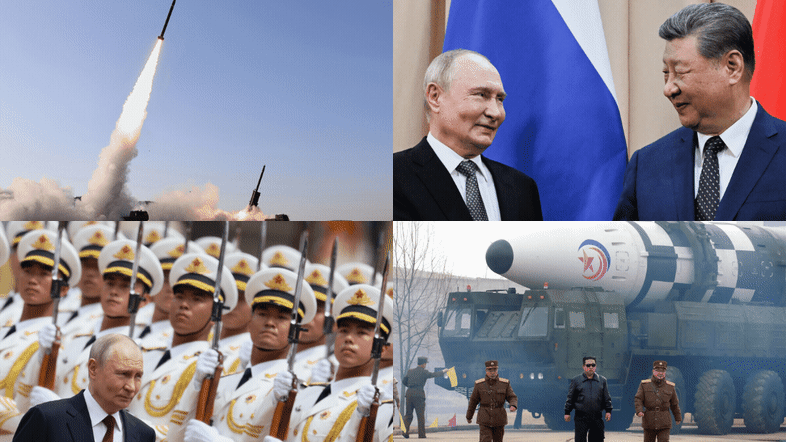
Geopolitical risk assessment requires moving beyond static bilateral accounting to evaluate multi-actor feedback loops. The strategic convergence between Beijing, Moscow, and Pyongyang presents a systemic challenge to Australian security architecture. Standard defense commentary often frames this alignment through the lens of ideological solidarity or reactive diplomacy. This approach misses the underlying transactional mechanics. The current alignment functions as a mutually reinforcing resource-and-technology exchange network designed to strain Western coalition bandwidth, creating distinct operational vectors that directly impact Indo-Pacific stability.
The Mechanics of the Trilateral Resource Loop
To understand the exposure profile facing Canberra, one must deconstruct the functional dependencies binding the three states. Each actor brings a discrete set of comparative advantages to an informal division of labor designed to bypass Western sanctions and deterrence structures.
- Pyongyang as the Conventional Munitions Reservoir: North Korea provides deep industrial-scale artillery and ballistic missile stockpiles, functioning as an external manufacturing surrogate. This allows Moscow to sustain high-attrition operations in Europe without exhausting domestic reserves.
- Moscow as the Technology Transfer Engine: In exchange for conventional ordnance and manpower support, Russia provides advanced aerospace, submarine, and missile guidance technical assistance to North Korea. This accelerates Pyongyang's weapons development cycle past traditional technological bottlenecks.
- Beijing as the Strategic Stabilizer and Economic Absorber: China provides the overarching economic buffer, absorbing sanctioned energy exports and supplying dual-use industrial inputs. Beijing maintains plausible deniability while benefiting from the distraction of Western military and intelligence assets across multiple theaters.
This triangular exchange creates a compounding security dilemma. Technologies and operational lessons tested in European-theater engagements flow back into East Asian missile and naval development, raising the baseline threat profile for maritime democracies like Australia.
The Australian Exposure Vector
Australia's geographic isolation has historically provided a strategic buffer. However, the modernization of long-range strike capabilities, combined with contested maritime and digital choke points, neutralizes the protective value of distance. The exposure manifests across three structural vectors:
- Indo-Pacific Strategic Diversion: As Washington and its key allies allocate intelligence, surveillance, reconnaissance (ISR), and high-end munitions to support European and Middle Eastern security architectures, the marginal capacity available for regional deterrence in the First and Second Island Chains decreases. This creates an opening for accelerated gray-zone coercion in Australia's immediate maritime approaches.
- Supply Chain and Economic Coercion Vulnerabilities: The Australian economy remains structurally exposed to primary export dependencies coupled with concentrated import routes. While direct military conflict remains a tail-risk event, the alignment of three major authoritarian states increases systemic risks regarding critical mineral supply security, maritime shipping lane insurance rates, and cyber intrusions targeting critical infrastructure.
- Information Warfare and Cyber-Domain Convergence: State-aligned actors increasingly share tactics, techniques, and procedures (TTPs) for disruptive cyber operations and strategic influence campaigns. The integration of foreign interference operations with automated data harvesting amplifies the domestic friction within democratic societies, testing social cohesion and institutional resilience.
Evaluating Traditional Deterrence Deficits
Standard strategic responses rely heavily on traditional alliance frameworks, specifically the United States security umbrella and minilateral minilaterals such as the Quad. While these mechanisms provide essential baseline deterrence, they suffer from structural constraints when confronted with a synchronized multi-theater challenge.
The primary limitation of traditional deterrence is its reliance on cost-imposition models that assume rational economic and political calculus. When regimes face extreme structural sanctions or existential isolation, their tolerance for economic pain shifts. Consequently, conventional deterrence mechanisms—such as economic sanctions or diplomatic isolation—exhibit diminishing marginal returns when all three revisionist powers actively insulate one another from Western pressure. Furthermore, capability delivery timelines for advanced maritime defense platforms under arrangements like AUKUS operate on decadal horizons, whereas the trilateral technology-sharing loop accelerates adversary capabilities on a compressed timeline.
Strategic Adjustments for Asymmetric Resilience
Mitigating structural exposure requires shifting from reactive alliance management to proactive asymmetric denial. Australia's strategic calculus must incorporate several operational pivots:
- Decoupling Regional Defense Planning from Euro-Atlantic Bandwidth: Australian defense capability planning must assume a high degree of operational self-reliance within the Indo-Pacific theater. This entails prioritizing sovereign long-range strike, undersea warfare capabilities, and resilient northern-base logistics that do not depend on external reinforcement during a multi-theater crisis.
- Asymmetric Economic Hardening: Moving beyond trade diversification rhetoric requires instituting mandatory supply-chain stress testing for critical sectors, including energy, telecommunications, and advanced manufacturing. Critical infrastructure operators must treat cyber-physical resilience as an operational continuity metric rather than an IT compliance checklist.
- Intelligence Integration Focused on Seams: As historical analyses of multi-actor alignments demonstrate, coalitions of convenience contain inherent structural seams and divergent long-term national interests (such as historical friction between Moscow and Beijing regarding influence in Central Asia and the Russian Far East). Australian intelligence assets should prioritize exploiting these diplomatic and strategic seams rather than treating the trilateral axis as a monolithic, unbreakable bloc.