When a state emergency management application fails during a cyberattack, the breach is rarely a sophisticated zero-day exploit; it is almost always a failure of architectural isolation and notification trust boundaries. Reports from Russian state news agency TASS indicating that the Ministry of Emergency Situations (EMERCOM) mobile application suffered a cyberattack highlight a specific vulnerability class in modern civic infrastructure. Public alert systems are designed for maximum reach and low-latency delivery, characteristics that directly oppose strict zero-trust authentication and heavy perimeter filtering.
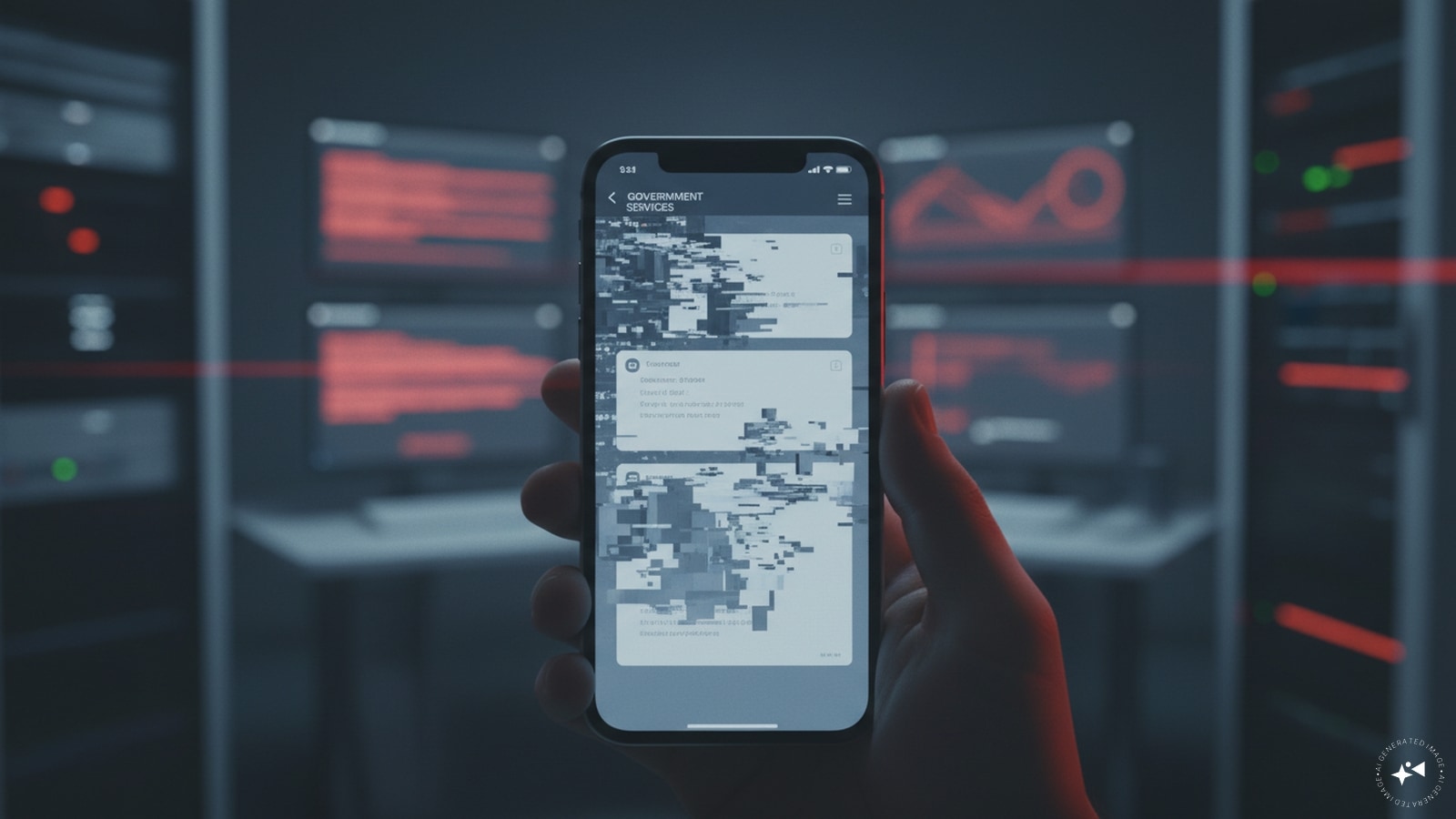
To understand the operational failure of an emergency mobile application under attack, one must separate the public-facing reporting from the underlying technical mechanics. News wire summaries typically state that an application experienced "unauthorized interference" or "disruptions" resulting in false alerts or service unavailability. In systems engineering, this translates to two distinct failure modes: compromised push-notification pipelines or volumetric denial-of-service against backend APIs. For another view, read: this related article.
The Architecture of Public Alert Systems
Emergency mobile applications operate on a hub-and-spoke distribution model. The central government agency maintains an administrative console connected to an aggregation server. This server interfaces with third-party push notification gateways—specifically Apple Push Notification service (APNs) and Firebase Cloud Messaging (FCM)—to wake client devices and display high-priority alerts.
This architecture introduces three structural weak points: Similar insight on this matter has been shared by CNET.
- The Administrative Control Plane: The web portal or API used by ministry officials to draft and dispatch alerts. If credentials for this plane are compromised via phishing, credential stuffing, or unpatched vulnerabilities in the administrative web stack, an attacker gains native broadcast capabilities.
- The Push Gateway Token Store: To send targeted regional alerts, the backend stores millions of device tokens mapped to geographic coordinates. Exposure or manipulation of this database allows attackers to spoof location-based emergencies or exhaust rate limits on the push gateways.
- The Content Delivery API: When a user taps a push notification, the app queries a central server for full instructions, maps, or shelter locations. This read-heavy endpoint is the primary target for volumetric attacks designed to blind the public during an actual crisis.
Distinguishing Compromise Mechanics
Without forensic logs from the affected ministry servers, analysts must evaluate the incident through established threat models. Public reports of state app disruptions generally stem from one of two operational scenarios, each carrying vastly different recovery timelines and security implications.
Scenario A: Control Plane Compromise (Integrity Failure)
If users receive unauthorized, fabricated, or politically motivated push notifications through the official app, the attackers bypassed authentication on the dispatch server. This indicates a failure in identity and access management (IAM). The root cause is typically a lack of hardware-based multi-factor authentication (MFA) for dispatch operators or an exposed internal API endpoint lacking strict IP allow-listing. In this scenario, the underlying infrastructure remains online, but the integrity of the information channel is destroyed. Trust in the platform collapses immediately, rendering future legitimate alerts ineffective due to alert fatigue and public skepticism.
Scenario B: Volumetric Exhaustion (Availability Failure)
If the application simply fails to load maps, regional advisories, or live status updates, the system is experiencing a Distributed Denial-of-Service (DDoS) attack or a poorly configured database lock. Emergency apps suffer from extreme traffic spikes during geopolitical events or natural disasters. Attackers exploit this by flooding the backend APIs with unauthenticated GET requests, saturating bandwidth or exhausting database connection pools. While less damaging to long-term institutional trust than spoofed alerts, an availability failure during an active emergency creates immediate physical risk for civilians relying on the platform for evacuation routing.
The Asymmetric Cost of Civic App Defense
Defending public-facing emergency infrastructure presents an acute economic asymmetry. An attacker requires minimal resources to launch a layer-7 HTTP flood against a poorly cached government API or to purchase compromised credentials from an initial access broker. Conversely, the defending agency must maintain 99.999% uptime while serving millions of concurrent users who cannot be subjected to friction-heavy security checks like CAPTCHAs or complex login flows during an emergency.
Standard enterprise defense mechanisms frequently fail when applied directly to emergency apps:
- Aggressive Web Application Firewalls (WAF): Tuning a WAF to block automated traffic often results in false positives, blocking legitimate users whose mobile devices route through carrier-grade NAT (CGNAT) gateways where thousands of citizens share a single outbound IP address.
- Geographic IP Blocking: While domestic emergency apps logically serve domestic populations, restricting foreign IP ranges breaks functionality for citizens traveling abroad or devices routing traffic through commercial VPNs—a common practice in regions with heavy internet censorship.
- Rate Limiting: Strict per-IP rate limits fail when an entire apartment block or cellular tower routes emergency app queries through a single exit node simultaneously during a localized siren event.
Systemic Vulnerabilities in State Mobile Ecosystems
The specific incident involving the Russian emergencies ministry sits within a broader pattern of digital infrastructure degradation. When state agencies rapidly digitize public services, security architecture frequently lags behind feature deployment. Mobile applications are often contracted out to third-party vendors who prioritize user interface delivery over secure software development lifecycles (SDLC).
This outsourcing model introduces supply-chain risk. The mobile client itself may contain hardcoded API keys, weak certificate pinning, or verbose error handling that maps internal network topologies for anyone reverse-engineering the APK. Furthermore, if the backend infrastructure shares hosting environments or authentication directories with less secure municipal portals, lateral movement allows attackers to pivot from a low-security regional website directly into the high-impact emergency broadcast system.
Strategic Remediation for Public Alert Infrastructure
Securing an emergency notification platform requires decoupling the broadcast mechanism from the general information portal. The system must be engineered under the assumption that the public-facing web servers will be saturated and that administrative credentials will eventually be targeted.
1. Implement Cryptographic Signing at the Edge
Push notifications and emergency payloads must be cryptographically signed using an offline or hardware-security-module (HSM) backed private key before hitting the push gateway. The mobile client must verify this signature locally before rendering an alert. Even if an attacker compromises the web server or the push notification API keys, the mobile app will silently drop any message lacking a valid cryptographic signature from the isolated signing authority.
2. Enforce Multi-Party Authorization for Broadcasts
No single compromised account should possess the authority to trigger a mass alert. The dispatch plane must enforce a two-person integrity rule: one operator drafts and signs the alert payload, and a second independent operator on a separate physical device approves the dispatch. This eliminates single-point credential compromise as a viable attack vector for spoofing emergencies.
3. Static Edge Caching for Read-Heavy Payloads
Emergency instructions, shelter maps, and regional advisories must not be served dynamically from an origin database. All static and semi-static emergency data should be compiled into flat JSON files and pushed to a globally distributed Content Delivery Network (CDN) with aggressive edge caching. During an attack, the origin servers remain entirely isolated from public traffic, allowing the CDN to absorb volumetric floods without degrading access to critical survival information.
4. Graceful Degradation Protocols
The mobile client must be built with an offline-first architecture. Core survival protocols, offline regional maps, and emergency contact frequencies must reside locally within the application binary, updated periodically via background delta syncs. When network connectivity is severed by a DDoS attack or infrastructure failure, the application must automatically transition to local-only mode rather than hanging on timed-out API requests.
Organizations managing critical civic applications must abandon perimeter-based security models in favor of cryptographic payload verification and air-gapped dispatch controls. Until public alert pipelines isolate message signing from web-facing infrastructure, state emergency apps will remain high-leverage targets for low-cost disruption campaigns.