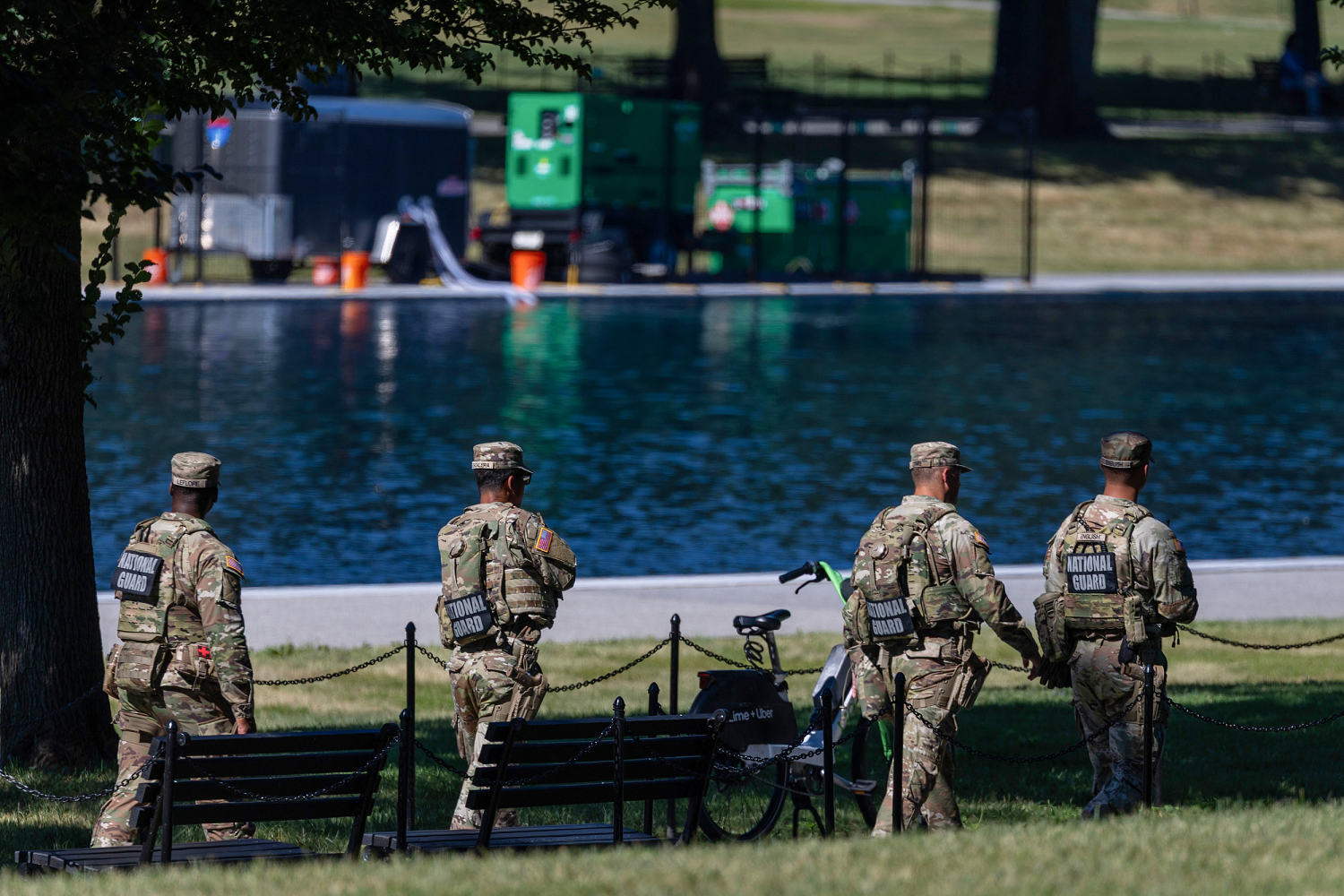
The arrest of a citizen at the Lincoln Memorial Reflecting Pool and the subsequent filing of federal disorderly conduct and obscenity charges under 36 C.F.R. § 2.34(a)(2) serves as a stark case study in how physical infrastructure failures, heightened municipal surveillance, and asymmetric law enforcement priorities converge to create institutional friction. While conventional media narratives frame the event through a purely political or behavioral lens, a rigorous structural analysis reveals a clear cause-and-effect loop. The interaction was driven by technical failures in municipal engineering, an exponential increase in spatial securitization, and a distinct tactical playbook utilized by independent digital actors documenting state authority.
By analyzing the specific mechanisms governing public space enforcement, the operational logic of federalized policing, and the legal constraints of administrative code, we can map exactly how a minor infrastructure dispute escalated into a high-stakes constitutional friction point.
The Tri-Particle Failure Loop of Public Infrastructure Securitization
The structural origin of the enforcement action does not begin with civilian misconduct; it begins with an engineering and procurement failure that destabilized the spatial equilibrium of the National Mall. When public spaces undergo rapid, high-visibility capital expenditure deployments, any subsequent operational failure creates an immediate political vulnerability. The escalation pathway follows three distinct phases.
+----------------------------+     +----------------------------+     +----------------------------+
|  1. Material Degradation  | --> | 2. Institutional Narrative | --> | 3. Hyper-Securitization    |
|  $14.7M renovation fails;  |     | Attribution of failure to  |     | Deployment of out-of-state |
|  algae and peeling paint.  |     | "sabotage" or "vandalism." |     | assets to guard physical assets.|
+----------------------------+     +----------------------------+     +----------------------------+
1. Material Degradation and Procurement Anomalies
The underlying variable driving physical interaction at the site was the immediate degradation of a $14.7 million renovation project. Within two weeks of completion, the structural integrity of the pool’s new blue interior coating failed, resulting in widespread delamination (peeling paint) and acute rapid algae blooms. The chemical deployment of hydrogen peroxide and industrial vacuums by the National Park Service to mitigate the biological growth inadvertently accelerated the mechanical failure of the adhesion layer. This visible failure created an immediate information asymmetry between taxpayers expecting a premium public asset and the reality of a compromised structural surface.
2. Institutional Narrative Deflection
To protect institutional authority and mitigate the fallout from a high-profile municipal contract failure, the executive branch implemented a narrative framework attributing systemic material degradation to discrete human intervention—specifically, "vandalism" and "deliberate sabotage." By shift-shifting the root cause from a technical or contractual failure (shoddy application or inadequate curing of the polymer liner) to an external security threat, the state established a logical predicate for a hyper-securitized response.
3. Spatial Hyper-Securitization
Once an asset is designated as a target of active sabotage, the law enforcement deployment model shifts from passive community policing to active target hardening. This manifested in the physical deployment of out-of-state law enforcement assets—including Oklahoma State Troopers and U.S. Park Police—forming an explicit security perimeter around a standard public water feature. The physical presence of heavily armed, non-local tactical personnel guarding a failing municipal pond introduces immediate friction into the civilian-spatial dynamic, lowering the threshold required to trigger an enforcement action.
The Mechanics of the Friction Point: First Amendment Audit Tactics meets Zero-Tolerance Mandates
The specific interaction that led to the arrest of civilian Christian Miles highlights a structural collision between two distinct operational playbooks: the decentralized "First Amendment Audit" strategy and the state's top-down zero-tolerance enforcement mandate.
Miles, a freelance video editor and former U.S. Navy submariner, was operating under a highly structured, self-directed protocol designed to document what he termed a "creeping police state." This tactical approach relies on a deliberate behavioral model:
- Objective Camera Proximity: Utilizing high-definition mobile recording devices to film law enforcement personnel at close range within traditional public forums.
- Verbal Provocation Matrix: Using intense verbal critique, profanity, and ideological challenges designed to test the emotional and professional discipline of officers.
- Legal Insulation Assumption: Relying on established First Amendment protections regarding public filming and protected speech to act as a legal shield against physical detention.
The structural flaw in the auditor’s playbook is the failure to calculate the state's shifting risk tolerance. In a standard operational environment, trained municipal officers typically ignore verbal provocation to avoid escalating minor incidents. However, under a zero-tolerance mandate driven directly by executive focus, the operational calculation changes completely.
When officers are explicitly instructed that an asset is under active threat of vandalism, their psychological threshold for perceived non-compliance drops precipitously. Verbal dissent is no longer processed merely as protected speech; it is interpreted by the security apparatus as a tactical diversion or an active impediment to a critical security mission. The trooper’s assertion to Miles that the nation was a free society where he could "video all he want" immediately preceded a physical arrest by precisely seven minutes—a temporal window that marks the exact duration it took for verbal friction to transition into a formal operational command to clear the space.
Legal Analysis of 36 C.F.R. § 2.34(a)(2): The Elasticity of Administrative Code
The specific charges leveled against individuals detained at the Reflecting Pool—ranging from misdemeanor destruction of government property for ex-Olympian David Hearn (who merely touched loose, peeling paint out of curiosity) to disorderly conduct and obscenity for Miles—reveal how administrative law is weaponized to achieve spatial compliance.
The federal government’s primary instrument in this scenario is Title 36 of the Code of Federal Regulations, specifically Section 2.34, which defines disorderly conduct in national parks and monuments. The state's reliance on subsection (a)(2) is a highly tactical legal maneuver:
$$36 \text{ C.F.R. } \S 2.34(a)(2): \text{ Prohibits language, utterances, or gestures that are obscene, physically threatening, or create a hazardous condition.}$$
The strategic utility of this code for law enforcement lies in its semantic elasticity. Unlike state-level criminal statutes, which face strict constitutional scrutiny regarding vagueness and overbreadth, federal administrative codes governing symbolic national spaces afford rangers and deployed troops massive discretionary latitude.
The inclusion of "obscenity" within the charging document functions as a legal mechanism to bypass the high threshold required to prove "fighting words" under standard First Amendment jurisprudence. By framing a civilian's aggressive verbal critique as an "obscene display," the state attempts to classify the speech as unprotected, thereby validating the physical extraction and handcuffing of the individual from the public space.
However, this strategy carries severe systemic vulnerabilities. Defensive litigation invariably exposes the underlying operational reality: the actual charges filed against individuals at the Reflecting Pool completely lack any empirical evidence of physical property destruction or vandalism. The systemic disconnect between the executive narrative ("arresting saboteurs facing years in jail") and the judicial filings (administrative misdemeanors for speech and curiosity) undermines the long-term credibility of the enforcement agencies involved.
Strategic Operational Recommendations for Municipal Asset Security
The ongoing enforcement crisis at the National Mall demonstrates that hyper-securitizing physical infrastructure to mask procurement and engineering failures yields severe institutional diminishing returns. To decouple civil liberties friction from physical asset protection, public safety agencies and municipal managers must pivot toward a data-driven, objective operational framework.
Decentralize and De-Escalate Guard Deployments
Replacing high-visibility, out-of-state tactical forces with localized, un-weaponized community ambassadors or clear structural barriers (such as low-profile aesthetic fencing) removes the immediate psychological trigger for civilian confrontation. Law enforcement personnel should only be deployed as a secondary response tier, rather than static sentries guarding non-critical, non-hazardous municipal features.
Implement Objective Adhesion and Material Testing Protocols
To defuse narrative warfare regarding public asset degradation, municipal agencies must deploy transparent, third-party engineering diagnostics. Utilizing standardized ASTM (American Society for Testing and Materials) cross-hatch adhesion tests and real-time digital water chemistry analytics provides a publicly accessible data baseline. When the public can verify via open data portals that a coating failed due to hydrostatic pressure or poor polymer curing rather than civilian intervention, the logical basis for predatory vandalism narratives evaporates.
Standardize Objective Video Recording Compliance Training
Faced with an increasing volume of independent digital documentation and citizen journalists, federal and state security forces must undergo standardized behavioral adaptation training. Deployed personnel must operate under the assumption that all public interactions are being captured on high-definition video. Survival of verbal audits requires strict adherence to a non-engagement protocol: officers must maintain a neutral physical posture, completely refuse to engage with ideological or profane provocations, and execute physical detentions strictly when an overt, legally defined physical act of property destruction or physical threat occurs.
Enforcing spatial compliance through highly elastic administrative obscenity charges creates an unsustainable legal bottleneck that ultimately damages the institutional authority it was deployed to protect.