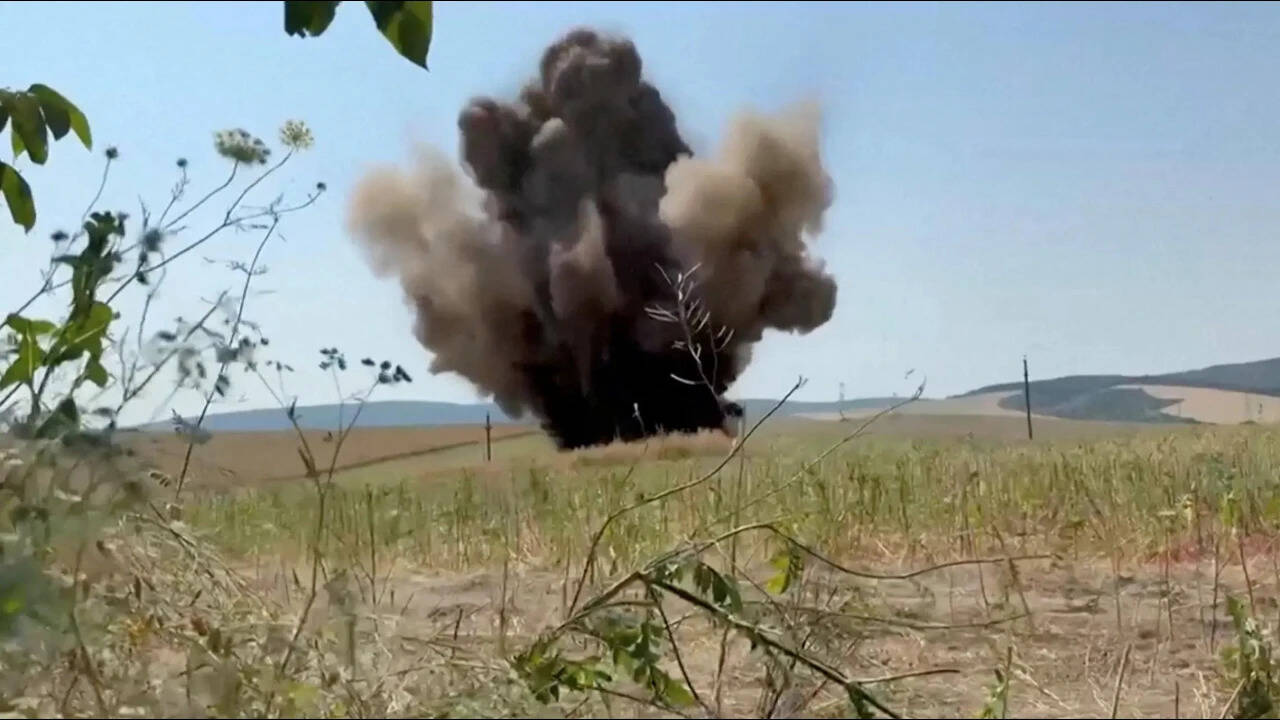
The sequential downing of three unmanned aerial vehicles by Romanian F-16 fighter jets over a 72-hour window marks a structural break in NATO's eastern flank defensive posture. For years, border states absorbed shallow, unpunished incursions as collateral spillover from Russian strikes on Ukrainian Danube ports. The recent operational shift from passive tracking to active kinetic interception transforms a localized security nuisance into a calibrated test of alliance deterrence thresholds.
Understanding this shift requires analyzing the underlying economic and operational mechanics governing modern airspace defense. For an alternative perspective, consider: this related article.
The Cost Asymmetry Matrix
The core vulnerability exploited by long-range loitering munitions is the extreme cost asymmetry between offense and defense. A standard Russian-deployed Shahed-type platform carries a production cost estimated between twenty thousand and forty thousand dollars. Conversely, intercepting these assets using crewed tactical aviation—specifically F-16 multirole fighters operated under NATO operational command out of bases like Fetești—involves a radically different expenditure curve.
When factoring in fuel, flight-hour maintenance costs, pilot training amortization, and the potential wear on high-value airframes, a single sortie by a fourth-generation fighter jet costs tens of thousands of dollars per hour, excluding the expense of precision-guided air-to-air ordnance if deployed. This creates a severe economic friction point: Similar analysis regarding this has been shared by TIME.
- Offensive Scaling: Mass production of low-cost composite airframes allows saturation tactics that exhaust conventional air defense inventories.
- Defensive Constraint: Relying exclusively on fighter jets to counter low-cost autonomous threats is financially and operationally unsustainable over a protracted conflict timeline.
- The Interceptor Gap: The transition to localized ground-based air defense systems, such as the MEROPS counter-drone architecture recently acquired by Bucharest, represents an urgent structural fix to lower the cost-per-kill metric.
Operational Drivers Behind the Danube Corridor
The concentration of incursions in the Sulina and Chilia arms of the Danube Delta is driven by tactical geography rather than random error. As Moscow targets Ukrainian grain export terminals and maritime trade routes near Odesa ahead of harvest cycles, flight paths for loitering munitions frequently clip narrow bends of Romanian sovereign territory.
Navigation systems on these autonomous platforms rely heavily on commercial satellite navigation signals, which are routinely spoofed or jammed by electronic warfare systems operating across the Ukrainian theater. This electronic degradation directly degrades trajectory accuracy, causing munitions to drift across the 650-kilometer land and river border.
However, frequency matters. With Bucharest logging 33 unauthorized airspace entries since the beginning of the full-scale conflict, the accumulation of events forced a political and military recalculation. Tolerating navigational drift ceased to be viable once domestic political pressure intersected with physical risks to civilian infrastructure—highlighted earlier by an incident where a stray drone impacted a residential building.
Diplomatic Signaling and Command Integration
Summoning the Russian ambassador is a standardized diplomatic mechanism, but its efficacy depends on the accompanying military posture. By shifting from non-intervention to kinetic destruction under Article 4 and Article 5 consultative frameworks, Romania alters Moscow's calculation of risk.
The integration of Romanian air assets into Supreme Headquarters Allied Powers Europe (SHAPE) ensures that these responses are not isolated national decisions but coordinated alliance signals. Every interception over territorial waters acts as a live demonstration of rules of engagement along NATO's perimeter, testing how far peripheral pressure can be escalated without triggering a direct conventional clash.
Strategic Outlook
The mechanical reality of border proximity dictates that loitering munitions will continue to stray near or across the Danube corridor as long as southern Ukraine remains a contested strike zone. Future stability depends entirely on the speed at which frontline states can deploy distributed, short-range kinetic and electronic counter-measures. Shifting the defensive burden away from expensive tactical jets toward automated ground networks will determine whether alliance members can sustainably neutralize peripheral airspace violations without depleting high-end military readiness.