Mass sports victories do not merely generate emotional release; they catalyze rapid, high-density physical migrations that stress municipal infrastructure to its breaking point. Following the Game 4 matchup of the 2026 NBA Finals—where the New York Knicks engineered a 29-point comeback against the San Antonio Spurs—the sudden exit of over 19,000 spectators from Madison Square Garden collided with thousands of un-ticketed observers in Midtown Manhattan. This flash mobilization presents a predictable structural pattern governed by spatial limits, crowd psychology, and municipal containment strategies.
Understanding this phenomenon requires moving past sensationalized reporting of "rowdy fans" and examining the operational mechanics of urban crowd surges. When a championship drought extending back to 1973 nears its end, the resulting civic energy operates like a high-pressure fluid dynamic system. If the city infrastructure fails to provide adequate escape valves, the structural integrity of the surrounding urban grid degrades.
The Tri-Partite Catalyst of the Post-Game Surge
The spatial volatility observed in Manhattan was not accidental. It was the direct consequence of three compounding variables that escalated crowd density faster than civil authorities could deploy counter-measures.
- The Proximity Bottleneck: Madison Square Garden sits directly atop Penn Station, one of the densest transit hubs in North America. Unlike modern, isolated stadium complexes ringed by expansive parking lots, the Midtown Manhattan grid forces exiting arena occupants immediately onto narrow public sidewalks, mixing them with standard pedestrian traffic and commuters.
- The Spillover Effect of Restricted Zones: Municipal authorities and the New York Police Department established a multi-block "frozen zone" spanning West 30th to West 35th Streets between Sixth and Eighth Avenues. By deploying structural fencing and limiting access checkpoints exclusively to ticket holders, residents, and transit passengers, the city compressed the natural dispersal zone. Un-ticketed fans who previously gathered under the "We outside" rallying cry were displaced, concentrating the crowd mass into adjacent, unregulated corridors.
- The High-Stimulus Chronology: The psychological profile of the crowd was altered by the game’s mechanics. A gradual, blowout victory allows for early fan exit and a staggered dissipation of energy. Conversely, a historic, single-point comeback settled in the final 1.2 seconds creates an instantaneous, synchronized exit where the entire stadium capacity attempts to occupy the street level simultaneously.
The Mechanics of Structural Escalation
When thousands of individuals occupy a restricted urban envelope, the transition from celebration to civic disruption follows a distinct operational progression. The physical degradation of the environment—such as fans climbing light poles, damaging vehicles, and setting off unpermitted pyrotechnics—is a function of spatial saturation rather than a uniform intent to destroy property.
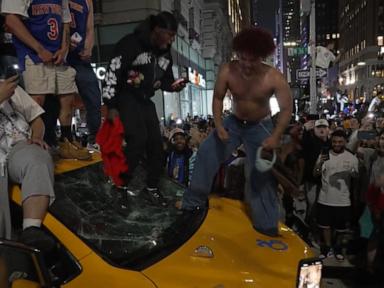
The first breakdown occurs at the sidewalk capacity threshold. Standard municipal walkways are engineered for linear, moving traffic. When a crowd stops moving and transitions into a static, celebratory mass, the effective capacity of the sidewalk drops to zero. This forces the crowd overflow into active vehicular lanes, paralyzing automotive transit and trapping city buses and taxis. Once vehicles are immobilized within a dense crowd, they become improvised physical platforms, leading to spectators climbing onto roofs and hoods.
The second breakdown involves the weaponization of urban infrastructure. High-density environments suffer from an immediate lack of vertical visibility. Individuals seeking better vantage points or attempting to signal to the wider crowd scale light poles, scaffolding, and transit signage. This behavior introduces immediate structural failure risks, as street furniture is not rated for dynamic, multi-person weight loads.
The third breakdown is the friction of counter-flow containment. When law enforcement attempts to clear major arteries using linear skirmish lines, they often compress the crowd into secondary bottlenecks like narrow side streets or transit entrances. Following the Game 3 viewing events at Bryant Park, this compression resulted in localized friction points, leading to 21 detentions, property damage, and injuries to five officers. The data shows that physical altercations scale when a moving crowd is suddenly forced into a stationary perimeter.
The Operational Strain on Municipal Resources
Managing a post-game surge exposes the structural trade-offs inherent in urban policing and city administration. The friction between Madison Square Garden corporate management and City Hall highlights a fundamental operational dilemma: balancing public celebration with civil liability.
The economic cost of managing these zones is steep. Deploying thousands of officers to maintain a multi-block perimeter requires extensive overtime expenditures and strips resources from outer boroughs. Local commercial enterprises face a bifurcated reality. While bars and restaurants directly outside the perimeter experience unprecedented demand, businesses trapped inside the security checkpoints suffer from strict capacity limits and restricted foot traffic, choking off expected game-day revenue.
The primary limitation of the city's current containment strategy is its binary nature. By shifting between an outright ban on gatherings and a highly restrictive, 1,000-person permitted watch party, the city failed to accommodate the true scale of the public demand. When dealing with an emotional volume built up over five decades, suppression strategies do not eliminate the crowd; they merely displace it to areas less equipped to handle the density.
De-escalation Through Spatial Design
The strategic resolution to mass sports celebrations within dense urban environments relies on managed dissipation rather than rigid containment. Municipalities must treat fan energy as a predictable utility that requires routing, not a tactical threat that requires blockading.
Future planning for high-stakes championship series requires the designation of high-capacity, low-risk "release valves." Rather than forcing fans into tight Midtown corridors or attempting to compress thousands into small park permits, cities must pedestrianize major thoroughfares ahead of time. Temporarily converting wide avenues into pedestrian-only celebratory zones lowers the crowd density per square meter, reducing the physical pressure on transit hubs and minimizing the structural incentives for individuals to climb infrastructure or block vehicular traffic.
By designing flexible spaces that expand with the volume of the crowd, municipal authorities can preserve public safety without triggering the hostile spatial friction that transforms a historic sports victory into an urban crisis. The final game of the series will test whether the city can adapt its architecture to the crowd, or if it will continue to use the police grid to fight the inescapable physics of the street.