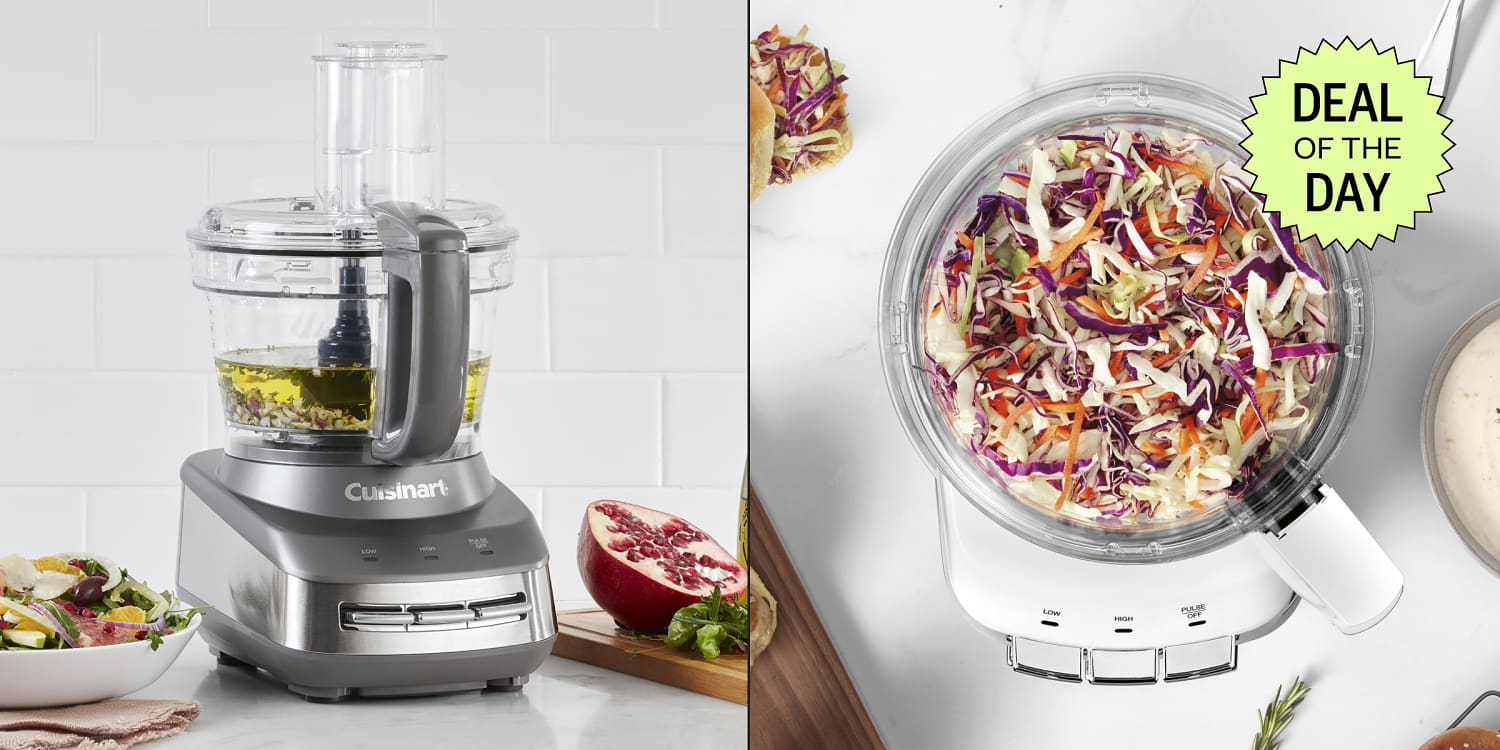
Kitchen automation relies on reducing physical manipulation time across high-volume ingredient processing. When retail pricing on a dominant market share appliance drops by fifty percent, the acquisition cost equation shifts for domestic operators. The Cuisinart ten-cup food processor functions less as a single-purpose gadget and more as a mechanical throughput multiplier. Processing throughput in domestic food preparation depends on three primary variables: motor torque consistency, feed chute geometry, and blade rotational velocity relative to particle shearing resistance. Analyzing a promotional price reduction on this specific hardware class requires evaluating the utility gain against storage footprint constraints and maintenance overhead.
The Operational Bottleneck of Manual Ingredient Processing
Manual chopping, slicing, and homogenization introduce severe kinetic friction into domestic workflow optimization. A human operator using an eight-inch chef knife achieves an average processing rate dictated by muscle fatigue, grip security, and spatial precision limits. This manual loop contains distinct steps: object retrieval, stabilization, kinetic reduction, transfer, and cleanup.
Manual Loop: [Retrieval] -> [Stabilization] -> [Kinetic Reduction] -> [Transfer] -> [Cleanup]
Mechanical Loop: [Retrieval] -> [Loading Chute] -> [High-Velocity Shearing] -> [Immediate Evacuation]
The introduction of motorized kinetic reduction alters this sequence by compressing the reduction phase from minutes to fractional seconds. A 450-to-500-watt induction or direct-drive motor spinning a stainless steel S-blade generates shear forces capable of cellular wall disruption across diverse material densities. Hard root vegetables, fibrous aromatics, and cohesive proteins undergo simultaneous reduction without progressive fatigue degradation. The economic justification for purchasing this hardware at a fifty percent discount rests entirely on whether the time saved per batch exceeds the amortization cost of counter space allocation and post-use sanitation labor.
Mechanical Architecture and Torque Dynamics
Performance degradation in low-tier food processing units typically stems from thermal overload and gear stripping. Consumer-grade appliances frequently rely on universal motors that generate high initial RPM but struggle under continuous high-torque loads, resulting in stalled blades when encountering dense root masses like raw sweet potatoes or dense emulsifications.
The architectural profile of a ten-cup mid-tier processor utilizes a vertical direct-drive shaft connected to a calibrated induction-style or heavy-duty permanent magnet motor.
- Motor Wattage and Thermal Thresholds: Sustained power delivery prevents stalling during viscous phase transitions, such as emulsifying oil into chickpea purees for hummus production.
- Interlock Safety Systems: Mechanical and magnetic sensors mandate precise bowl-to-base and lid-to-bowl alignment before circuit closure, mitigating catastrophic user error during high-velocity rotation.
- Blade Plane Offset: Dual-level or single-plane offset blades ensure vertical cascading of unrefined material into the cutting zone, eliminating stagnant dead zones where chunks evade contact.
When retail discounting reduces the entry barrier for this architecture, consumers frequently overlook the distinction between peak wattage and continuous operating wattage. Peak wattage represents momentary electrical draw under zero load conditions, whereas continuous load handling defines true meal preparation efficiency.
The Cost Function of Batch Preprocessing
Evaluating kitchen hardware investments demands a functional approach to capital expenditure versus operational yield. Let $C_{total}$ represent the total cost of ownership, combining initial acquisition price, electrical consumption, and sanitation time. Let $V_{output}$ represent the total volume of processed food per operational cycle.
$$C_{total} = P_{acquisition} + E_{consumption} + T_{sanitation}$$
When $P_{acquisition}$ is slashed by fifty percent through promotional discounting, the weight of the initial purchase term in the equation drops significantly. However, $T_{sanitation}$ remains constant. Disassembling a ten-cup work bowl, removable stem, stainless steel slicing disc, chopping blade, and locking lid requires approximately ninety seconds of physical manipulation and washing.
If an operator processes small, discrete batches, the mechanical setup and teardown overhead outweighs the time saved during the reduction phase. Conversely, batch preprocessing—generating five to seven days of structural meal components in a single twenty-minute session—inverts this ratio. The equipment becomes economically viable only when batch scale surpasses the threshold where manual knife work incurs diminishing returns due to physical fatigue and inconsistent particle sizing.
Particle Size Distribution and Culinary Chemistry
The physical output of a food processor directly dictates the chemical and textural behavior of the final recipe. Inconsistent particle sizing introduces variable surface area exposure, which alters moisture release rates during thermal processing.
- Shearing via S-Blade: Produces heterogeneous particle distributions, ranging from micro-pulverized paste to coarse chunks, depending entirely on pulse duration and cycle count. This configuration is optimal for binding agents, marinades, and structural purees where uniformity is secondary to cohesion.
- Slicing and Shredding Discs: Generates uniform geometric cross-sections. Uniform thickness ensures predictable thermal transfer rates during roasting or sautéing, preventing localized burning of thin edges while thick centers remain raw.
Operators attempting to scale meal preparation without understanding these mechanical limitations often experience textural failure, such as vegetable slaws turning aqueous due to ruptured cell walls from excessive blade friction or dull cutting edges.
Strategic Allocation of Kitchen Real Estate
Kitchen hardware deployment is bounded by spatial economics. Counter space and accessible cabinet volume represent finite resources. A ten-cup processor occupies a specific physical footprint that permanently displaces alternative preparation assets.
Deploying this asset permanently on a countertop implies a high frequency of utilization—defined as a minimum of three operational cycles per week. If utilization drops below this threshold, the appliance transitions from an operational tool to an inventory liability, consuming spatial utility relative to its financial return. Seasonal or sporadic meal preppers maximize long-term efficiency by housing the chassis in immediate-access lower cabinetry, ensuring retrieval friction remains lower than the friction of manual alternatives.
Integrate the processing unit directly into a synchronized batch workflow: stage raw inputs by density class, execute high-density root processing via slicing attachments, transition to viscous blending via the central S-blade, and execute immediate containerization for cold storage prior to any equipment sanitation cycle.