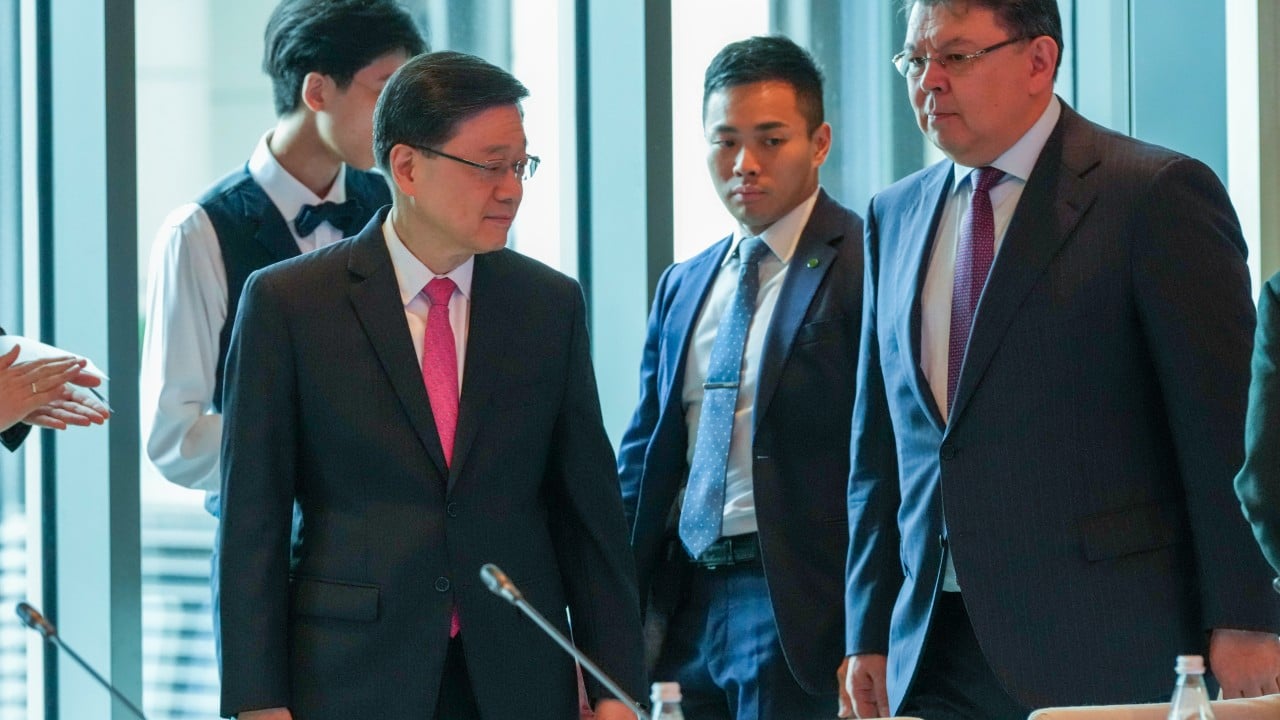
The globalization of capital requires a permanent reassessment of geography. When political entities describe economic missions using diplomatic platitudes, they obscure the cold, mathematical reality of capital allocation. The recent bilateral agreements between the Hong Kong Special Administrative Region (HKSAR) and the Republic of Kazakhstan—culminating in 61 distinct memoranda of understanding (MOUs) and specific institutional pacts targeting the emerging Alatau City economic zone—are not mere diplomatic goodwill gestures. They represent a structural plumbing operation designed to solve specific macroeconomic bottlenecks for both regions.
To evaluate the long-term viability of this corridor, analysts must strip away political narrative and map the exact transactional mechanisms at play. Kazakhstan faces an acute economic diversification imperative; it must double its gross domestic product (GDP) by 2030 from its 2023 baseline while reducing its systemic exposure to volatile hydrocarbon revenues. Hong Kong, conversely, is managing structural shifts in its traditional capital flows and must expand its operational architecture as a dual-conduit hub—simultaneously routing international capital into mainland China and facilitating the global expansion of mainland corporate balance sheets.
The structural synergy of this relationship operates through a clean input-output matrix. Kazakhstan provides raw sovereign and corporate demand for non-Western, non-dollarized capital optimization. Hong Kong provides the institutional, legal, and financial infrastructure necessary to convert raw sovereign asset demand into liquid, tradeable, and globally compliant securities.
The Strategic Triad: Structural Bottlenecks and Capital Asymmetry
The economic interaction between Hong Kong and Kazakhstan is dictated by two highly specific institutional frameworks: the Belt and Road Initiative (BRI) as a primary policy umbrella, and the creation of Alatau City as an isolated, special-jurisdiction laboratory for high-tech and logistically driven growth.
The structural friction of this corridor can be understood through three core components.
1. The Capital Cost Function and Currency De-Risking
Kazakhstan’s corporate and sovereign issuers are heavily exposed to Western capital market volatility and strict dollar-clearing mechanisms. To fund massive domestic infrastructure projects and high-tech industrial parks like the Astana Hub, Kazakh entities face a steep cost of capital when issuing traditional Eurobonds due to shifting Western interest rate environments and compliance premiums.
The alternative mechanism is the offshore Renminbi (RMB) market. Hong Kong operates as the world’s largest offshore RMB business hub. By shifting the financing base from USD to RMB, Kazakh issuers can tap into deep pools of Asian liquidity that are actively looking for yield-bearing assets outside the Western banking perimeter.
This mechanism is already functional. In September 2025, the Development Bank of Kazakhstan executed a 2 billion RMB offshore "dim sum" bond issuance in Hong Kong. This was followed by Samruk-Kazyna, the Kazakh sovereign wealth fund, closing the order book on a 3 billion RMB debut panda bond in April 2026. The total volume of China-linked credit flowing through these channels reached 9.65 billion RMB within a three-quarter window. The capital cost function shifts favorably for Kazakhstan because Hong Kong’s capital markets provide a liquidity premium that lowers the coupon rate compared to domestic or unhedged regional financing alternatives.
2. Legal Architecture Arbitrage and Soft-Landing Infrastructure
High-tech startups and scale-ups within the Astana Hub face international expansion constraints due to jurisdictional friction. Foreign venture capital is often hesitant to invest directly into Central Asian legal frameworks due to perceived civil law unpredictability and enforcement lag.
The institutional agreements signed between the Astana International Financial Centre (AIFC), the Hong Kong Stock Exchange (HKEX), Hong Kong Cyberport, and the Hong Kong Science and Technology Parks Corporation (HKSTP) establish a legal arbitrage bridge.
- Hong Kong operates as the only common law jurisdiction within China.
- The city maintains independent courts and zero foreign exchange controls.
- By utilizing Hong Kong’s corporate registration framework, a Kazakh technology firm can achieve a "soft landing" in East Asia, restructuring its corporate architecture to match international common law expectations without losing its operational base in Alatau City.
This structural alignment allows technology assets to be packaged under Hong Kong legal governance, making them immediately bankable for global institutional investors.
3. Logistic Connectivity and Velocity of Trade
Capital velocity is directly constrained by physical transport friction. While Kazakhstan accounts for approximately 60 percent of Central Asia’s collective GDP and serves as a primary overland logistics spine connecting Western China to Europe, its service-sector integration with East Asia has historically suffered from low human and data velocity.
The immediate structural remedy settled during the latest bilateral mission is the formalization of a direct aviation corridor, with scheduled flights between Hong Kong and Almaty set to commence in the first quarter of 2027. This physical link reduces the travel-time friction for professional services—including legal counsel, forensic accountants, and structural engineers—essential for auditing and valuing Kazakh industrial and tech assets prior to cross-border listing.
Institutional Interlocking: Mapping the Corporate Mechanics
The success of the Alatau City initiative depends on the transition from high-level government agreements to functional, enterprise-level integration. The latest transaction volume involved a 74-entity delegation yielding 61 total accords, with 15 intergovernmental documents and 46 distinct commercial agreements valued at over 1.5 billion USD.
Analyzing the mechanics of these agreements reveals a clear division of operational responsibilities.
+------------------------------------------------------------+
|                  KAZAKH OPERATIONAL ENGINES                |
|  [Astana Hub (IT)]  [Alatau City (Smart Hub)]  [AIFC (Fin)] |
+------------------------------------------------------------+
                              |
                              v  (Institutional Bridges)
+------------------------------------------------------------+
|                 HONG KONG STRUCTURAL PLATFORMS             |
|    [Cyberport / HKSTP]   [Hong Kong Stock Exchange]        |
+------------------------------------------------------------+
                              |
                              v  (Liquidity / Market Access)
+------------------------------------------------------------+
|                  GLOBAL & MAINLAND CAPITAL                 |
+------------------------------------------------------------+
Tech Park Co-Incubation
The agreement linking Astana Hub with Cyberport and HKSTP creates a reciprocal pipeline. Technology startups in Central Asia lack access to a large domestic consumer testing ground. By integrating with Hong Kong’s tech parks, these companies gain immediate proximity to the Greater Bay Area (GBA), a contiguous consumer market of 86 million people. The operational play here is clear: Kazakh firms build software or AI logic in the low-overhead environment of the Astana Hub, validate and scale the business using Hong Kong’s incubation capital, and deploy the commercialized solution across the GBA industrial stack.
Dual-Listing Frameworks
The MOU between the HKEX and the Astana International Exchange (AIX) targets the structural lack of liquidity in Central Asian equity markets. Large-scale Kazakh state-owned enterprises, particularly in mining, green energy, and logistics, require massive capital injections to fund the Alatau City infrastructure blueprint. The HKEX-AIX agreement sets up a technical framework for depository receipts and secondary dual-listings. This allows a Kazakh entity to maintain its primary listing in Astana to satisfy domestic regulatory mandates, while simultaneously pooling global liquidity via a secondary listing in Hong Kong.
Professional Services Integration
The introduction of Invest Hong Kong and the Hong Kong Trade Development Council (HKTDC) into the AIFC framework provides the structural compliance layer. Central Asian firms frequently struggle with international financial reporting standards (IFRS) conversion, environmental, social, and governance (ESG) reporting compliance, and complex cross-border tax structuring. Hong Kong’s professional services sector acts as a translation layer, transforming raw corporate data from Alatau City firms into institutional-grade, transparent disclosures that mitigate the risk premiums typically demanded by global fund managers.
Systemic Risks and Structural Vulnerabilities
No robust strategic analysis can ignore the inherent vulnerabilities of a cross-border capital corridor. The hub-to-hub cooperation model between Hong Kong and Kazakhstan carries structural risks that could derail project execution.
Currency Alignment Concentration
By aggressively tilting its debt architecture toward RMB-denominated assets (dim sum bonds, panda bonds, and AIFC clearing facilities), Kazakhstan reduces its dependency on the USD but introduces a high correlation to Chinese monetary policy and the macroeconomic health of the mainland domestic market. If the RMB experiences structural depreciation or if capital controls on the mainland tighten unexpectedly, the cost of servicing RMB debt for Kazakh firms could spike relative to their local currency (Tenge) revenues.
Implementation Asymmetry
An MOU is a non-binding declaration of intent, not a deployment of capital. There is a persistent structural risk that while financial institutions establish the plumbing (tax treaties, exchange linkages, direct flights), actual corporate transaction volume may stall. If Kazakh enterprises cannot meet the stringent listing requirements of the HKEX, or if Hong Kong venture capitalists view Central Asian tech assets as overly speculative, the corridor will remain underutilized, leaving Alatau City underfunded.
Geopolitical Friction and Compliance Overlap
As Hong Kong serves as a super-connector for mainland Chinese enterprises looking to expand into Central Asia—exemplified by the inclusion of heavy industrial and automotive players like Li Auto in the recent trade delegations—the corridor runs parallel to broader geopolitical tensions. Navigating the overlapping compliance demands of Western secondary sanctions, Chinese trade regulations, and Kazakh domestic ownership laws requires a highly sophisticated legal apparatus. Any compliance failure by a joint venture operating within Alatau City could instantly freeze its access to Hong Kong’s financial system.
The Strategic Directive
To maximize the ROI of this emerging economic corridor, corporate and sovereign strategists must execute a precise, non-speculative playbook based on the structural realities established by the June 2026 agreements.
Kazakh state-linked enterprises must immediately establish special purpose vehicles (SPVs) under Hong Kong common law jurisdiction to house high-value infrastructure and technology assets. This structural ring-fencing removes the geographic risk premium from the underlying asset.
Simultaneously, the AIFC should institutionalize a standardized RMB-denominated project financing template, matching the issuance parameters of the successful 2025 and 2026 bond placements. This will lower the underwriting friction for subsequent issuers.
Finally, Hong Kong venture funds and tech incubators should treat the Astana Hub not merely as a portfolio source, but as a low-cost, high-skill engineering talent laboratory. By arbitrating the wage and operational cost differentials between the GBA and Central Asia, firms can optimize their research and development margins while building out the foundational logistics software that will govern the next decade of Eurasian trade. The infrastructure is now laid; the mandate shifts entirely to ruthless transactional execution.