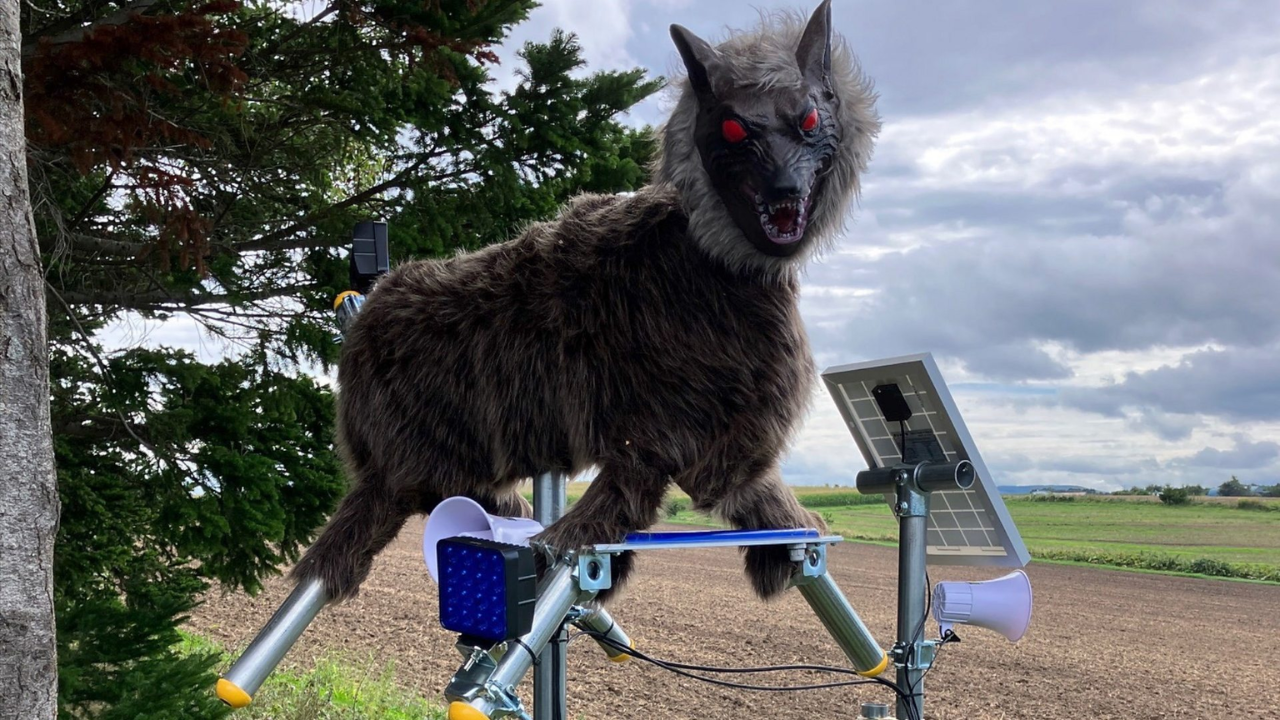
Japan is experiencing an unprecedented surge in human-wildlife conflict, evidenced by 13 fatalities and over 50,000 documented bear sightings nationwide. This ecological friction has triggered a sudden demand shock for a specific niche technology: the "Monster Wolf," a $4,000 animatronic apex-predator replica developed by Hokkaido-based manufacturer Ohta Seiki. While mainstream commentary treats these flashing, howling mechanical wolves as an eccentric internet novelty, a cold, structural analysis reveals them as a capital-allocative response to severe labor deficits, demographic collapse, and localized ecological imbalances.
Understanding this market shift requires moving past sensationalized headlines. The immediate commercial success of these devices is a direct function of macroeconomic and biological variables converging on rural Japan.
The Macro Drivers of Human-Bear Friction
The escalation in bear encounters is not accidental. It is driven by two independent, compounding structural shifts: demographic contraction and localized ecosystem failure.
1. The Demographic Saturation Barrier
Rural Japan is undergoing rapid depopulation. As younger demographics migrate to urban centers, agricultural land on the peripheries of mountain ranges is abandoned. The removal of human activity eliminates the traditional geographic buffer zones that historically separated wildlife habitats from human settlements. This vacuum allows Asian black bears and Hokkaido brown bears to claim abandoned villages and uncultivated fields as extended foraging territories, shortening the distance between wildlife populations and active human infrastructure.
2. The Caloric Deficit Vector
Climatic variations have destabilized wild food systems. Severe failures in hard mast production—specifically acorns and beech nuts—force bears out of their primary forest habitats during the hyperphagia phase preceding hibernation. To meet their metabolic requirements, the animals migrate lower into the elevation gradient, penetrating human-inhabited zones in search of alternative caloric sources found in agricultural crops, orchard fruits, and suburban waste.
The Economics of Deterrence: Capital vs. Human Capital
The rapid adoption of the Monster Wolf by farmers, golf course operators, and rural municipal bodies highlights a severe supply bottleneck in traditional wildlife management. Historically, human-wildlife conflict mitigation relied on physical intervention: culling campaigns, active patrolling by local hunting associations, and continuous manual property maintenance.
[Demographic Contraction] ---> [Hunter Population Decline] --\
                                                              \---> [Traditional Defense Deficit]
[Caloric Failure in Forests] -> [Bear Range Expansion] --------/
This human-centric defense model faces absolute failure due to the shrinking labor pool. The average age of licensed hunters in Japan exceeds 60 years, and their overall headcount is declining. Simultaneously, the state executed an all-time high of 14,601 bear culls in response to the crisis, exhausting available state and civilian personnel resources.
When human capital is unavailable or prohibitively expensive, operations must substitute capital for labor. A $4,000 capital expenditure on a mechanical deterrent represents an automated, depreciable asset capable of 24-hour operation, effectively offsetting the lack of physical security personnel.
Technical Specifications and Cost Functions
The Monster Wolf operates as a multi-sensory aversion system designed to exploit the innate predator-avoidance instincts of large mammals. The system operates on a straightforward technical architecture:
- Detection Mechanism: An integrated passive infrared (PIR) sensor monitors localized structural perimeters.
- Actuation Suite: Upon trigger, the device activates mechanical head rotation, synchronized blue LED tail indicators, and strobing red LED ocular matrices.
- Acoustic Arrays: Dual-channel directional speakers broadcast from an internal library of over 50 distinct audio profiles, ranging from simulated lupine vocalizations and gunfire to synthetic alarms and human voices, reaching volumes audible up to a one-kilometer radius.
- Power Management: The base unit draws from a standard 12-volt automotive battery system, which can be coupled with an optional photovoltaic solar charging panel to ensure autonomous operation in remote, off-grid deployments.
The economics of the manufacturer, Ohta Seiki, reveal a classic production bottleneck. The firm has received over 50 orders in the opening months of the year—a figure exceeding its historical annual output. Because production relies on bespoke, manual assembly rather than automated manufacturing lines, lead times have expanded to two to three months. This supply inelasticity prevents the firm from fully capitalizing on the current demand peak.
The Biological Bottleneck: Habituation and Cognitive Adaptation
The long-term viability of the Monster Wolf hinges on a critical variable in animal behavior: the rate of habituation. Large carnivores, particularly bears, possess highly developed cognitive faculties and excel at risk-reward assessment based on environmental feedback loops.
$$\text{Probability of Intrusion} = f(\text{Caloric Reward}) - f(\text{Perceived Risk Cost})$$
Initially, the combination of high-intensity optical stimuli and unfamiliar acoustic signals creates a high perceived risk cost, deterring entry. However, if the target animal repeatedly encounters the stimulus without suffering physical injury or negative kinetic reinforcement, the perceived risk decays over time. The speed of this decay is directly proportional to the intensity of the animal's hunger; a starving bear will tolerate higher levels of sensory discomfort to access food.
The primary limitation of the current Monster Wolf iteration is its static geographic placement. Because the unit remains anchored to a single coordinate, its sensory outputs eventually transform from an unpredictable threat vector into a predictable localized nuisance.
Strategic Shift to Autonomous and Dynamic Interdiction
To delay the inevitable curve of animal habituation, the engineering roadmap for wildlife deterrents must pivot away from static animatronics toward dynamic, mobile, and intelligent systems. Ohta Seiki's stated intention to introduce wheeled configurations and AI-guided computer vision represents the correct evolutionary path for this hardware.
To maximize asset lifetime value and prevent total behavioral habituation, operators should deploy these systems using a strict three-phase operational framework:
- Dynamic Spatial Rotation: Units must not remain permanent fixtures. Operators should shift the physical location of the units along perimeter lines at irregular intervals to disrupt the animal's territory mapping.
- Algorithmic Sensory Variation: The device's internal audio playback loops must use randomized sequencing rather than predictable patterns. The sensory output must remain highly variable to minimize cognitive recognition by recurring wildlife.
- Sensor-Driven Discrimination: Upgrading from basic motion sensors to AI-enabled camera systems allows the device to conserve power and reserve its highest-intensity deterrent arrays exclusively for confirmed target species. This prevents sensory saturation caused by false triggers from non-threatening urban or local fauna.
The current run on animatronic wolves is a rational, short-term stopgap for an agricultural sector running out of human defenders. However, long-term security in rural zones will require integrating these automated scarecrows into broader, networked perimeters that mix sensory deterrents with physical fencing and autonomous patrol drones. Relying on stationary visual intimidation alone will eventually yield diminishing returns as nature adapts to the hardware.