Macro-environmental volatility in the Central Pacific basin requires a rigorous reassessment of disaster response frameworks, particularly when overlapping meteorological phenomena strain local municipal infrastructure. The declaration of a state of emergency across the Hawaiian archipelago in response to Hurricane Lowell exemplifies the compounding operational risks inherent in an unusually active tropical season. Evaluating this event demands moving past superficial weather reporting to examine the underlying climatological drivers, logistical stress points, and quantitative economic impacts that define modern emergency management.
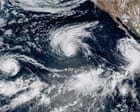
Operating concurrently with Hurricane Karina and Tropical Storm Marie, Lowell represents the first triple-hurricane configuration in the region within a decade. This clustering is not a statistical anomaly but a predictable output of a supersized El Nino cycle altering thermal energy distribution across oceanic boundaries.
The mechanics of this meteorological pressure system involve three primary interacting vectors:
- Sustained sea surface temperatures exceeding baseline averages across the Central Pacific basin.
- An upper-level trough mechanism positioned to the north, dictating the eventual translation vector of the storm via directional steering currents.
- Compressed inter-storm temporal spacing, which severely restricts recovery windows for municipal emergency supplies and institutional readiness.
Emergency declarations function as statutory instruments designed to bypass procedural friction, allowing administrative bodies to allocate capital, deploy national guard assets, and mobilize high-clearance municipal vehicles into vulnerable sectors like Kauai and Niihau prior to landfall. The financial exposure of such infrastructure stress is substantial; preceding events like Hurricane Lala demonstrated direct structural and residential damages exceeding tens of millions of dollars on isolated landmasses, creating a compounding capital deficit for local governance.
Risk mitigation in island isolation environments relies on a decentralized logistics chain where supply replenishment is fundamentally bottlenecked by port accessibility and air cargo limits. When sequential storm cells threaten the same geographical coordinates within a three-week window, the velocity of asset depletion outpaces the replenishment rate of commercial supply lines. Retail inventories of basic provisions experience immediate localized exhaustion, forcing municipal authorities to transition from open-market consumer dependencies to tightly managed municipal distribution protocols.
Asset positioning strategies must account for spatial variance in storm trajectories. Because Lowell's projected path remains dependent on the exact angular momentum of the northern steering trough, emergency operations centers cannot rely on deterministic routing models. Instead, resource allocation must operate on probabilistic boundary conditions, staging heavy pumps, backup generation units, and mobile communication arrays across multi-island footprints to ensure redundancy if primary transit hubs experience wind or flood closures.
Structural resilience in the face of escalating meteorological frequency requires shifting capital allocation models from reactive emergency expenditure to proactive asset hardening. Municipalities must dynamically stress-test drainage capacity, enforce stricter coastal zoning definitions to mitigate storm surge run-up, and institutionalize redundant digital telemetry for remote grid monitoring before seasonal baseline thresholds are crossed.