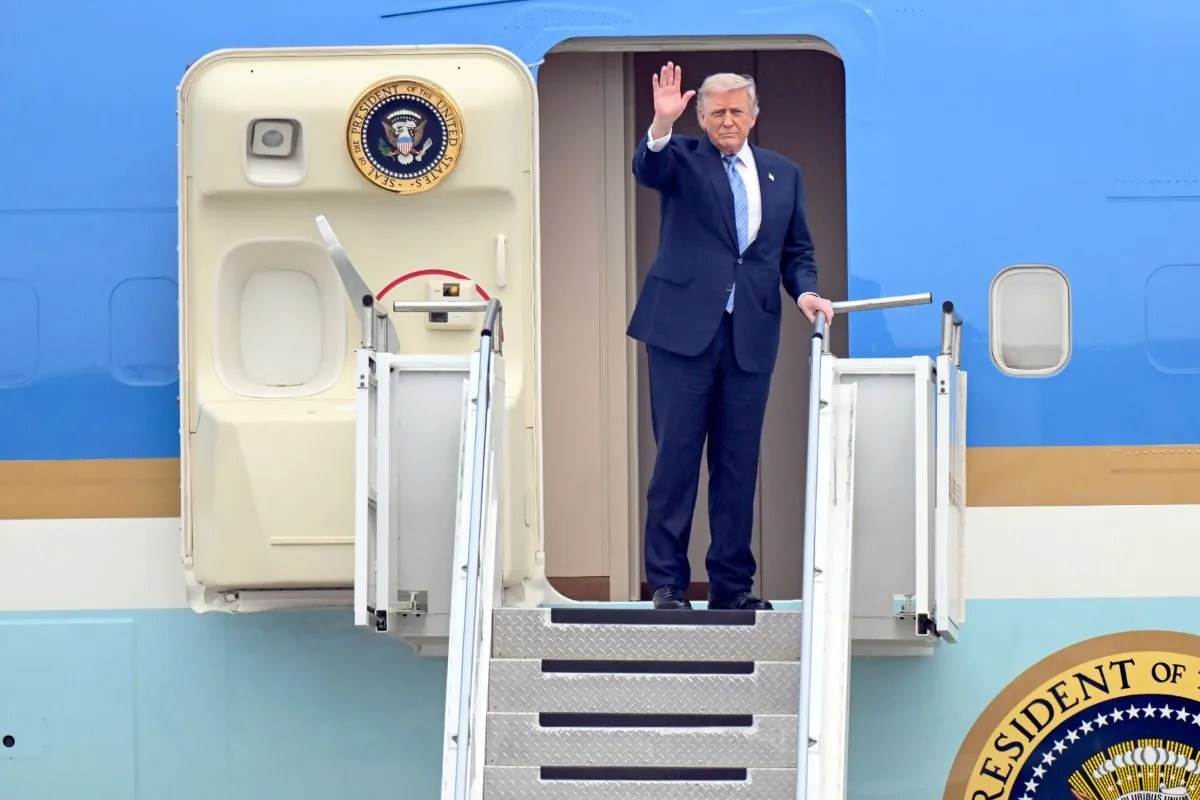
High-stakes executive protection relies on calculated redundancy, asymmetrical deception, and risk redistribution. When intelligence channels detect a targeted kinetic threat against a head of state during international transit, standard protocol shifts from routine travel management to active operational compartmentalization. The covert transfer of United States President Donald Trump from a primary presidential transport to a secondary aircraft via an airport catering truck in Ankara, Turkey, offers a concrete case study in executive protection mechanics, exposing the hard choices required when managing asymmetric aerial threats.
Deconstructing the operational parameters of this maneuver reveals the underlying cost functions, systemic vulnerabilities, and structural trade-offs inherent to modern presidential movement.
The Threat Vector and the Mechanics of Deception
The operational requirement for a decoy movement arises when intelligence indicates a specific, actionable vector against a high-value asset. In this instance, intelligence assessments flagged potential hostile actions by Iranian state or proxy elements targeting the presidential aircraft upon departure from the NATO summit.
Executive aviation security operates under strict probability matrices. When the probability of an intercept crosses a designated threshold, protection details must introduce noise into the adversary's targeting loop. The execution in Ankara followed a classic strategic deception template:
- Observable Confirmation: The primary aircraft, designated as the public-facing transport, maintained normal boarding procedures. The target asset boarded in full view of media pools and local observers, anchoring the adversary's real-time intelligence collection on a false positive.
- Concealed Extraction: Utilizing a hydraulic airport catering vehicle positioned against the fuselage, the primary asset was moved laterally out of the visual line of sight. This minimized exposure duration on the open tarmac.
- Asset Reallocation: The principal was transferred into a secondary military transport, a modified Boeing C-32A, while the original aircraft—carrying staff and the press pool—proceeded down the runway as an operational decoy.
This maneuver effectively split the unified target package into two distinct entities: a high-value decoy carrying personnel without the principal, and an austere transport carrying the principal along a modified signature path.
The Risk Redistribution Equation
A critical element of the Ankara operation that demands rigorous analysis is the distribution of existential risk among the traveling party. Standard executive protection dictates that the principal and the accompanying operational infrastructure travel together to maintain command continuity and administrative oversight. Decoy operations break this paradigm, creating an unavoidable asymmetry in risk exposure.
By placing the press pool and administrative staff inside the legacy Air Force One while the principal departed on a separate military jet, the protection detail altered the risk equation. If the primary threat profile involved a guided projectile targeting the heat or radar signature of the larger, recognizable airframe, the decoy aircraft inherently bore the brunt of that statistical probability.
President Trump later noted his assessment that the decoy flight carried the higher statistical risk due to its high-visibility signature. From an aerospace defense perspective, adversaries utilizing infrared or radar guidance systems lock onto the dominant radar cross-section and thermal output of a wide-body airframe like a Boeing jumbo jet. Consequently, the decoy airframe functioned as an effective electronic and physical shield, absorbing the primary threat vector while the narrow-body C-32A slipped out of the theater under a minimized radar and visual footprint.
Equipment Variables and the Qatari Asset Factor
Complicating the logistics of the Ankara departure was the type of aircraft utilized for the inbound leg of the summit trip. President Trump had arrived in Turkey aboard a newly configured Boeing 747-8 donated by Qatar, an airframe intended to eventually augment or replace aging presidential transport assets.
However, structural security analysis of the Qatari-donated asset revealed critical variances compared to legacy executive fleets:
- Defensive Countermeasure Gaps: The newer airframe lacked certain classified, integrated electronic countermeasures and hard-point missile defense architecture standard on dedicated military-configured presidential transports.
- Operational Transition Friction: Introducing a non-standardized commercial airframe into an active theater under high threat conditions introduces vulnerabilities related to crew familiarity, secure communication compatibility, and emergency egress protocols.
These hardware limitations heavily influenced the tactical decision to alter the return itinerary. Rather than exposing a less-defended, newly integrated airframe or standardizing a predictable departure route, the Secret Service utilized the logistical pivot to reset the security baseline.
Institutional Friction and Information Cascades
The operational necessity of secrecy during an active threat environment creates a secondary vector of friction: institutional communication breakdown. Reports following the disclosure of the Ankara flight highlighted sharp pushback from legislative oversight bodies, notably from congressional leaders who criticized the lack of immediate notification regarding the threat level and the clandestine transport shift.
In high-threat executive operations, information compartmentalization is inversely proportional to operational security leaks. Expanding the circle of notification increases the probability of compromise through electronic interception or human intelligence leakage. The decision to keep legislative oversight and even portions of the White House staff unaware of the mid-tarmac transfer was a deliberate trade-off: sacrificing immediate political transparency to maximize tactical surprise and protect the principal's physical security.
This dynamic illustrates a permanent tension within democratic governance during kinetic crises. The executive branch prioritizes operational variables—such as secure routing and threat mitigation—while legislative bodies demand procedural transparency and real-time accountability. When security protocols require absolute deception, institutional friction is an inevitable byproduct.
Strategic Execution and Operational Takeaways
The Ankara transport shift demonstrates that modern executive protection cannot rely on stationary security assumptions, even within allied airspace or formal diplomatic settings. As state and non-state actors develop increasingly sophisticated long-range kinetic capabilities, traditional air travel vectors require dynamic, real-time alterations.
The primary operational takeaways from this event dictate future protocol adjustments for high-risk executive transits:
- Decoupled Signatures: Standardizing the separation of executive transport from predictable media and staff pools reduces the efficacy of hostile targeting intelligence.
- Hardware Parity Enforcement: Introducing non-standard or donor assets into presidential fleets creates unacceptable defense vulnerabilities unless uniform countermeasure architecture is fully validated.
- Information Siloing: Maintaining operational security during active threat windows requires strict adherence to need-to-know parameters, superseding standard administrative notification loops.
Future executive deployments will likely institutionalize these dynamic switching protocols as a baseline standard rather than an anomalous emergency response, neutralizing targeted interception vectors through continuous operational ambiguity.