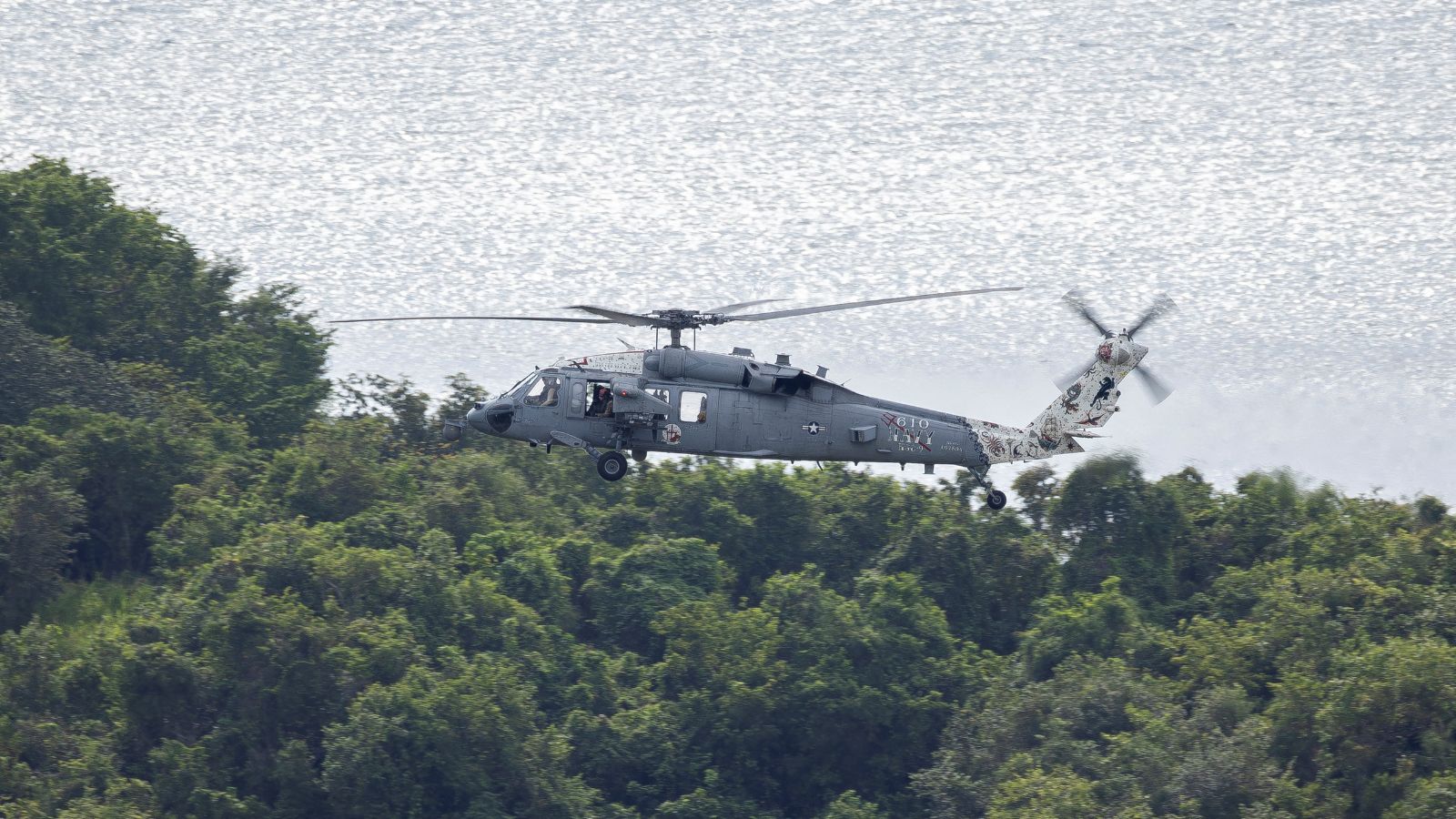
The forced water landing of a U.S. Navy MH-60S Sea Hawk in the Arabian Sea on July 1, 2026, isolates the distinct operational liabilities inherent to carrier-based rotary-wing aviation. Operating from the Nimitz-class aircraft carrier USS George H.W. Bush (CVN 77) at 03:30 Eastern Time, the aircraft carried four crew members; three were recovered in stable condition, while one remains missing. Although U.S. Naval Forces Central Command and the U.S. 5th Fleet have explicitly stated there is no initial indication of hostile intent, evaluating this incident requires an objective examination of the mechanical, structural, and physiological variables that dictate survival outcomes during open-ocean ditching.
The standard media narrative attributes water landing risks vaguely to "dangerous conditions." A rigorous technical assessment, however, identifies a repeatable sequence of physical forces and design limitations that jeopardize aircraft stability and crew egress within seconds of water impact.
The Hydrodynamic Inversion Mechanics
The primary risk factor governing a helicopter ditching is the high vertical center of gravity relative to its buoyant center. This asymmetry creates an unstable equilibrium the moment the airframe settles into the water.
- The Top-Heavy Mass Profile: The MH-60S houses its heaviest components—the twin General Electric T700-GE-401C turboshaft engines and the main rotor gearbox—directly above the cabin.
- The Inversion Axis: Unlike fixed-wing aircraft designed with buoyant hulls or low wings that provide lateral stabilizing surfaces, a helicopter's cross-section resembles a high-walled box. When thrust terminates and the hull meets water resistance, the aircraft rapidly rolls along its longitudinal axis, flipping upside down within 5 to 10 seconds.
- The Disorientation Factor: Inversion immediately deprives the crew of visual reference points, particularly during nocturnal operations like this 03:30 ET incident. Gravity-dependent escape routes invert, forcing crew members to navigate exit hatches backward and upside down while fighting the rapid onset of rushing water.
The Triad of Maritime Egress Barriers
Survival rates in controlled water landings depend heavily on the crew's ability to clear the airframe prior to complete submersion or sinking. This process is constrained by three distinct bottlenecks.
Structural Disruption and Latch Jamming
Upon impact, hydrodynamic forces exert tremendous stress on the aluminum and composite skin of the airframe. Minor structural warping can jam sliding cabin doors or cockpit egress windows. If a latch deforms by even a fraction of an inch, the physical force required to manually jettison the hatch can exceed human capability, trapping personnel inside an inverting cabin.
Ingress of Water and Thermal Shock
The Arabian Sea features high ambient temperatures, but the physiological response to sudden immersion remains a critical friction point. The immediate intake of seawater into the cabin triggers the mammalian dive reflex or, conversely, an involuntary gasp reflex. If a crew member is not breathing from an emergency egress breathing device at the precise moment of inversion, water inhalation occurs almost instantly.
Entanglement and Kit Density
Modern naval aviators and aircrew wear significant gear, including body armor, survival vests, flotation collars, and communication tethers. In the cramped interior of an MH-60S, these items frequently catch on cyclic sticks, collective levers, seat frames, or loose cabin equipment. Disentangling a harness while inverted and submerged requires blind tactile memory under extreme cognitive load.
The Search and Rescue Operational Blueprint
Once an aircraft is down, the survival window transitions from airframe egress to localization and recovery. The U.S. 5th Fleet relies on structured search protocols to maximize the probability of detection within the first golden hours.
The search area is calculated dynamically using a shifting probability density function. Surface currents, wind velocity, and localized sea states in the Arabian Sea cause rapid drift. Naval planners utilize the Environmental Data Spatial Operational System to project where a floating service member or debris field will move over time.
Because the incident occurred during the early morning hours, initial search assets had to rely heavily on Forward-Looking Infrared sensors and night-vision capabilities from hovering aircraft and surface vessels. The transition to daylight shifts the search matrix to high-resolution visual scanning and synthetic aperture radar sweeps to identify small reflective targets on the surface, such as survival strobes or dye markers.
Regional Geopolitical Stressors and Operational Fatigue
While the technical cause of this specific emergency landing is under formal military investigation, the operational context provides critical data on asset wear. The USS George H.W. Bush has maintained an active presence in the Middle East since April 2026 as part of a two-carrier footprint designed to deter regional escalation during a delicate ceasefire between the United States and Iran.
Continuous high-tempo operations create specific maintenance and physiological stresses:
- Environmental Degradation: The high salinity and ambient heat of the Arabian Sea accelerate compressor blade erosion and electrical corrosion within rotary assets. This environment demands compressed maintenance turnarounds, which narrows the margin for minor mechanical anomalies.
- Crew Fatigue Cycles: Sustained flight operations under heightened alert status increase cumulative fatigue among both aircrews and deck-level maintenance personnel. Chronic sleep deprivation degrades situational awareness and micro-second reaction times required to manage in-flight emergencies.
The operational reality of naval aviation is that mechanical and environmental variables pose as persistent a threat to force preservation as direct kinetic action. Navy investigators will focus on analyzing the flight data recorder, maintenance logs, and survivor testimonies to isolate whether material failure, environmental factors, or a combination of both forced the Sea Hawk down.
The immediate tactical requirement demands that the 5th Fleet sustain an exhaustive surface and subsurface search pattern within the calculated drift corridor, utilizing all available unmanned maritime systems and airborne radar platforms until the missing service member is located or the survival window is mathematically closed.