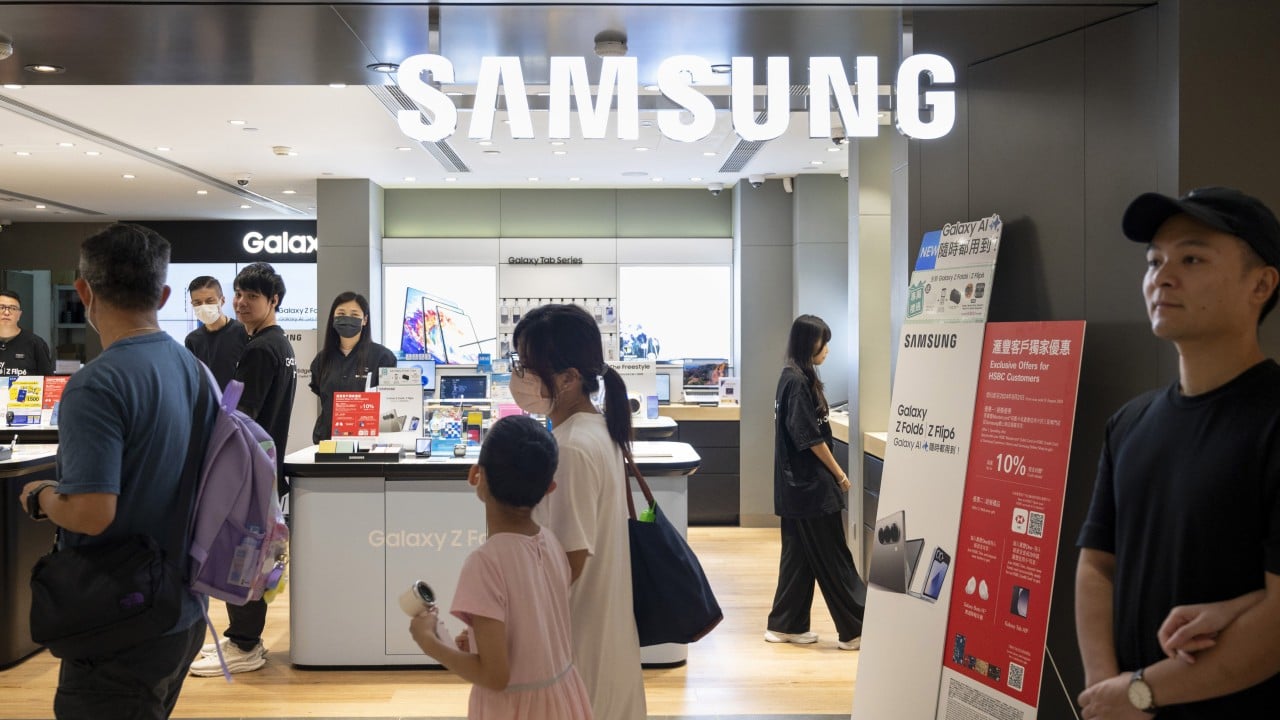
Multinational consumer electronics firms rarely abandon mature, high-income retail markets unless the underlying unit economics have structurally inverted. Reports indicating that Samsung Electronics is winding down its home appliance sales operations in Hong Kong point to a calculated capital reallocation rather than an isolated regional misstep. When fixed overhead, hyper-local spatial constraints, and aggressive regional price compression converge on a low-margin hardware vertical, exiting the market becomes the only rational path to protecting consolidated operating margins.
Understanding this operational retreat requires separating confirmed corporate mechanics from broader strategic hypotheses. While Samsung Electronics maintains dominant market share in Hong Kong across mobile communications, memory semiconductors, and visual displays, its white goods division—comprising refrigerators, washing machines, air conditioners, and vacuum cleaners—operates under entirely different supply chain and fulfillment physics. Analyzing this exit reveals a blueprint of how legacy appliance economics fail in ultra-dense urban micro-markets. Recently making headlines in this space: Inside Hong Kong's Quiet Corporate Purge.
The Structural Unit Economics of White Goods in High-Density Micro-Markets
Home appliances suffer from a brutal physical-to-value ratio compared to consumer electronics like smartphones or tablets. A flagship smartphone packs over a thousand dollars of retail value into a box weighing less than half a kilogram; a mid-tier washing machine occupies half a cubic meter, weighs seventy kilograms, and commands a comparable or lower retail price. In a market like Hong Kong, where commercial real estate, warehousing, and last-mile logistics rank among the most expensive globally, the cost of physical handling erodes gross margins before a unit ever reaches a showroom floor.
This creates a severe structural bottleneck across three operational vectors: More insights into this topic are covered by CNBC.
- Inventory Carrying Costs: White goods require vast cubic footage for buffer stock. Because Hong Kong retailers operate with minimal back-of-house storage, manufacturers or their local distributors must absorb the cost of third-party logistics warehousing in the New Territories or cross-border facilities in Shenzhen.
- Last-Mile Fulfillment Friction: Residential architecture in Hong Kong—characterized by narrow elevator shafts, steep walk-ups, and strict building management delivery windows—turns standard appliance installation into specialized labor. Every delivery carries a high probability of damage, return, or multi-person rigging fees.
- After-Sales Service Overhead: Unlike a defective phone that a customer brings to a centralized service center in Mong Kok or Causeway Bay, a malfunctioning refrigerator requires dispatching a certified technician with proprietary spare parts to the customer's residence. Maintaining a dedicated fleet and parts inventory for a relatively small installed base guarantees a negative return on invested capital.
Known Facts Versus Strategic Hypotheses
Rigorous market analysis demands a clear boundary between verifiable operational realities and analytical deduction regarding Samsung's reported move.
Verifiable Operational Realities
Samsung Electronics has long bifurcated its Hong Kong operations. Its Device eXperience (DX) division manages mobile devices, televisions, and digital appliances, while its Device Solutions (DS) division handles semiconductor components. Within the local retail ecosystem, Samsung's mobile and display units enjoy massive economies of scale, commanding premier shelf space at major electronics chains like Broadway, Fortress, and Suning, alongside carrier partnerships. Conversely, Samsung's home appliance footprint in these same channels has steadily contracted, facing entrenched incumbents and acute spatial limitations. Furthermore, Samsung's global Digital Appliances business has publicly struggled with profitability over multiple consecutive quarters, weighed down by global shipping inflation, raw material volatility, and sluggish replacement cycles in developed economies.
Educated Strategic Hypotheses
If Samsung formally terminates direct home appliance sales in Hong Kong, the decision stems from a portfolio optimization mandate originating at its Suwon headquarters. The primary hypothesis is that the Hong Kong appliance unit failed to clear internal hurdle rates for return on assets. Rather than subsidizing an uncompetitive white goods operation using profits generated by Galaxy smartphones or Neo QLED televisions, management is isolating the loss-making vertical. A secondary hypothesis involves channel cannibalization: continuing to push low-margin appliances through major retail partners forces Samsung's local account managers to spend negotiation capital on floor space for washing machines—capital better spent securing prime end-caps and promotional rebates for high-margin mobile flagships and AI-enabled displays.
The Four Pillars of Market Failure in Hong Kong Appliances
Standard market commentary often reduces corporate exits to vague notions of "intense competition" or "changing consumer preferences." In reality, Samsung's position in Hong Kong's appliance sector deteriorated due to four specific, quantifiable market mechanics.
1. Spatial Incompatibility of Global Product Platforms
Samsung designs its core appliance platforms—such as the Bespoke refrigerator series and large-capacity front-load washers—primarily for South Korean, North American, and European residential footprints. These markets favor standard 600mm depths and expansive kitchen layouts. Hong Kong's housing stock, among the smallest per capita in the developed world, dictates non-standard, ultra-slim appliance dimensions. Modifying global manufacturing tooling to produce hyper-localized, narrow-chassis SKUs for a market of 7.5 million people destroys manufacturing economies of scale. Without localized chassis sizes, Samsung was effectively selling oversized hardware into undersized apartments.
2. Asymmetric Competition from Japanese and Chinese Incumbents
Samsung found itself trapped in a classic strategic middle-ground squeeze. At the premium tier, Japanese brands—specifically Panasonic, Hitachi, and Mitsubishi Electric—possess decades of entrenched brand equity in Hong Kong. These competitors build bespoke, compact models specifically engineered for East Asian urban apartments, including multi-door slim refrigerators and specialized window-type air conditioners that dominate local residential retrofits. At the value and mid-tier, mainland Chinese manufacturers like Midea, Haier, and Gree leverage proximity to manufacturing hubs in Guangdong Province. Their factories sit less than a hundred kilometers from Hong Kong's border, enabling just-in-time inventory replenishment and aggressive retail pricing that a South Korean supply chain cannot match.
3. The Collapse of Cross-Border Retail Arbitrage
Historically, Hong Kong's retail sector benefited from mainland Chinese tourists purchasing foreign-branded electronics in the city to avoid mainland import tariffs and guarantee product authenticity. That structural advantage has evaporated. Domestic manufacturing quality in mainland China has reached parity, cross-border e-commerce platforms have equalized pricing, and consumer spending patterns have inverted—Hong Kong residents now routinely travel north to Shenzhen for retail and dining. Without tourist-driven volume supplementing local replacement demand, the addressable market for mid-to-high-end appliances in Hong Kong shrank to a stagnant pool of local household replacements.
4. The Digital Ecosystem Disconnect
Samsung's broader corporate strategy relies on the SmartThings ecosystem to lock consumers into multiple hardware categories. The theory holds that a consumer with a Galaxy phone will buy a Samsung TV, which then drives the purchase of a Samsung refrigerator or air conditioner. In Hong Kong, this flywheel broke down at the appliance layer. While consumers readily adopted Galaxy smartphones and Samsung displays, the high switching costs, landlord-supplied appliances in rental properties, and spatial mismatches prevented ecosystem lock-in from translating into white goods sales.
The Cost Function of Retaining a Sub-Scale Division
To appreciate why an exit makes financial sense, examine the operational cost function of maintaining a sub-scale appliance division in a high-cost territory:
$$\text{Net Operating Profit} = (P \times Q) - (C_{\text{mfg}} + C_{\text{logistics}} + C_{\text{channel}} + C_{\text{service}} + C_{\text{compliance}})$$
Where $P$ represents average selling price and $Q$ represents unit volume. In Hong Kong, $Q$ is capped by demographic limits and spatial constraints, while $P$ is suppressed by Chinese price competition. Simultaneously, the cost variables scale unfavorably:
- $C_{\text{logistics}}$ (Warehousing and Drayage): Fixed warehouse leases and specialized two-man delivery crews do not scale down linearly when unit volume drops. Lower volume simply increases the per-unit logistics burden.
- $C_{\text{channel}}$ (Retail Slotting and Rebates): Securing floor space in high-rent Hong Kong malls requires guaranteed minimum marketing funds and display subsidies. When unit velocity slows, the effective channel cost per unit spikes.
- $C_{\text{service}}$ (Warranty Liability): Statutory warranty obligations and consumer protection expectations require maintaining a parts depot and technician roster for years after a model is sold. Even if sales drop by half, the service infrastructure must remain intact to support the legacy installed base.
- $C_{\text{compliance}}$ (Regulatory Certification): Hong Kong enforces strict mandatory energy efficiency labeling schemes (MEELS) and electrical safety certifications. Testing, certifying, and labeling small batches of localized SKUs introduces fixed administrative overhead that amortizes poorly over low unit volumes.
When $Q$ falls below a critical threshold, the sum of fixed logistics, channel slotting, and warranty infrastructure exceeds the gross margin generated by hardware sales. Continuing operations ceases to be a market-share play and becomes a permanent cash drain.
Operational Consequences for Channels, Consumers, and Competitors
A withdrawal of this nature triggers immediate second-order effects across the local retail ecosystem, requiring precise management to avoid collateral damage to Samsung's profitable divisions.
For major retail chains like Fortress and Broadway, losing a tier-one global brand reduces vendor diversity in their white goods aisles. However, floor space in Hong Kong retail is zero-sum. Retailers will rapidly reallocate Samsung's former display footprints to high-velocity Japanese brands or high-margin Chinese challengers like Hisense and TCL, which are actively subsidizing retail slotting fees to capture overseas market share.
For existing Hong Kong consumers who own Samsung refrigerators, washers, or air conditioners, the primary risk lies in spare parts availability and warranty fulfillment. Hardware manufacturers exiting a vertical typically transition after-sales support to third-party authorized service contractors while maintaining a statutory reserve of critical components—such as inverter compressors and control boards—for five to seven years. Any failure in this transition risks severe brand contagion, where a consumer frustrated by an unrepairable washing machine defects from Galaxy smartphones to Apple or Xiaomi on their next mobile upgrade.
Strategic Imperatives for Hardware Operators in Constrained Markets
Samsung's reported exit provides an unambiguous operational playbook for multinational hardware executives managing complex product portfolios across heterogeneous global markets.
- Enforce Strict Vertical P&L Isolation: Never allow high-margin divisions (mobile, semiconductors, displays) to subsidize structurally unprofitable hardware verticals (white goods) under the guise of "brand presence" or "ecosystem completeness." Evaluate every product line on standalone return on invested capital at the country level.
- Execute Asset-Light Licensing Over Direct Distribution: In micro-markets where physical logistics and localized engineering destroy unit economics, transition from direct wholesale distribution to brand licensing or master-distributor models. Allow a local conglomerate with existing warehousing, delivery fleets, and multi-brand service technicians to absorb the fixed overhead in exchange for wholesale margin.
- Ring-Fence After-Sales Service During Exits: When winding down a physical hardware line, over-invest in the transition of warranty and repair operations. Ring-fence spare parts inventory and lock in long-term service-level agreements with third-party repair networks before announcing the commercial exit to prevent brand erosion from bleeding into adjacent, profitable product categories.
- Reallocate Retail Capital to High-Velocity Categories: Immediately redirect the trade marketing funds, slotting fees, and key account management hours freed by the appliance exit into high-margin, high-turnover verticals—specifically flagship mobile devices, wearable ecosystems, and premium display panels—to fortify market share against regional competitors.


