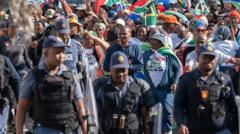
The assassination of Andile Somgxada, a prominent provincial leader of the anti-illegal immigration movement "March and March" in Ekurhuleni, exposes a dangerous inflection point in South Africa’s internal security. It is a stark indicator that the state is losing its monopoly on violence to decentralized, informal civic coalitions. The South African Police Service (SAPS) has deployed a specialized investigative unit to probe the killing, but this tactical maneuver fails to address a deeper structural crisis.
What appears to be a localized policing issue is actually a complex macroeconomic and geopolitical crisis. When citizens form parallel structures to enforce immigration laws, and those structures clash with migrant networks, it creates a highly volatile security landscape. This environment disrupts local retail supply chains, damages foreign direct investment (FDI), and triggers diplomatic retaliation from key regional trade partners.
The Triad of Governance Failures
To understand why figures like Somgxada emerge, one must analyze the institutional vacuum that creates them. This structural failure operates across three distinct axes:
[State Capacity Deficit] ───> [Informal Sovereignty (Vigilantism)] ───> [Symmetric Escalation (Retaliation)]
- The State Capacity Deficit: SAPS operates under severe resource constraints, resulting in low detection rates for violent crimes. Combined with a backlogged immigration bureaucracy, large swathes of the informal economy—particularly township "spaza" shops—operate outside formal regulatory oversight.
- The Rise of Informal Sovereignty: When a state fails to enforce its own laws, informal actors step in to fill the void. Groups like March and March organize citizen-led "business compliance" checks and set arbitrary deadlines for undocumented migrants to leave. While these actions lack legal authority, they carry significant physical weight on the ground.
- Symmetric Escalation: When informal groups use intimidation, targeted communities inevitably organize for self-defense. The assassination of Somgxada—shot outside his home in what his organization calls a targeted hit—points to a shift toward organized, armed resistance from opposing factions.
This feedback loop turns immigration enforcement into a conflict between competing, non-state armed actors.
The Economic and Diplomatic Cost Function
Xenophobic unrest in South Africa is often analyzed purely through a human rights lens. However, the economic and diplomatic fallout carries severe material consequences for the country's sovereign risk profile.
1. Supply Chain Disruption and Capital Flight
The informal retail sector, or township economy, is a vital economic driver. When groups like March and March target foreign-owned spaza shops, they disrupt local distribution channels. The resulting looting, property damage, and displacement of shop owners lead to localized supply chain failures, increased costs for basic goods, and a drop in municipal tax revenue. For institutional investors, this persistent instability raises the risk premium for capital deployment in South African infrastructure and retail.
2. The Diplomatic Strain on Pan-African Trade
South Africa’s economic model relies heavily on its position as a gateway to the rest of the continent. The recent unrest has triggered immediate diplomatic pushback:
- Malawi: Following violent clashes, including the murder of a Malawian national in Pietermaritzburg, the Malawian government initiated large-scale repatriation efforts.
- Nigeria and Ghana: Both nations have raised formal complaints over the safety of their citizens, with Nigeria warning of potential diplomatic retaliation under international law. Ghana went a step further, postponing high-level bilateral meetings scheduled for August.
These diplomatic fractures directly undermine the implementation of the African Continental Free Trade Area (AfCFTA), a framework designed to position South African firms as dominant players across regional markets.
| Country of Origin | Estimated Repatriations / Deportations (Mid-2026) | Primary Diplomatic Response |
|---|---|---|
| Malawi | ~42,400 (80% of 53,000+ total) | Active state-sponsored repatriation via air and bus |
| Nigeria | Indeterminate | Warnings of international law recourse; demand for independent probes |
| Ghana | Indeterminate | Postponement of bilateral trade and diplomatic meetings |
The Limits of Tactical Policing
Deploying a specialized SAPS task force to investigate Somgxada's murder is a reactive, short-term measure. It addresses the symptom of violence rather than the systemic failures driving it.
The primary limitation of this tactical approach is its inability to scale. The state cannot deploy specialized units to every township, informal settlement, or business district experiencing these tensions. When police intervention is temporary, vigilante groups simply wait for law enforcement to redeploy before resuming their campaigns.
Furthermore, high-profile arrests of migrants during these crackdowns inadvertently validate the rhetoric of vigilante groups. This dynamic encourages further extrajudicial enforcement, as informal groups feel their actions are forcing the state's hand.
Strategic Action Plan for State Stabilization
To regain control of its sovereign space and stabilize the economy, the South African government must shift from crisis management to a structured, institutional response.
Reclaim the Regulatory Space
The state must strip vigilante groups of their political leverage by implementing rigorous, state-led regulatory enforcement in the informal economy. This requires joint task forces comprising the Department of Home Affairs, municipal business licensing divisions, and the South African Revenue Service (SARS). By systematically registering all informal businesses and enforcing labor laws, the state can address grievances regarding "unfair competition" through formal legal channels, rendering informal vigilante actions obsolete.
De-escalate Regional Diplomatic Friction
South Africa must rebuild trust with its regional partners to avoid retaliatory trade measures. The Department of International Relations and Cooperation (DIRCO) should establish joint, bilateral security committees with embassies of major migrant-sending nations, such as Zimbabwe, Mozambique, Malawi, and Nigeria. These committees must provide transparent, weekly updates on criminal investigations involving foreign nationals and coordinate orderly, legal repatriation processes. This collaborative approach is vital to neutralizing allegations of state complicity and preserving South Africa's regional trade standing.


