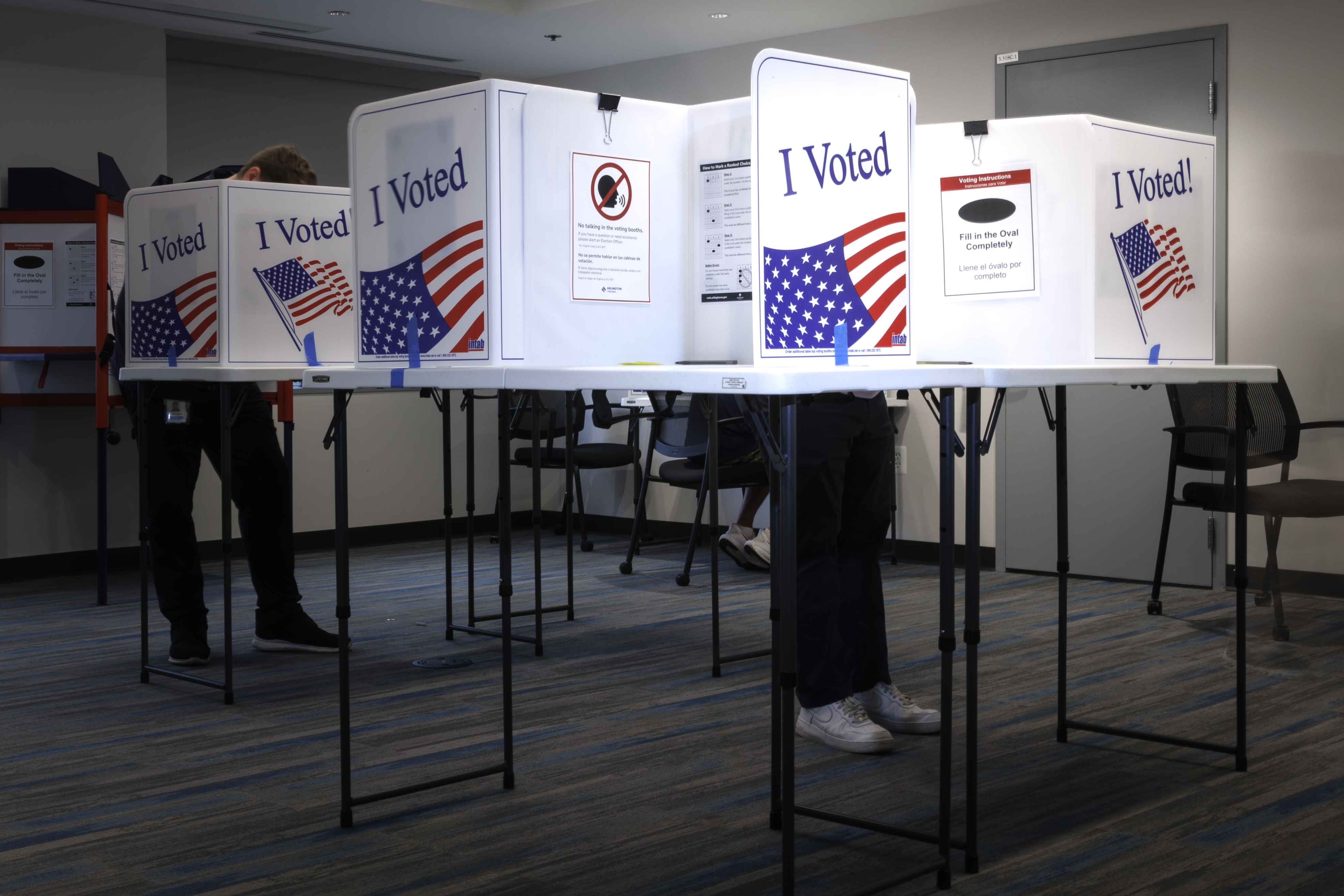
The conventional pre-election narrative surrounding the 2026 midterms relied on a binary assumption: voters in battleground states were either rigidly locked into partisan tribalism or reacting purely to localized pocketbook inflation. Post-election data from six bellwether states—Maine, Texas, North Carolina, Georgia, Ohio, and Michigan—demonstrates that both models failed to capture the actual mechanism driving ballot behavior. Rather than operating as isolated regional markets, these six electorates functioned as an integrated stress-test for how exogenous macroeconomic shocks interact with declining partisan elasticity.
To understand why the 2026 cycle produced sweeping structural shifts—including Democrats capturing majorities in both the U.S. House and U.S. Senate alongside major statehouse gains—analysts must strip away anecdotal campaign reporting and examine the underlying mechanics of voter decision-making across these six distinct operational theaters. Expanding on this topic, you can also read: Debra Messing Endorsing Bruce Blakeman Is Not the Political Earthquake You Think It Is.
The Exogenous Shock Transmission Mechanism
Standard midterm models treat domestic inflation and foreign policy as separate variables on a voter's utility function. In 2026, exogenous geopolitical and trade interventions collapsed that boundary. When federal policy introduces broad tariffs alongside active military conflict involving Iran, the resulting cost increases do not register with voters as abstract diplomatic events; they transmit directly into household balance sheets at the retail checkout counter and the fuel pump.
This creates a specific attribution problem for the incumbent party in Washington. Under normal economic conditions, voters distribute blame for localized price increases across corporate actors, state regulators, and global market cycles. When cost-of-living pressures are visibly tethered to explicit executive actions—such as tariff schedules and foreign military engagements—attribution concentrates sharply on the governing federal coalition. Experts at Associated Press have shared their thoughts on this situation.
The Three Pillars of Household Cost Attribution
- Direct Input Pass-Through: Tariffs act as an immediate consumption tax on imported goods, compressing real wages in manufacturing-heavy and retail-dependent counties without requiring a multi-quarter lag to alter consumer sentiment.
- Energy Price Volatility: Geopolitical instability in the Middle East introduces an immediate risk premium into global crude markets, turning daily commuting costs into a recurring reminder of foreign policy execution.
- Policy Salience Convergence: Because both major parties campaigned heavily on affordability, economic anxiety ceased to be an asymmetric advantage for the out-of-power party and instead became a referendum on executive competence.
Deconstructing the Six-State Matrix
A rigorous evaluation of the 2026 electorate requires categorizing the six bellwether states not by geography, but by their structural function within the national political system. Each state tested a different hypothesis regarding partisan loyalty, demographic realignment, and institutional durability.
1. The Partisan Elasticity Test: Maine
Maine served as the primary laboratory for measuring whether ticket-splitting and personal brand equity can survive nationalized midterm waves. Historically, Maine's electorate exhibited low partisan rigidity, allowing incumbent Republican Senator Susan Collins to win re-election in cycles where Democratic presidential candidates carried the state.
In 2026, the contest between Collins and Democratic challenger Troy Jackson tested the breaking point of incumbency insulation. Maine's economy is uniquely exposed to cross-border trade friction and energy heating costs, amplifying the exogenous shock mechanism described above. Simultaneously, debates over immigration and federal trade policy forced moderate and independent voters to weigh individual candidate tenure against systemic party control of the Senate. The outcome—Troy Dale Jackson defeating Collins to flip the seat for Democrats—confirmed that when macroeconomic salience crosses a critical threshold, nationalized partisan alignment overrides candidate-specific incumbency advantages.
2. The Sun Belt Realignment Floor: Texas and Georgia
Analysts frequently group Sun Belt states together, yet Texas and Georgia represent distinct stages of demographic and structural evolution.
- Georgia (The Competitive Equilibrium): Following razor-thin margins in recent federal cycles, Georgia transitioned from an emerging battleground into a mature two-party competitive system. The 2026 cycle tested whether Democratic coalition turnout could hold without a presidential candidate at the top of the ticket, alongside whether suburban swing voters would punish Republicans for federal economic disruptions. Democrats successfully defended their Senate seat with Jon Ossoff winning re-election and expanded their executive footprint as Keisha Lance Bottoms won the gubernatorial race, proving that suburban realignment in the Atlanta metro core has hardened into a durable midterm baseline.
- Texas (The Structural Tipping Point): For decades, Texas functioned as an expensive mirage for national Democrats—a state with favorable long-term demographic trends neutralized by chronic midterm turnout drop-offs among younger and Hispanic voters. In 2026, the combination of rapid urbanization, rising property and consumer costs, and dissatisfaction with federal governance pushed Texas past its structural tipping point. Democrats flipped the Texas U.S. Senate race and captured the Texas governorship, demonstrating that high-turnout midterm environments—national turnout reached roughly 49.1 percent of the voting-eligible population—can overcome traditional off-year participation deficits in high-growth states.
3. The Institutional Gerrymander Stress-Test: North Carolina
North Carolina represents the purest test of institutional map-making versus macro-level wave dynamics. Prior to the 2026 election, Republican lawmakers redrew congressional district boundaries to maximize structural advantage, operating on the assumption that precise geographic sorting could insulate congressional majorities from modest swings in the popular vote.
This strategy relies on a classic optimization trade-off: packing opposing voters into a small number of districts while spreading friendly voters across a larger number of districts with smaller, engineered margins (typically 5 to 8 percentage points). While efficient in neutral environments, this architecture creates acute systemic fragility during wave elections. When uniform swings exceed the engineered buffer, multiple districts fail simultaneously. In North Carolina, Roy Cooper won the U.S. Senate race while every single county in the state swung toward the Democrats, eroding the protective buffers built into the redrawn map and demonstrating that aggressive redistricting cannot withstand double-digit shifts in independent voter preference.
4. The Industrial Rust Belt Divergence: Ohio and Michigan
Political commentary frequently treats Ohio and Michigan as interchangeable components of the industrial Midwest. Operationally, they have diverged onto separate trajectories over the past decade, and the 2026 midterms clarified the mechanics of that split.
- Michigan (High-Variance Swing): Michigan remains a hyper-elastic battleground where control of state government and federal offices oscillates rapidly based on working-class turnout in Macomb and Oakland counties alongside union mobilization in Detroit and Ann Arbor. Voters in Michigan entered 2026 exhibiting classic "exhaustion fatigue"—frustrated by persistent cost-of-living pressures yet skeptical of partisan orthodoxy. Democrats held the open U.S. Senate seat with Abdul El-Sayed, retained the governorship, and flipped competitive U.S. House seats including Michigan's 7th and 10th districts, confirming that Michigan's electorate responds dynamically to perceived economic mismanagement by the party holding the White House.
- Ohio (Mean-Reversion Under Economic Stress): Ohio had drifted steadily rightward across recent federal cycles, leading strategists to classify it as a lean-Republican state. However, Ohio's heavy concentration of manufacturing and agricultural employment makes its economy acutely sensitive to tariff retaliation and supply-chain cost spikes. Rather than permanently realigning, Ohio's working-class electorate demonstrated conditional loyalty. When federal trade and foreign policies threatened industrial margins and household purchasing power, voters reverted toward economic populism, enabling Sherrod Brown to win the Senate race and Democrats to flip the Ohio governorship.
Why Standard Electoral Models Misread Voter Motivation
Pre-election journalism routinely frames voter sentiment in emotional binaries—asking whether the electorate is "mad, sad, or exhausted." While useful for narrative color, emotional categorization obscures the rational calculus voters apply at the ballot box.
In economics, retrospective voting theory posits that citizens do not evaluate candidates based on complex policy white papers; instead, they use their personal financial trajectory and observable social stability over the preceding 24 months as a proxy metric for incumbent competence. When voters report feeling "exhausted," they are describing high cognitive load caused by persistent uncertainty—unstable prices, geopolitical escalation, and relentless political conflict.
Operational Failures in Pre-Election Forecasting
- Over-Weighting Partisan Registration: Analysts assumed that declining ticket-splitting meant voters were permanently locked into partisan camps. In reality, modern voters express dissatisfaction not by switching party registration, but through differential turnout and independent defection. When base voters stay home or independents break 60-40 against the incumbent party, electoral maps flip without a single voter formally changing party affiliation.
- Underestimating Down-Ballot Coupling: Strategists treated gubernatorial and state legislative races as insulated from federal headwinds. The 2026 results—where Democrats flipped governorships in Georgia, Iowa, Nevada, Ohio, and Texas and gained control of key state legislative chambers—prove that when macroeconomic dissatisfaction reaches acute levels, voters apply a uniform anti-incumbent heuristic from the top of the ticket down to statehouse races.
- Ignoring Turnout Elasticity: Midterm electorates are historically older, wealthier, and more conservative than presidential electorates. The 2026 cycle shattered that constraint by generating near-record midterm turnout of 49.1 percent, neutralizing the structural turnout advantage Republicans typically rely upon in non-presidential years.
Limitations of the Six-State Diagnostic Framework
While analyzing Maine, Texas, North Carolina, Georgia, Ohio, and Michigan exposes the core mechanics of the 2026 wave, extrapolating these results blindly into the 2028 presidential cycle introduces three analytical hazards:
- Thermostatic Public Opinion: Political scientist Christopher Wlezien's thermostatic model demonstrates that public opinion adjusts against whichever party holds power. The same independent voters who punished Republicans in 2026 for tariff-induced inflation and foreign entanglements will immediately recalibrate their expectations toward the incoming Democratic congressional majorities and newly elected Democratic governors.
- Asymmetric Presidential Turnout: Midterm waves frequently mislead strategists about presidential baselines because the coalitions differ. While 2026 saw historically high participation, a presidential general election brings lower-propensity, less-engaged voters back into the electorate, altering the demographic composition of states like Texas and Ohio.
- State-Specific Candidate Effects: Separating wave momentum from candidate quality remains imperfect. Victories by high-profile figures such as Roy Cooper in North Carolina or Sherrod Brown in Ohio benefited from decades of statewide name recognition that generic replacement candidates cannot easily replicate in open-seat contests.
Strategic Mandate for the 2028 Cycle
Political operatives, campaign strategists, and policy analysts must abandon static geographic classifications ("safe red," "purple," "blue wall") in favor of economic sensitivity indexing. The 2026 midterms proved that partisan loyalty is conditional upon macroeconomic stability.
For the incoming Democratic congressional majority and expanded roster of Democratic governors, the operational imperative is immediate cost containment: neutralizing tariff pass-throughs, stabilizing energy supply chains, and demonstrating measurable relief in housing and healthcare expenses before the 2028 primary calendar opens. Conversely, Republican strategists must decouple their domestic economic messaging from protectionist trade policies and open-ended foreign interventions that directly tax working-class households. In an era of high-turnout, hyper-elastic electorates, whichever coalition owns consumer price inflation will lose the six states that govern the federal balance of power.