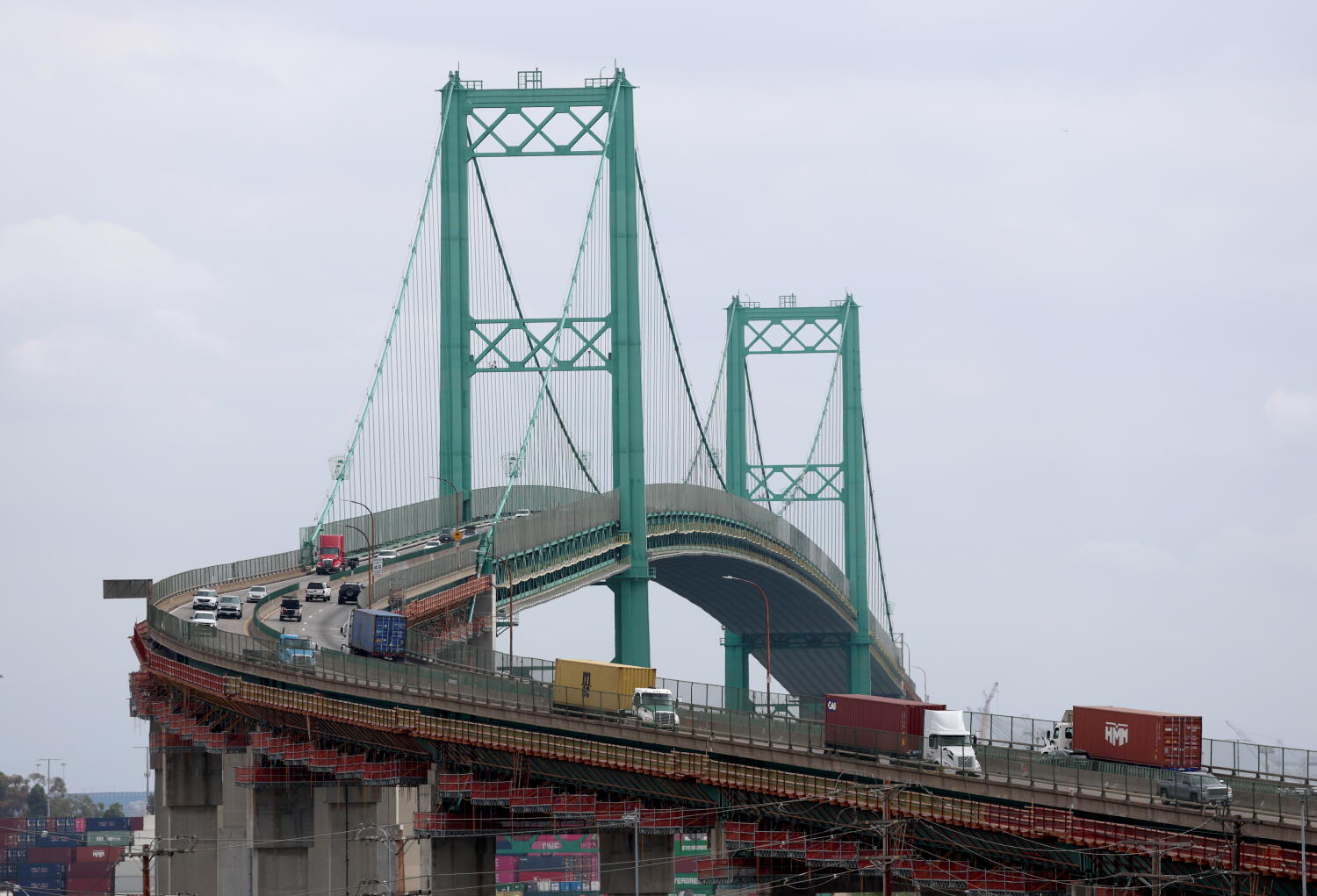
Shutting down the Vincent Thomas Bridge for sixteen months removes a primary arterial link between San Pedro and Terminal Island, forcing an immediate redistribution of freight and commuter volume across the Los Angeles harbor complex. When a critical node in a constrained transportation network fails or goes offline for scheduled maintenance, the resulting congestion does not distribute evenly. Instead, traffic follows the path of least resistance until secondary corridors reach saturation, triggering non-linear delays across the entire regional supply chain.
The closure of State Route 47 over the Main Channel of the Port of Los Angeles represents a classic network bottleneck problem. Built in 1963, the suspension bridge serves two distinct user groups with conflicting operational profiles: daily commuters moving between the Palos Verdes Peninsula, San Pedro, and Long Beach, and heavy-duty drayage trucks hauling containerized cargo between marine terminals and inland rail yards. Removing this 1,500-foot main span forces both cohorts onto a limited set of alternative routes, primarily the Harbor Freeway (I-110), the Long Beach Freeway (I-710), and surface streets running through Wilmington.
The Three Pillars of Harbor Network Vulnerability
To understand the operational fallout of a sixteen-month outage, one must evaluate the harbor transportation grid through three structural variables: capacity elasticity, modal friction, and detour geometry.
Capacity Elasticity
Highway corridors operate on a fundamental flow-density relationship. Under free-flow conditions, adding vehicles increases throughput linearly. Once traffic density crosses a critical threshold—typically around 40 to 45 passenger car equivalents per mile per lane—flow breaks down into stop-and-go waves, and actual throughput drops sharply. The alternative routes surrounding the Port of Los Angeles, specifically the I-110 and I-710 corridors, already operate near their saturation points during peak daytime windows. They possess virtually zero spare capacity elasticity to absorb displaced bridge volume without triggering systemic gridlock.
Modal Friction
Passenger vehicles and Class 8 drayage trucks exhibit vastly different acceleration, braking, and turning radii profiles. On the Vincent Thomas Bridge, grades and lane geometry separated local commuter flows from the heaviest industrial traffic heading directly into Terminal Island. Diverting both streams onto surface streets like Anaheim Street, Pacific Coast Highway, and Harry Bridges Boulevard introduces severe modal friction. Heavy trucks require longer gaps to merge and clear intersections, reducing the effective green-light capacity of signalized intersections for all adjacent passenger vehicles.
Detour Geometry
The physical layout of the San Pedro Bay port complex penalizes north-south and east-west cross-harbor movement when the direct water crossing disappears. Without the bridge, a trip from San Pedro to Terminal Island or Long Beach requires a horseshoe-shaped detour north around the West Basin and Cerritos Channel. This geometry multiplies vehicle miles traveled (VMT) for every displaced trip. Higher VMT directly increases fuel consumption, equipment wear, and exposure to secondary incidents, creating a compounding drag on regional mobility.
Operational Mechanics of the Deck Replacement
The sixteen-month timeline is dictated by the structural realities of rehabilitating a major suspension span while preserving its primary load-bearing cables and towers. Unlike routine resurfacing, a full deck replacement requires stripping the existing roadway down to the steel stiffening trusses and installing precast concrete or orthotropic steel deck panels.
- Dead Load Management: A suspension bridge maintains its geometric profile through a precise equilibrium between the tension in the main cables and the dead weight of the suspended deck. Removing large sections of the deck simultaneously causes the main cables to rise and the towers to deflect toward the anchorages. Engineers must sequence the demolition and installation in balanced stages to prevent structural distortion.
- Marine Clearance Constraints: The Vincent Thomas Bridge provides 185 feet of vertical clearance over the Main Channel to accommodate post-Panamax container vessels. Construction scaffolding, containment systems for lead paint removal, and under-deck travelers cannot infringe upon this navigational envelope without halting maritime commerce. Working above an active shipping channel restricts the size and weight of cranes and barges that can be staged below.
- Seismic Retrofitting Integration: Full deck replacement projects provide the only viable access window to upgrade hinge restrainers, dampers, and expansion joints deep within the superstructure. Executing these seismic upgrades concurrently with deck replacement prevents a second multi-month closure later in the decade, trading acute short-term disruption for long-term structural survival.
The Cost Function of Freight Displacement
For the maritime logistics sector, the closure alters the daily turn-time equation for drayage operators. Drayage drivers are typically paid by the load rather than by the hour, making turn times—the duration required to enter a terminal, pick up or drop off a container, and exit—the primary determinant of driver profitability and terminal fluidity.
When the Vincent Thomas Bridge closes, trucks moving between the San Pedro side of the port and terminals on Terminal Island or in Long Beach lose their direct connector. They must route north via the I-110 to the I-405 or traverse congested surface arterials through Wilmington to reach the Commodore Schuyler F. Heim Bridge or the Long Beach International Gateway Bridge.
This detour imposes three distinct costs on the supply chain:
- Turn-Time Degradation: A 15-to-25-minute addition to each leg of a drayage trip can reduce a driver's daily capacity from three container moves to two. Across a fleet of thousands of trucks, a 33 percent drop in daily turn capacity creates immediate container dwell issues at marine terminals.
- Chassis and Equipment Dwell: Slower drayage cycles tie up intermodal chassis on the road longer, reducing the pool of available equipment at marine terminals and inland warehouses. Equipment shortages cascade quickly, preventing cargo owners from retrieving time-sensitive freight even when terminal gates are open.
- Surface Street Deterioration: Wilmington surface streets were not engineered to bear sustained, diverted interstate-level freight volumes. Concentrated axle loads accelerate pavement rutting, pothole formation, and utility cover failures, necessitating emergency municipal road repairs that further constrict lane availability during the sixteen-month window.
Commuter Behavioral Adaptation and Braess's Paradox
Commuters crossing between San Pedro and Long Beach face a narrower set of routing choices than freight operators, yet their collective decisions will govern peak-hour travel times across the South Bay. Transportation economics relies on Wardrop's principles of equilibrium: drivers will continuously adjust their routes until travel times on all utilized paths between an origin and destination are equal, and no driver can unilaterally reduce their travel time by switching routes.
During the initial two weeks of the closure—the shock phase—network performance will degrade below equilibrium as drivers rely on outdated habits or follow consumer navigation apps that react slowly to hyper-local bottlenecks. Navigation algorithms frequently route traffic off congested freeways onto residential collector streets, overwhelming neighborhood intersections that lack synchronized traffic signals.
Once the network settles into a new user equilibrium, three behavioral shifts will absorb the displaced commuter demand:
- Temporal Shifting: Commuters with flexible schedules will depart earlier than 6:00 AM or delay trips until after 9:30 AM to bypass the peak congestion wave on the I-110 and Pacific Coast Highway. This flattens the peak-hour spike while extending the total duration of congested conditions across the day.
- Mode Substitution: A subset of commuters traveling between San Pedro, downtown Long Beach, and central Los Angeles will abandon single-occupancy vehicles in favor of express bus transit, ferry connections where available, or micro-mobility links paired with regional rail.
- Destination Substitution: Discretionary trips—retail, dining, and personal services—that previously crossed the harbor will contract locally. San Pedro residents will patronize businesses on the Palos Verdes Peninsula, while Long Beach residents will remain east of the Los Angeles River, depressing cross-harbor retail velocity for sixteen months.
Limitations of Mitigation Frameworks
Public agencies routinely deploy Transportation Management Plans (TMPs) during major infrastructure closures, incorporating signal timing optimization, expanded transit service, and ramp metering. Practitioners must recognize the hard physical limits of these interventions.
Signal synchronization along Wilmington arterials can improve progression for through-traffic, yet it cannot create physical asphalt where none exists. When intersection demand exceeds capacity, optimizing green-light splits merely redistributes delay from the main arterial to cross streets, trapping local residents trying to exit their neighborhoods. Similarly, expanding commuter bus frequency fails to attract drivers if those buses sit in the exact same mixed-flow traffic lanes as private automobiles. Without dedicated, physically separated bus-only lanes on the detour corridors, transit reliability degrades at the same rate as general traffic.
Nighttime and weekend port gate operations offer a theoretical pressure valve for freight, shifting truck volume out of commuter peak hours. However, extending terminal gate hours requires synchronized staffing across marine terminal operators, longshore labor, customs brokers, and inland receiving warehouses. If an importer's warehouse in the Inland Empire closes at 5:00 PM, a drayage driver picking up a container at 11:00 PM must store that container in an off-dock yard overnight, adding a double-handling fee that many shippers refuse to absorb.
Tactical Navigation and Logistics Protocol
Organizations and individuals operating within the San Pedro Bay influence zone must execute immediate structural adjustments rather than relying on ad-hoc daily routing.
For Logistics Managers and Beneficial Cargo Owners:
Audit all container routing instructions immediately to separate San Pedro-side terminals from Terminal Island and Long Beach facilities. Shift appointments for Terminal Island cargo to night gates (6:00 PM to 3:00 AM) wherever inland warehouse receiving schedules permit, eliminating daytime detour penalties. Update drayage rate tables to account for increased fuel burn and extended cycle times on cross-harbor moves, securing dedicated carrier capacity before spot rates spike during peak shipping seasons.
For Daily Commuters:
Abandon dynamic app-based routing during the first fourteen days of the closure, as algorithms will repeatedly trap vehicles in saturated Wilmington surface-street queues. Commit to a fixed northern detour via the I-110 and I-405, or shift departure times by a minimum of 45 minutes outside traditional peak windows. Employers with workforces crossing the harbor should institute staggered shift starts or hybrid remote schedules for administrative staff to remove non-essential vehicle trips from the corridor until the new deck opens.