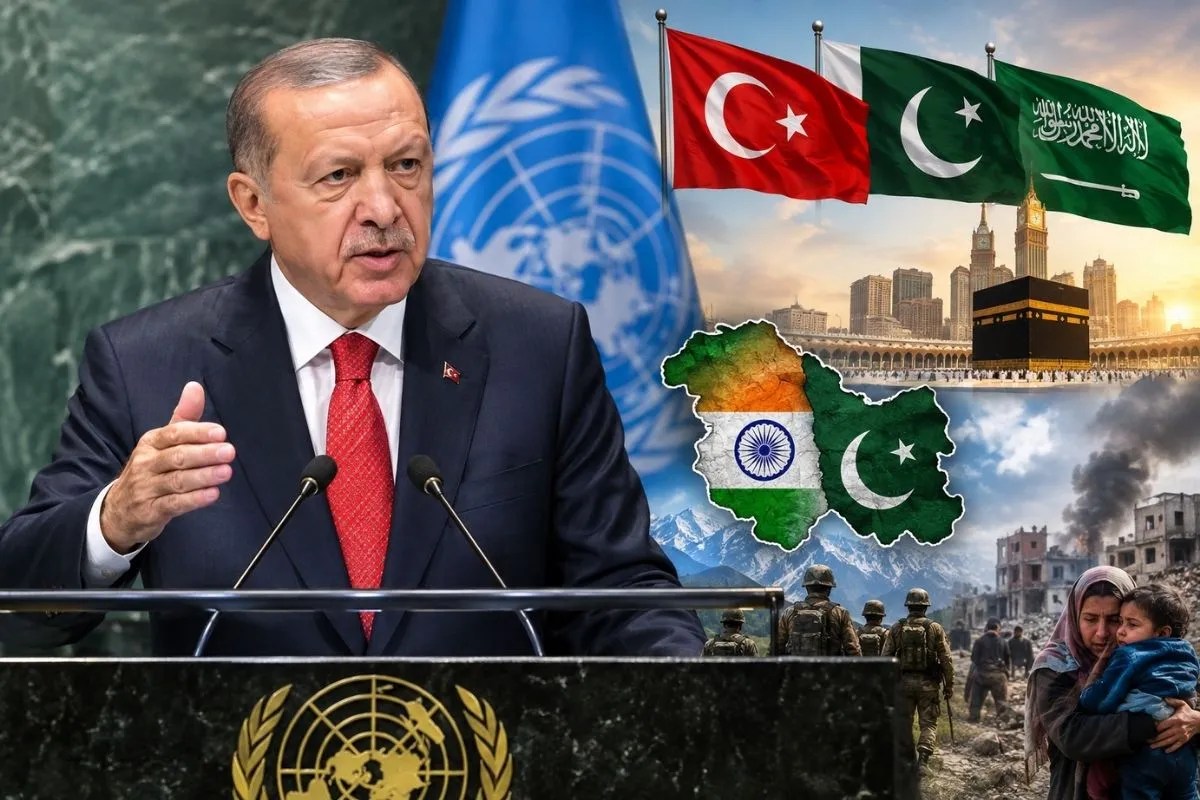
When Turkish President Recep Tayyip Erdoğan stepped onto the podium at the United Nations General Assembly, his rhetoric returned to a familiar yet intensified diplomatic script. Days after formalizing the Mecca Joint Defense Agreement alongside Saudi Arabia and Pakistan, Erdoğan revived the Kashmir dispute on the global stage, urging international dialogue over regional friction. New Delhi responded with immediate and unyielding dismissal, rejecting external interference in its sovereign territory and calling out Islamabad for cross-border terror. This convergence of a trilateral military pact and renewed UNGA rhetoric exposes a shifting diplomatic arithmetic across Eurasia, one that forces foreign ministries from South Asia to the Middle East to recalibrate old alliances.
Beneath the surface of standard diplomatic sparring lies a calculated realignment of middle-power ambitions and long-standing territorial disputes. Turkey has steadily transformed its foreign policy posture from a traditional Western-aligned security anchor into an assertive, autonomous actor willing to challenge established regional order. By intertwining its defense commitments with Pakistan and Saudi Arabia through the newly minted Mecca Pact, Ankara has provided Islamabad with a fresh diplomatic vehicle to internationalize a bilateral issue that New Delhi maintains is permanently closed. Understanding the true weight of these developments requires looking past the rhetorical noise of annual UN debates and examining the structural mechanics of the defense agreement itself. Learn more on a similar topic: this related article.
Anatomy of the Mecca Agreement
The text of the Mecca Joint Defense Agreement carries profound structural implications for regional security architecture. Signed by senior leaders in Saudi Arabia and later advanced through legislative channels in Ankara, the pact binds Turkey, Pakistan, and Riyadh into a formalized mutual defense framework. Article 2 of the sixteen-article agreement operates on a straightforward principle. An armed attack originating externally against any single signatory is treated as an aggression against all three.
Immediate assistance becomes mandatory under Article 51 of the United Nations Charter. Yet, execution requires consensus after consultations, filtering each state action through domestic constitutional processes. For Turkey, parliamentary sign-off remains mandatory before any overseas troop deployment, a legal constraint underscored during the ratification debate in Ankara's Grand National Assembly where lawmakers engaged in rigorous floor opposition before passing the enabling legislation. For Pakistan, the agreement offers a diplomatic shield and an expanded security umbrella that reaches well beyond South Asian borders. For Saudi Arabia, the arrangement represents a diversification of security partnerships in a volatile Middle East where traditional security guarantees face constant reassessment. Additional analysis by The New York Times highlights related views on the subject.
Critics often misinterpret the pact as a direct replica of North Atlantic Treaty Organization protocols. The reality is far more nuanced. It reflects an evolving transactional security market where traditional security architectures are augmented by flexible minilateral coalitions. States no longer rely on single superpower patrons. Instead, they weave overlapping bilateral and trilateral safety nets designed for specific regional contingencies without binding themselves to permanent ideological blocs.
The Mechanics of the Trilateral Pact
Diplomatic texts rarely emerge in a vacuum. The timing of the defense pact preceded Erdoğan's address at the United Nations General Assembly by mere weeks, establishing a direct operational link between military alignment and diplomatic posturing. When a head of state signs a binding mutual defense treaty with a nuclear-armed South Asian nation and an influential Gulf monarchy, subsequent international pronouncements carry weighted intent.
Pakistan has long sought external champions to internationalize the Kashmir dispute, attempting to drag multilateral bodies into a bilateral dispute governed by historical frameworks like the Simla Agreement. Ankara has willingly stepped into that advocacy role. By tying the defense pact's ratification timeline to high-profile diplomatic speeches, Turkish statecraft signals a deliberate alignment with Islamabad's core foreign policy narratives.
Military cooperation under the agreement extends far beyond mutual defense clauses. Intelligence sharing, joint exercises, counterterrorism coordination, and defense-industrial ties form the backbone of the pact. These elements provide concrete operational substance to what might otherwise remain a purely symbolic political declaration. Analysts examining procurement pipelines and military exercises must track how equipment transfers flow among the three capitals. Joint defense manufacturing initiatives could alter regional supply chains, especially given Turkey's growing drone and defense technology exports.
Logistical integration between nations with vastly different military doctrines presents severe operational hurdles. Standardization of communications, ammunition types, and command structures takes decades of deliberate effort, something a newly enacted parchment treaty cannot instantly solve. When nations span thousands of miles of distinct geographic terrain, operational coordination remains theoretical until tested by actual crisis conditions.
Ankara Foreign Policy Ambitions and Islamabad Calculations
Ankara pursues an expansive strategic footprint. Neo-Ottoman diplomatic ambitions drive Turkish foreign policy toward deeper involvement in regional disputes from the Eastern Mediterranean to South Asia. Championing causes popular within specific Islamic political constituencies allows Ankara to project leadership across the broader Muslim world while asserting autonomy from Western capitals.
Domestic political dynamics inside Turkey also shape this outward posture. Economic pressures at home require external diplomatic distractions and lucrative defense export contracts. Selling military hardware to partners across Asia and the Middle East generates revenue while cementing geopolitical influence. Defense manufacturing has become a pillar of Turkish economic strategy, making foreign military partnerships essential commercial ventures as much as strategic alliances.
Islamabad views this partnership through the lens of strategic parity and diplomatic reinforcement. Facing internal economic turmoil and ongoing security challenges along its western frontier, Pakistani leadership seizes upon any external diplomatic platform to challenge New Delhi's diplomatic dominance. Securing Turkish rhetorical backing at the United Nations General Assembly serves an internal domestic audience while attempting to keep international pressure alive on a territorial issue that India considers permanently settled.
Yet, this reliance carries inherent diplomatic risks. Aligning too closely with Ankara's aggressive diplomatic stances can complicate Pakistan's relationships with other regional powers that maintain strict bilateral partnerships with New Delhi. Diplomacy is rarely a zero-sum game without friction. Every diplomatic maneuver exacts a cost in secondary relationships, forcing foreign ministries to weigh short-term rhetorical gains against long-term strategic stability.
New Delhi Strategic Doctrine and Diplomatic Pushback
India maintains a disciplined and unyielding posture regarding external commentary on Jammu and Kashmir. Ministry of External Affairs officials respond swiftly to internationalization attempts, dismissing uninvited commentary as legally baseless and diplomatically irrelevant.
New Delhi's core doctrine rests on bilateralism established under historical accords, asserting that no third party possesses standing or jurisdiction to intervene in internal constitutional matters. When foreign leaders invoke United Nations resolutions from decades past, Indian diplomats point directly to persistent cross-border terrorism emanating from Pakistani territory as the primary impediment to regional stability. This counter-narrative frames the entire discussion around security and terrorism rather than territorial dispute, effectively shifting the terms of engagement on international platforms.
The economic weight of contemporary India further alters how foreign capitals calculate their rhetoric. Turkey remains an important economic partner in certain sectors, yet bilateral trade operates alongside sharp political disagreements. New Delhi separates commercial interaction from core security sensitivities, ensuring that political posturing at podiums in New York does not disrupt commercial realities on the ground, while simultaneously maintaining a firm red line against diplomatic encroachment.
Defense planners in South Asia evaluate the Mecca pact through a cold lens of military reality. While a trilateral paper agreement creates formal obligations, the practical military capacity for Turkey to project sustained conventional combat power into South Asia remains severely constrained by geography, logistics, and competing commitments in its own immediate neighborhood. Rhetoric at the United Nations podium costs nothing. Sustaining military intervention thousands of miles away requires logistics that few states possess.
The Broader Regional Fallout
Geopolitical realignments ripple outward. The inclusion of three distinct states in a mutual defense framework alters the calculus for neighboring governments who must navigate overlapping security spheres.
Gulf security dynamics are transforming rapidly. Saudi Arabia diversifying its defense partnerships away from exclusive reliance on Western capitals creates space for middle powers like Turkey to expand their footprint. However, this diversification introduces friction with other regional actors who view Turkish ambitions with deep suspicion.
The security architecture of the wider region grows increasingly complex. Multilateral minilaterals and defense pacts are replacing rigid Cold War-era blocs. States sign specific, targeted agreements tailored to immediate operational needs rather than broad ideological alignment, creating a fluid diplomatic environment where alliances shift depending on the issue at hand.
Watch the deposit of ratification instruments and the subsequent formation of the Strategic Political and Defense Committee secretariat. That institutional machinery will determine whether the Mecca pact becomes an active security anchor or remains a parchment alliance designed for diplomatic theater.