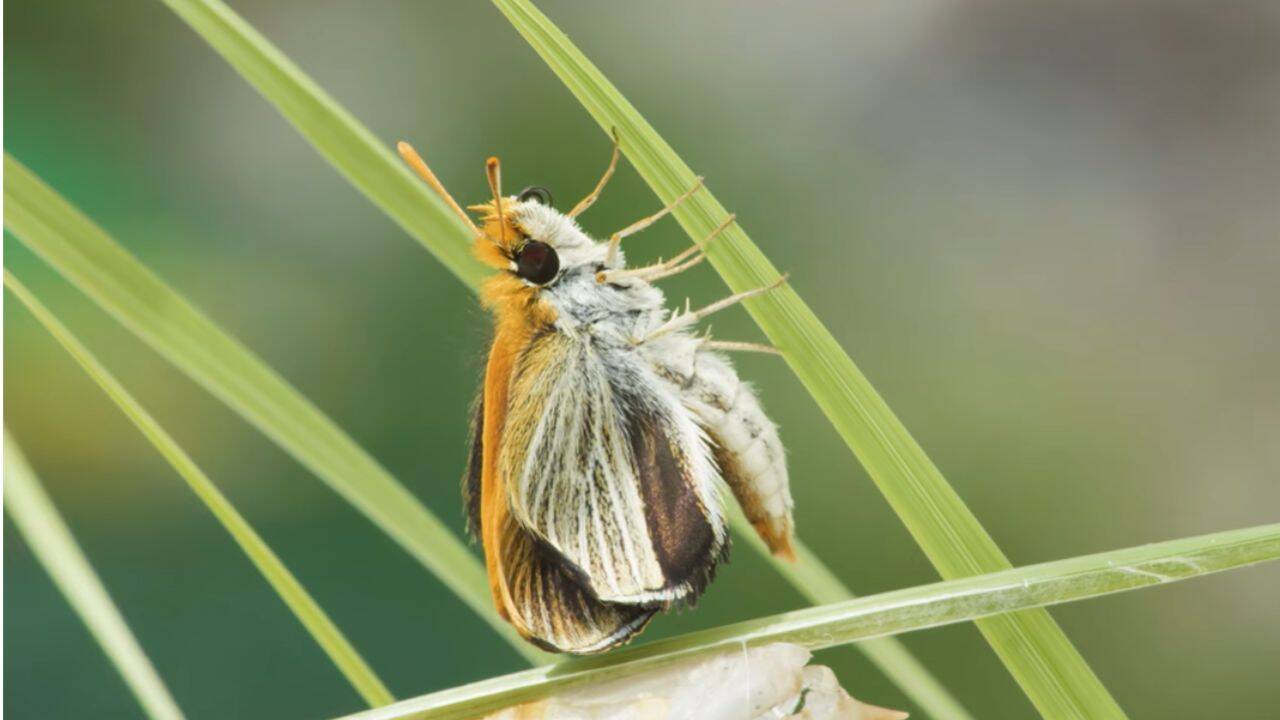
Species recovery programs routinely fail at the intersection of biological fragility and capital allocation, yet a rare operational success has emerged within specialized conservation engineering. By scaling captive population densities from a baseline low of nine documented wild individuals in the United States during 2022 to over 1,300 captive-reared releases by 2025, multi-institutional teams across Michigan State University, the John Ball Zoo, and federal agencies have demonstrated a functioning template for avoiding terminal extinction loops. This intervention moves beyond passive environmental protection into active biosecurity management, unpacking the precise operational variables required to transition an endemic insect from hyper-endangered status to managed population expansion.
The collapse of the Poweshiek skipperling followed a classic ecological attrition curve. Historically distributed across midwestern tallgrass systems from the Dakotas through Iowa to Michigan and southern Canada, the species experienced a near-total geographic compression by the early decades of the twenty-first century. Habitat fragmentation driven by agricultural conversion and hydrological disruption destroyed the micro-climates required for larval development. As wild populations dropped below minimum viable population thresholds, standard conservation frameworks—relying purely on legislation or passive reserve creation—became mathematically obsolete.
Reversing this trajectory demanded an operational pivot toward intensive ex-situ production. The primary bottleneck in butterfly conservation is not merely adult survival, but the extended larval lifecycle. Poweshiek skipperlings spend the vast majority of their existence as caterpillars, highly vulnerable to localized micro-climate shifts, parasitoids, and fungal pathogens. To bypass this natural mortality barrier, researchers engineered specialized hoop houses designed to replicate the extreme heat and humidity profiles of southern Michigan prairie fens.
This artificial environmental control shifts the survival probability function. In the wild, eggs and early-instar caterpillars face catastrophic attrition rates. Under managed laboratory and zoological protocols, the input-to-output conversion of viable pupae is artificially decoupled from ambient stochastic threats. At the height of the intervention, the total global population of the species was mathematically inverted: more individuals existed within controlled captive rearing facilities than survived across the entirety of the natural world. This ex-situ reserve acts as a biological hedge fund, protecting principal genetic stock against localized extinction events in native ranges.
Executing a transition from captive stock to wild release introduces complex logistical constraints. Reintroduction biology fails when organisms are dumped into degraded matrices without structural preparation. The Michigan recovery protocol addresses this through synchronized habitat rehabilitation and systematic post-release tracking mechanics. Prior to field deployment, individual specimens undergo light sedation and are marked using permanent ink identifiers, permitting field researchers to calculate dispersal distances, survival duration, and habitat utilization parameters across distinct prairie fen pockets.
The geographic concentration of remaining wild habitats within southern Michigan forms a unique structural advantage. Unlike linear ecosystems or vast continuous forests, Michigan's prairie fens represent isolated wetland patches cushioned by the moderating thermal mass of the Great Lakes system. This insular geography defines both the risk and the strategy. High isolation prevents natural recolonization from external regions, but it also creates finite, defensible perimeters where restoration capital can achieve maximum localized impact.
Deploying capital into these specific wetland matrices yields multiplicative returns. Restoration efforts directed at prairie fens do not merely benefit the skipperling; they stabilize co-dependent endemic flora and fauna, including other critically endangered lepidopteran assets such as the Mitchell's satyr and the Karner blue. The scaling trajectory—moving from 102 captive-reared releases in 2022 to more than 1,300 in 2025—reflects an operational learning curve where protocol refinement lowered per-unit rearing costs and increased post-release adaptation rates.
Evaluating the long-term viability of this intervention requires acknowledging inherent structural limitations. Captive breeding programs manage genetic bottlenecking and inbreeding depression, but they cannot permanently replace natural evolutionary selection pressures. Over-reliance on ex-situ propagation risks domesticated drift, wherein captive generations gradually lose behavioral or physiological adaptations necessary for unassisted survival. Mitigation requires that captive release programs transition rapidly from population rescue to population reinforcement, using newly established wild strongholds to restore natural gene flow channels.
To convert these isolated conservation victories into an enduring ecological asset class, resource allocators must prioritize three structural execution phases:
- Mandate continuous hydrological monitoring across all designated recipient prairie fens to protect micro-climate humidity against regional climate drift.
- Establish regional genetic pooling protocols between disparate captive facilities in Michigan, Minnesota, and federal laboratories to maintain allelic diversity across generations.
- Transition field monitoring from manual visual counts to automated telemetry and mark-recapture networks, ensuring real-time feedback loops for adaptive habitat management.