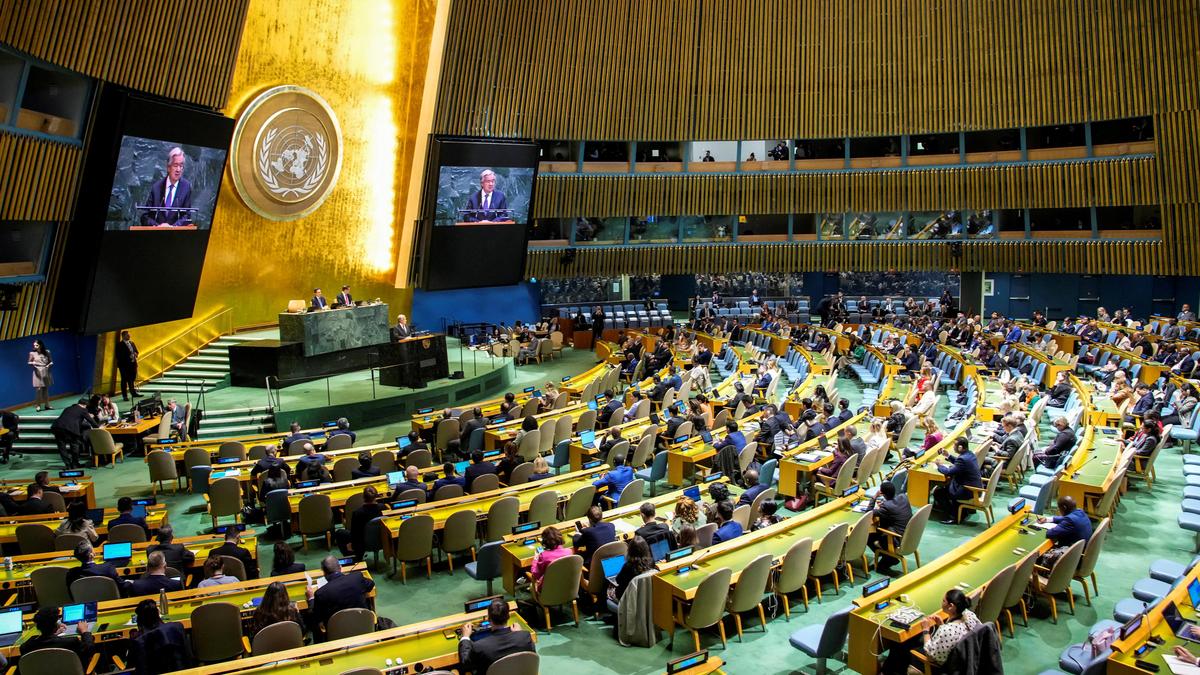
The selection of the United Nations Secretary-General (UNSG) is not a democratic election but a high-stakes diplomatic filtration process designed to find the "lowest common denominator" of Great Power interests. While Article 97 of the UN Charter provides the legal basis—appointment by the General Assembly upon the recommendation of the Security Council—the reality is governed by an informal, rigid hierarchy of veto power, regional rotation, and gender-based advocacy. The process functions as a multi-stage elimination tournament where the goal is to identify a candidate who is sufficiently competent to manage a global bureaucracy but not so assertive as to threaten the sovereignty of the Permanent Five (P5) members.
The Dual-Track Selection Framework
The selection logic operates on two distinct tracks: the Formal Constitutional track and the Informal Normative track. Understanding the friction between these two tracks explains why the most qualified global leaders often fail to secure the position.
1. The Formal Constitutional Track
The UN Charter grants the Security Council (UNSC) total gatekeeping authority. Because the recommendation is considered a "substantive" rather than a "procedural" matter, it is subject to the veto power held by the United States, China, Russia, France, and the United Kingdom. This creates a binary outcome: any candidate who is unacceptable to even one P5 member is immediately disqualified, regardless of overwhelming support from the rest of the 193 member states.
2. The Informal Normative Track
Over seven decades, a series of non-binding but politically potent norms have emerged to constrain the P5’s choice:
- Regional Rotation: To ensure global representation, the office generally rotates among five regional groups: Africa, Asia-Pacific, Eastern Europe, Latin America and the Caribbean, and Western European and Others (WEOG).
- Gender Parity: There is increasing systemic pressure to appoint the first female Secretary-General, as all nine previous incumbents have been male.
- The No-P5 Rule: By convention, a citizen of a P5 nation is never considered for the role to prevent the office from becoming a direct instrument of a single superpower.
The Strategic Filter Model
The path to the 38th floor of the Secretariat follows a three-stage filter. If a candidate fails at any stage, their campaign collapses.
Phase I: The Straw Poll Filtration
The Security Council conducts a series of "straw polls" behind closed doors. Members vote using ballots marked "encourage," "discourage," or "no opinion."
- Initial Rounds: These polls gauge general viability and force weak candidates to withdraw.
- The Color-Coded Poll: This is the critical inflection point. P5 members use colored ballots, while non-permanent members use white ones. A "discourage" vote on a colored ballot signals an impending veto. This is the moment where true power is exercised, often ending campaigns instantly without a public explanation.
Phase II: The Geopolitical Trade-off
The UNSC does not look for the "best" leader in a vacuum. They look for a candidate whose appointment satisfies a specific geopolitical equilibrium. For example, if the US and China are in a period of intense friction, they may gravitate toward a candidate from a neutral state or a "middle power." The candidate becomes a bargaining chip in broader negotiations involving unrelated files, such as climate treaties, trade disputes, or security alliances.
Phase III: General Assembly Ratification
Once the UNSC settles on a single name, it is passed to the General Assembly (UNGA). While the UNGA has the legal right to reject a candidate, it has never done so. Doing so would trigger a constitutional crisis between the two main bodies of the UN. Instead, the UNGA uses this stage to extract promises from the nominee regarding Secretariat appointments and budgetary priorities.
Determinants of Candidate Viability
Success in the selection process is rarely about a platform or a vision for the future. It is about "Acceptability Profiles."
The "Equal Distance" Requirement
A candidate must demonstrate that they can maintain equal distance from Washington, Beijing, and Moscow. Any perception of being "pro-Western" or "pro-China" is a disqualifier. This creates a structural bias toward candidates from countries with a history of non-alignment or specialized diplomacy, such as Portugal (Guterres), Ghana (Annan), or Austria (Waldheim).
The Bureaucratic Competency Floor
The candidate must have held high-level executive office—usually a Prime Minister or Foreign Minister. The P5 require a Secretary-General who understands the mechanics of statecraft and can manage a $3 billion core budget and a $6 billion peacekeeping budget. However, there is a "competency ceiling": a leader perceived as too charismatic or influential may be viewed as a threat to the P5’s control over the UN's political agenda.
Structural Bottlenecks and Reform Resistance
The primary criticism of this process is its inherent lack of transparency. Resolution 69/321, adopted in 2015, attempted to "democratize" the process by introducing public hearings and requiring candidates to submit vision statements. While this added a layer of public relations, it did not alter the underlying power dynamics.
The P5 resist fundamental reform for three reasons:
- Sovereignty Protection: The UN is a tool of member states, not a world government. A weak selection process ensures the Secretary-General remains a "Secretary" rather than a "General."
- Veto Utility: The veto is the ultimate insurance policy. No P5 member will voluntarily surrender their ability to block a hostile administrator.
- Institutional Continuity: The current system, while opaque, prevents the UN from becoming paralyzed by populist campaigns or ideological blocks within the General Assembly.
The 2026/2027 Strategic Landscape
As the term of António Guterres nears its end, the selection of the next chief will occur during the most fragmented geopolitical environment since the Cold War. Three specific pressures will dictate the outcome:
- The Eastern Europe Claim: The Eastern European Group is the only regional group that has never held the office. Russia previously insisted it was "their turn," but the war in Ukraine has complicated this. It is unlikely a candidate acceptable to both Russia and the NATO powers will emerge from this region, potentially breaking the rotation norm and shifting the focus back to Latin America or Africa.
- The Female Mandate: There is a near-universal consensus among the "1 for 7" campaign and other advocacy groups that the next SG must be a woman. If the P5 ignores this pressure, they risk a significant legitimacy crisis with the General Assembly.
- The Multi-Polar Veto: In previous decades, the US and Russia were the primary veto threats. Today, China has become an active gatekeeper, frequently using its influence to block candidates who have been vocal on human rights or who have close ties to Taiwan-friendly nations.
Strategic Forecast: The Consensus Path
The next UN Secretary-General will likely be a female leader from the Global South—specifically Latin America or a non-aligned African nation—who has extensive experience in multilateral finance or climate diplomacy. These "soft power" domains provide a safer neutral ground for P5 agreement than "hard security" backgrounds.
The successful candidate will not be the one with the most innovative vision for the 21st century. They will be the candidate who manages to survive the straw polls by remaining invisible enough to avoid a veto while being credible enough to satisfy the General Assembly’s demand for representation.
To predict the winner, ignore the public debates and "vision statements." Instead, monitor the bilateral meetings between the permanent missions of the P5. The name that eventually emerges will be the one that leaves no member state feeling as though they have lost. The office of the Secretary-General remains the world's most impossible job, precisely because the selection process is designed to ensure the incumbent never has enough independent power to make it possible.
Direct engagement with the Security Council’s rotating presidency in the year preceding the vote remains the only tactical move for a serious candidate. Public campaigning is for the audience; private assurance is for the appointment.