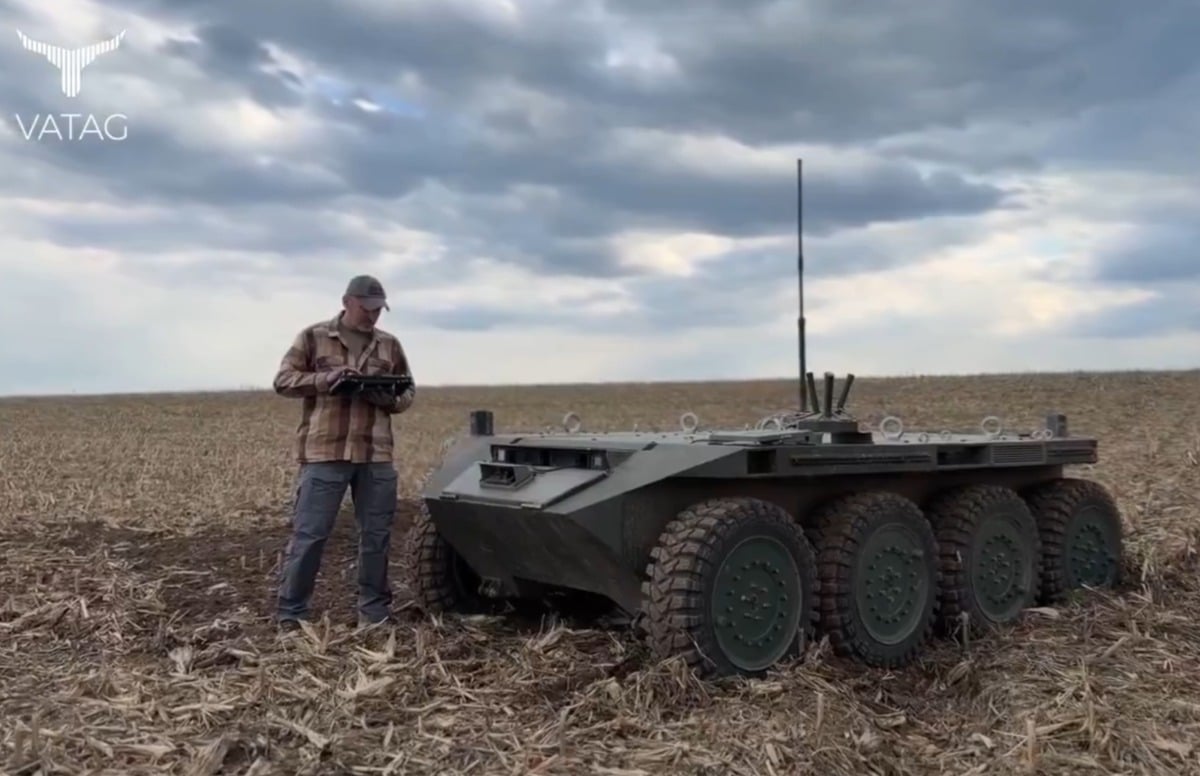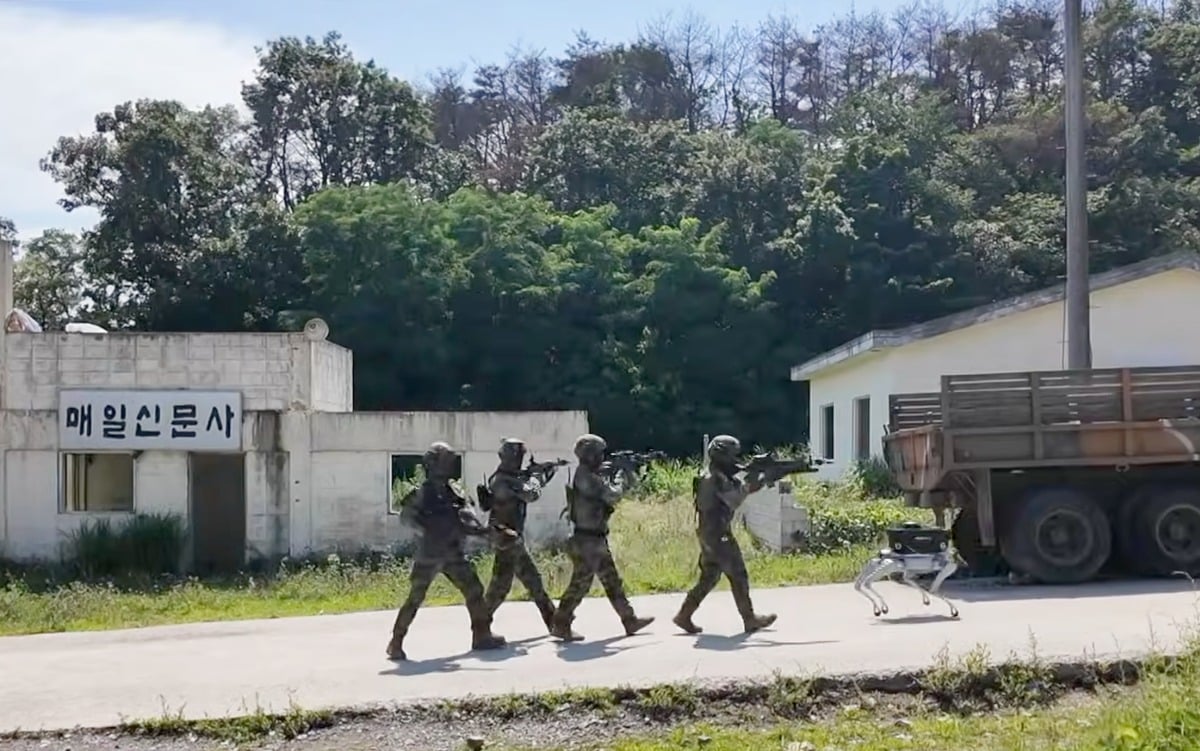
South Korea faces a structural crisis where demographic contraction directly threatens national defense architecture. The state's active-duty military personnel plummeted from 650,000 in 2020 to approximately 450,000 in 2026, with projections indicating a drop below 400,000 after 2030. This reality forces a transition from labor-intensive security models to capital-intensive, algorithmic defense networks. Recent exercises conducted by the Republic of Korea Marine Corps and Army units testing quadrupedal uncrewed ground vehicles (UGVs) and automated reconnaissance platforms reveal the operational friction points of integrating autonomous platforms into high-intensity infantry operations. Replacing human personnel with machines requires solving distinct engineering, logistical, and computational challenges.
The Mathematical Mandate of Force Attrition
The reduction of frontline General Outpost personnel from 22,000 down to a target of 6,000 demonstrates that tactical mass is no longer viable through human capital alone. To maintain defensive parity against an adversarial force that relies on raw volume, the replacement ratio requires one uncrewed ground platform to monitor or secure an operational envelope previously assigned to two or more human soldiers.
This structural shift introduces a performance equation governed by three variables:
- Area Exploitation Capacity: The square meters of rugged or hostile terrain a single platform can scan per hour without human intervention.
- Mean Time Between Mechanical Failure: The operational survival runtime of a robotic platform exposed to sub-zero temperatures, salt spray, and highly abrasive mountain soil.
- Cognitive Load Per Operator: The ratio of human supervisors to active deployed platforms. True efficiency occurs only when the ratio moves past 1:1 to a model where a single human operator monitors a cluster of automated assets.
The Mechanics of Quadrupedal Scouting on Point
During small-unit combat experiments, the deployment of quadrupedal systems (such as Boston Dynamics' Spot or Ghost Robotics' Vision 60 platforms) directly changes the risk allocation during hazardous clearing operations. In traditional close-quarters battle configurations, the point man experiences the highest probability of casualty when entering unmapped structures or dense cover.
[Human Command Unit] ──(Encrypted Radio Link)──> [Quadrupedal Platform]
                                                          │
                                         ┌────────────────┴────────────────┐
                                         ▼                                 ▼
                             [Thermal / Optical Arrays]       [LIDAR Topographic Mapping]
                                         │                                 │
                                         └────────────────┬────────────────┘
                                                          ▼
                                            [Threat Telemetry Stream]
When a quadrupedal platform walks point ahead of a marine stack, the risk profile shifts from human meatware to easily replaceable hardware. The platform executes structural penetration by running low-latency LIDAR and thermal imaging arrays, projecting a real-time three-dimensional map of the internal layout back to the unit’s tactical displays.
The value here is not found in science fiction concepts of fully automated lethality. The value is found in the physical mechanics of sensor positioning. By placing the primary multi-directional optical sensors on a low-profile, four-legged platform that can crouch, ascend debris, and crawl through sub-meter openings, the human squad gains an asymmetric informational advantage before crossing the threshold of an enemy fatal funnel.
The Transmission Bottleneck and Electronic Warfare
The primary technical vulnerability exposed during these real-world combat tests involves signal propagation in non-line-of-sight environments. Urban concrete, dense foliage, and mountain topography degrade high-bandwidth radio frequencies rapidly. A quadrupedal platform exploring an underground bunker or a concrete facility risks total command link disconnection.
To mitigate this operational failure mode, the military architecture relies on automated mobile communication relays. Wheeled mobility platforms, such as the Hyundai MobED system, function as mobile nodes that follow the forward scouting quadrupeds to the edge of the signal threshold. Once the signal degrades past a defined decibel limit, the wheeled relay stabilizes its position, establishes a high-gain directional link to the squad, and serves as an intermediary packet-routing hub.
This architecture creates a secondary vulnerability: the electronic signature. Active transmissions from these platforms produce a localized radio frequency footprint that enemy electronic warfare units can detect, localize, and target with indirect artillery fire within minutes. True survivability requires the implementation of narrow-beam directional communications or autonomous return-to-base subroutines that execute the moment a jamming field is encountered.
The Cost Function of Pervasive Deployment
The South Korean Ministry of National Defense outlined an aggressive procurement framework, aiming to train 500,000 personnel as drone operators and integrating tens of thousands of commercial and military-grade autonomous platforms by 2030. This strategy faces a stark economic reality. The cost function of deploying a massive fleet of uncrewed systems involves more than the initial acquisition price of the chassis.
The true operational expense structure scales along three axes:
Battery Chemistry and Thermal Constraints
Lithium-based battery systems degrade rapidly when subjected to the extreme seasonal temperature variances of the Korean Peninsula, where winters drop below -15 degrees Celsius. Low temperatures reduce battery discharge efficiency, cutting a platform’s operational timeline by up to 40 percent. This creates a massive logistical demand for field charging infrastructure, generator transport, and constant battery rotations in active combat zones.
Software Lifecycle Management
Autonomous navigation in dynamic environments requires constant software iterations to account for novel obstacles, camouflage, and adversarial deception techniques. Maintaining a unified code base across thousands of distributed platforms requires immense cloud infrastructure and secure over-the-air deployment mechanisms that are highly resistant to cyber intrusion.
The Maintenance Tail
Unlike standard wheeled transport vehicles, quadrupedal systems utilize high-precision actuators, multi-axis gyroscopes, and sensitive optical lenses. Mud, dust, and salt water accelerate mechanical wear. A force that replaces infantry with machines merely exchanges the casualty rate of combat troops for an expanded logistical footprint of technical repair teams and specialized component supply lines.
Architectural Standardization Over Hardware Novelty
The strategic path forward for the Republic of Korea Marine Corps requires abandoning the pursuit of bespoke, overly complex robotic platforms in favor of modular, commoditized architecture. The military must avoid the trap of buying closed-source proprietary systems that lock the armed forces into single-vendor ecosystems.
The immediate operational play demands the enforcement of a universal hardware-software interface standard. The chassis must be treated as a consumable utility, while the sensor payloads, communication modules, and automated target recognition software packages must remain entirely modular and easily swap-able in field conditions.
Units should prioritize simple, low-cost wheeled and tracked systems for basic transport and perimeter monitoring, reserving specialized quadrupedal units exclusively for specialized urban breaching and mine clearance missions. By decoupling the software intelligence layer from the underlying mechanical hardware, the military can rapidly iterate its algorithmic capabilities without waiting for slow, capital-intensive hardware procurement cycles.