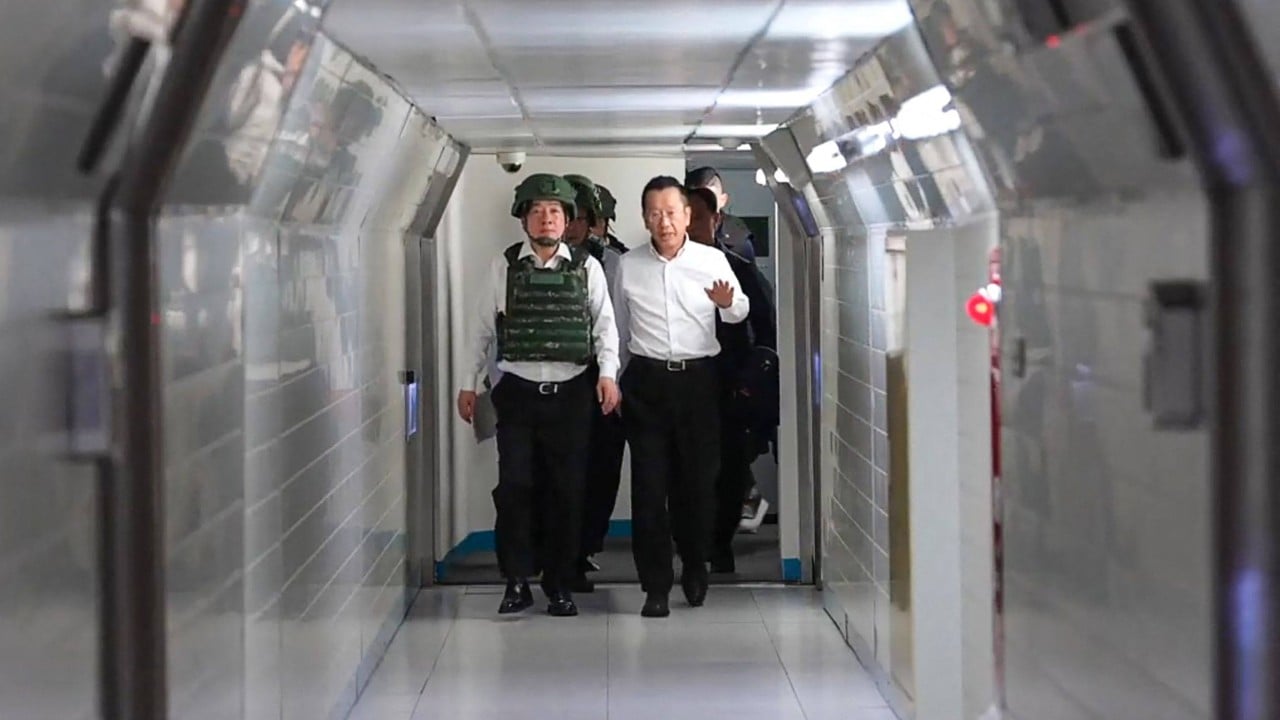
The probability of a military conflict across the Taiwan Strait is a function of capability, intent, and friction. Within this calculus, national leadership survival represents a critical operational variable. When Taiwan President William Lai executed a late-night evacuation drill during the Han Kuang exercises, sliding into a Clouded Leopard armored vehicle in tactical gear to test the Wan Chun Plan, the action was widely reported as a symbolic defense gesture. That interpretation mistakes tactical execution for structural design. The midnight mobilization protocol is a multi-layered test of command redundancy, interagency synchronization, and the mathematical limits of response time under asymmetric pressure.
Evaluating the architecture of a state's continuity of government requires examining three primary components: the spatial distribution of executive command, the latency of transmission channels, and the physical survivability of transit corridors.
The Vector of Executive Dispersal
A central vulnerability in any centralized political system is single-point decapitation. Modern precision-strike complexes, backed by satellite reconnaissance and long-range rocket artillery, dramatically shorten the temporal window between target identification and weapon impact. Against this threat, remaining static within a visible administrative core like the Presidential Office in Taipei creates an unacceptable risk profile.
The Wan Chun Plan shifts the executive baseline from a stationary target to a dynamic variable. By dispatching multiple convoys simultaneously—as executed during the recent night drill—security forces introduce deliberate confusion into an adversary's targeting matrix. This tactic operates on operational deception principles:
- Multi-vector dispatch splits surveillance attention across parallel routes.
- Armored personnel carriers provide ballistic and shrapnel protection against kinetic ambushes along urban corridors.
- Pre-designated underground command facilities, such as the Dazhi operations center, substitute vulnerable above-ground glass-and-steel architecture for blast-hardened subterranean infrastructure.
This structural relocation directly addresses the primary objective of an anti-decapitation strike: severing the link between political decision-making and military execution.
The Latency of Continuity Protocols
Moving a head of state is a trivial physical movement; preserving authority is an engineering challenge governed by communication latency. If a leader relocates to a secure bunker but loses encrypted, real-time data feeds to frontline units, the state effectively fragments into localized command cells.
The midnight drill measured the operational friction inherent in interagency coordination. The transition from the executive office to a subterranean command post demands the immediate safeguarding of digital networks, cryptographic keys, and secondary authorization channels. When leadership steps into a secure tactical vehicle, the communication node must simultaneously shift without dropping packets or introducing authentication vulnerabilities.
This establishes a strict operational trade-off:
- Mobility vs. Bandwidth: Highly mobile units face restricted workspace, reducing the volume of concurrent data streams a president can analyze.
- Security vs. Speed: Hardened encryption protocols add computational overhead, slowing down the dissemination of direct executive orders to field commanders.
By testing these protocols under nocturnal, low-visibility conditions, the military eliminates assumptions about digital handovers and tests the physical degradation of communication equipment under stress.
The Friction of Urban Asymmetry
Executing an evacuation through a metropolis like Taipei introduces high friction coefficients. Urban terrain is dense, elevation profiles vary, and choke points are fixed. An evacuation convoy must navigate narrow streets, elevated highways, and subterranean tunnels that are susceptible to structural blockage via conventional bombing or sabotage.
The integration of local defense elements—such as positioning mobile air defense units in public parks and adapting coast guard catamarans with tactical missile systems—serves an explicit logistical purpose. It denies the adversary uncontested airspace and sea lanes close to command nodes, widening the safety margin for the transit corridor.
The system's structural integrity depends on the synchronization of these auxiliary defenses. If coastal or air-defense layers fail to suppress initial kinetic strikes, transit corridors experience immediate bottlenecks, rendering armored mobility irrelevant against overwhelming localized fire.
Quantifying the Deterrence Dividend
Emergency mobility exercises do not prevent kinetic attacks; they alter the opponent's cost-benefit calculation. In strategic theory, deterrence functions when the anticipated cost of an action exceeds its expected utility. If an adversary calculates that a decapitation strike will achieve complete political paralysis, the threshold for aggression lowers.
When a government institutionalizes rapid-response evacuation protocols, it shifts the operational reality:
- The utility of a surprise kinetic strike drops toward zero because executive command immediately migrates to a hardened, decentralized network.
- The time window required to hunt a mobile target scales exponentially compared to striking a fixed coordinate.
- The state signals institutional resilience to both domestic populations and external allies, stabilizing macroeconomic expectations and defense cohesion.
The late-night deployment of armored transport is not merely a rehearsal for defeat; it is an active engineering of continuity designed to raise the enemy's operational friction to an unsustainable threshold.
Strategic Allocation of Defense Resources
[ Fixed Executive Core ] ---> ( Kinetic Vulnerability Window ) ---> [ Subterranean Redundancy ]
           |                                                                 |
           +-----------------> [ Mobile Decoy Convoys ] <--------------------+
To maintain this defensive posture without inducing economic friction, resource distribution must follow strict operational priorities. Capital expenditure must shift away from vulnerable, high-visibility platform acquisitions toward hardened command bunkers, redundant optical and satellite communication links, and decentralized regional supply depots.
Integrate civil-military fusion at the municipal level by embedding rapid-repair engineering units directly into urban infrastructure nodes. This minimizes transit corridor recovery times following localized infrastructure disruption. Prioritize software-defined cryptography over bulky hardware encryption systems to preserve bandwidth mobility inside moving command vehicles. Treat leadership survivability not as a detail of personal security, but as a critical node in national continuity engineering.