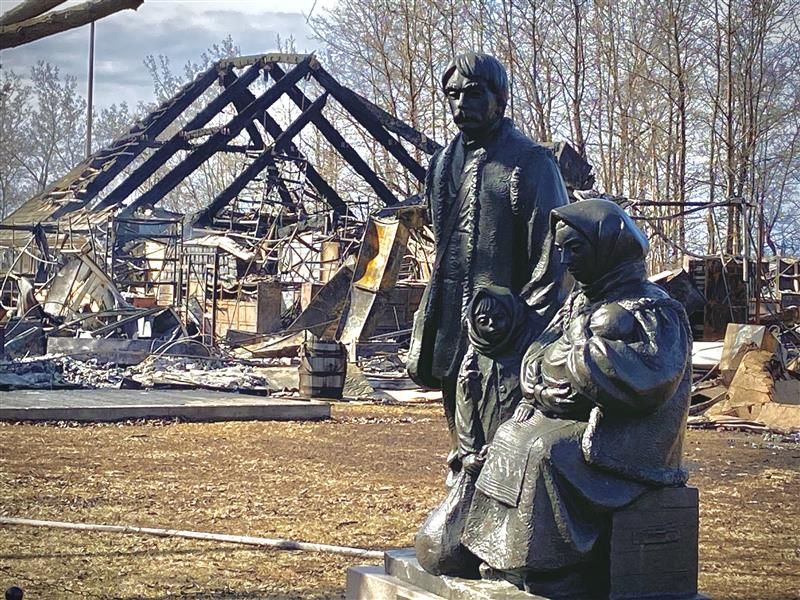
The gates are swinging open again, but do not look for the history that used to live at the entrance. Thirteen months after a ferocious, wind-driven grass fire tore through Lamont County and breached the perimeter of Alberta’s Ukrainian Cultural Heritage Village, the living history museum east of Edmonton has officially reopened to the public.
The immediate crisis has passed. On the surface, the story is one of classic prairie triumph over adversity. The province has approved a fully insured $14 million budget to rebuild. Staff are smiling, a temporary visitor reception structure is operational, and the museum directors are eager to welcome families back for the holiday weekend.
Look closer. The real narrative of the 2025 blaze is not about what was saved by the exhausted volunteer crews who fought the fast-moving wall of flames. It is about a permanent, crushing erasure of material culture that no amount of government funding or insurance payouts can ever replace.
While the site's iconic early 20th-century wooden churches, sod houses, and historic storefronts escaped unscathed, the modern heart of the museum was entirely obliterated. The fire targeted the visitor centre, the administrative offices, and the vital curatorial storage facilities. Inside those modern walls lay the vulnerable underbelly of the entire operation: the winter storage archive.
Approximately 27,000 irreplaceable artifacts were reduced to fine ash in a single evening.
The Midnight Ash of 27,000 Stories
To understand the scale of this loss, one must understand how an open-air museum functions. During the harsh Alberta winters, delicate items cannot remain inside unheated, historically authentic log homes and drafty pioneer buildings. Textiles rot. Antique furniture warps under frost-thaw cycles. Unique pioneer jewelry and hand-painted pysanky are targets for rodents or moisture damage.
Every autumn, curatorial teams meticulously catalog, pack, and transport thousands of pieces of material history into the modern, climate-controlled visitor centre for safe keeping. It was supposed to be a fortress. Instead, the April 18, 2025, fire turned that repository into a furnace.
Original clothing hand-spun in late 19th-century Galicia, immigration trunks that crossed the Atlantic in the 1890s, and rare early-settler tools vanished overnight. The loss extends far beyond physical objects; decades of original research papers, oral history transcripts, and field interviews conducted by the museum’s founding generations were burned out of existence.
Museum director David Makowsky noted that digital copies of research documents and artifact photographs exist for training purposes. This is a cold comfort. A digital file cannot replace the tactile truth of a century-old textile weave, nor can a database entry replicate the physical gravity of a family heirloom donated by descendants who broke the soil of east-central Alberta before it was even a province.
The Flaw in the Frontier Defense
The fire revealed a glaring vulnerability in how we protect decentralized heritage sites. This was not a forest fire high in the Rocky Mountains; it was a grass fire that started on a neighboring property, jumped Highway 16 during an afternoon of high winds, and moved too fast for the local infrastructure to handle.
Lamont County relies largely on volunteer and mixed fire crews. These men and women fought with immense bravery, standing between the advancing flames and the historic core of the village. Local farmers scrambled onto tractors, ripping firebreaks into the parched earth as wind speeds grounded provincial air support until the following day.
The site sat in a jurisdictional gray zone. Because the blaze occurred outside the provincial forest protection area, Alberta Wildfire was not immediately triggered to respond with heavy-duty initial attack resources. The defense fell squarely on municipal mutual aid.
While the tactical deployment successfully shielded the high-profile historic buildings, the loss of the administrative complex highlights a systemic failure to safeguard the infrastructure that keeps these volunteer-heavy operations alive. Without a central hub, the site was functionally dead for a year.
Rebuilding a Mirage
The province promises a fully restored, state-of-the-art visitor complex by 2028. The money is there. What will not be there are the artifacts that gave the original space its soul.
When visitors walk through the temporary entrance this summer, they will see costumed interpreters playing the roles of real Ukrainian pioneers from the 1920s. They will smell the woodsmoke and hear the livestock. It will look like the village has recovered.
It is a grand illusion. The interpreters will be working with replicated tools, looking at reproduced documents, and presenting a history that has lost its physical ballast. The Friends of the Ukrainian Village Society has launched an aggressive fundraising campaign, not just for structures, but to begin the exhausting process of sourcing new donations of period-accurate clothing, furniture, and tools from the dwindling collections of rural Alberta families.
The site reopens because it must. The living history community cannot afford to lose its audience, and the cultural footprint of the Ukrainian-Albertan diaspora remains a cornerstone of the province's identity. But the lesson of 2025 remains unlearned if we simply celebrate the return of the gates.
Built heritage is a fragile asset. Wooden monuments surrounded by dried prairie scrub are tinderboxes waiting for the next high-wind day in an increasingly dry climate. If provincial authorities do not overhaul the physical fire suppression infrastructure surrounding these open-air treasures—moving past simple grass cutting and into automated perimeter systems—the next fire will not stop at the visitor centre.
The 2026 season begins with a shadow over the prairie. Go for the perogies, listen to the stories, and support the interpreters who are keeping an identity alive. Just remember that the most important museum pieces you are looking at are the ones that are no longer there.
For a closer look at the immediate aftermath and the initial community reaction to the blaze, the Global News Alberta Heritage Site Fire Report provides localized broadcast footage from the ground during the early days of the assessment.