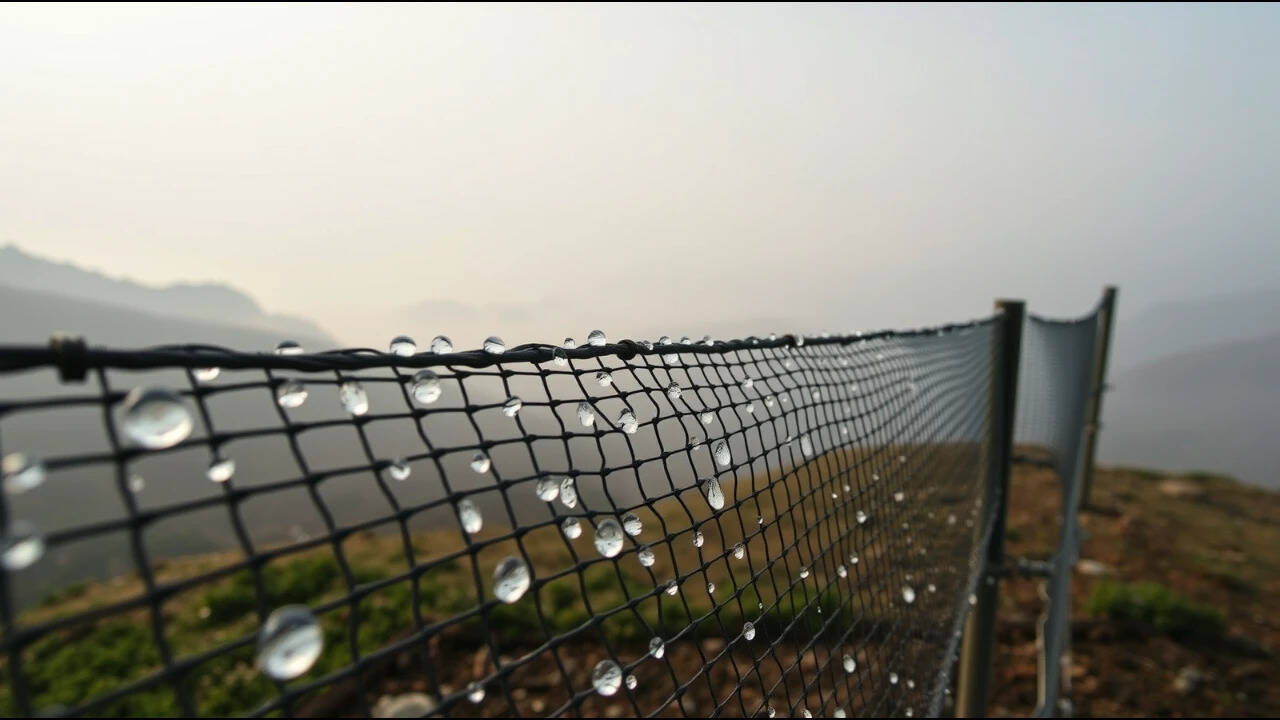
Freshwater scarcity in arid and semi-arid mountainous terrain is fundamentally an infrastructure distribution failure compounded by meteorological constraints. When maritime air masses rich in moisture encounter steep topographical barriers, adiabatic cooling forces water vapor to condense into suspended micro-droplets. Capturing this aerosolized water before it dissipates into the dry troposphere requires a distinct class of infrastructure known as fog collection systems. The deployment of these systems in the Anti-Atlas mountains of Morocco provides a case study in decentralized atmospheric water harvesting, but operationalizing the technology reveals strict physical boundaries that traditional water supply economics rarely account for.
The Thermodynamic and Meteorological Mechanics of Fog Harvest
Liquid water yield from fog is not a function of annual rainfall, but rather the intersection of wind velocity, liquid water content, and droplet size distribution. Fog persistence in high-altitude environments depends on stable atmospheric inversions that trap stratocumulus clouds against mountain ridges.
When designing an extraction grid, meteorological parameters dictate the theoretical maximum capture efficiency. The volume of water intercepted by a vertical screen is governed by the mass flux equation:
$$Q = E \cdot A \cdot v \cdot LWC$$
In this formulation, $Q$ represents the volumetric water yield, $E$ denotes the collection efficiency of the mesh material, $A$ is the total active surface area of the barrier, $v$ corresponds to the ambient wind speed passing through the installation, and $LWC$ stands for the liquid water content measured in grams per cubic meter.
Standard Raschel mesh nets, commonly deployed in these projects due to tensile strength and cost efficiency, typically achieve a collection efficiency between 20% and 30%. The primary technical hurdle involves the trade-off between mesh density and aerodynamic resistance. If the mesh is woven too tightly, air currents stall, creating a high-pressure zone upwind. This forces the moisture-laden wind to deflect around the structure rather than pass through it, rendering the collection surface obsolete. Optimal design requires balancing thread diameter, opening size, and porosity to allow continuous air mass penetration while maximizing droplet collision with the synthetic fibers.
Infrastructure Architecture and Structural Load Engineering
Deploying durable fog collection arrays in remote mountainous environments demands rigorous civil engineering. Unlike conventional flat land piping or subterranean well extraction, mountain ridges experience severe wind shear, UV degradation, and extreme temperature fluctuations.
The physical installation breaks down into three core components:
- The Interception Matrix: Dual-layer or single-layer polymer meshes suspended between vertical galvanized steel posts or reinforced timber anchors, elevated above the ground boundary layer to intercept unobstructed wind streams.
- The Drainage and Conduction Network: A system of high-density polyethylene gutters positioned directly beneath the lower edge of the mesh, designed to capture coalesced droplets via gravity drainage and channel the liquid without evaporative loss.
- The Gravity-Fed Transport Infrastructure: Sloped pipelines that transport raw water from high-altitude ridges down to lower-lying settlement cisterns, utilizing hydrostatic pressure to eliminate the need for electrical pumping stations.
Wind load calculations dictate structural survival. Because structural failure typically occurs at the anchor points due to torsional forces during high-altitude gales, cable-stayed stabilization networks are mandatory. These systems distribute dynamic wind loads across a wider footprint, protecting the structural integrity of the vertical posts.
The Economic Model and Cost-Yield Efficiency
Evaluating the economic viability of fog harvesting requires examining capital expenditure relative to volumetric output over a multi-year asset lifecycle. Traditional municipal water utilities rely on centralized capital investments with low marginal operating costs. Fog collection inverts this financial structure.
The capital expenditure concentrates on materials, transport logistics to remote sites, and manual labor for anchoring systems into rocky terrain. Operating expenditures remain low, consisting primarily of periodic mesh tensioning, structural inspections, and UV degradation replacements every decade.
However, the cost per cubic meter of water is volatile because yield is entirely dependent on climatic variations. During prolonged droughts or seasonal shifts in wind patterns, collection volumes drop while fixed capital costs remain constant. This introduces yield risk into decentralized water management. Planners must calculate the levelized cost of water by factoring in the standard deviation of historical fog days. If an installation operates below its nominal capacity factor for extended periods, the cost per liter spikes, making it less efficient than localized deep-well drilling or seasonal trucking, depending on local diesel and extraction costs.
Social Integration and Governance Models
Technical performance is frequently undermined by socio-institutional variables. Decentralized water assets require explicit community governance frameworks to prevent degradation and ensure equitable distribution. When a remote village shifts its primary hydration source from erratic truck deliveries to an automated mountain interceptor, the operational paradigm changes.
Community-managed water systems face three distinct administrative vulnerabilities:
- Maintenance Deficit: Without technical training, local users often fail to identify early signs of mesh sagging or gutter clogging, leading to progressive efficiency decay.
- Allocation Disputes: Because mountain ridges often sit on communal land used for extensive pastoralism, land-use agreements must be formalized to prevent grazing livestock from damaging collection piping or guy-wires.
- Quality Control Oversight: While atmospheric moisture is inherently pure, windborne dust, avian waste, and atmospheric pollutants can contaminate the collection mesh during prolonged dry spells before a precipitation event clears the air. First-flush diverters are necessary to automatically discard initial runoff until the collection surface is washed clean.
The Operational Frontier for Atmospheric Water Capture
Scaling fog harvesting beyond localized pilot initiatives requires moving past the artisanal phase of deployment into automated, site-optimized engineering. Future efficiency gains depend on material science innovations, specifically superhydrophobic and hydrophilic patterned coatings that accelerate droplet shedding and prevent clogging from organic matter.
Integration with Internet of Things telemetry allows real-time monitoring of wind vectors and yield metrics, shifting maintenance schedules from reactive repairs to predictive interventions. While atmospheric water collection cannot replace large-scale desalination or major watershed management for dense urban centers, it remains a structurally sound, energy-neutral intervention for high-altitude, fog-dense regions where conventional hydrological engineering is physically impossible or economically unviable.