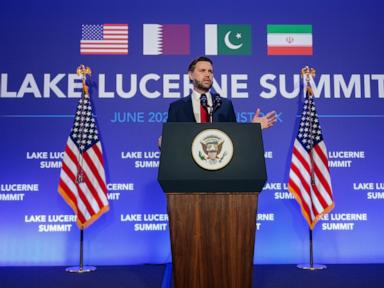
The diplomatic machinery has quietly shifted into motion in Switzerland. Vice President JD Vance confirmed that recent, unpublicized discussions between American officials and Iranian representatives have established what he termed a good foundation for a potential deal to avert wider conflict. While the public face of American foreign policy remains unyielding, these closed-door sessions indicate a pragmatic pivot. The administration is seeking a off-ramp before regional proxy conflicts escalate into an uncontrollable multi-front war.
For decades, the standard playbook for Middle Eastern diplomacy has relied on a predictable cycle of maximum pressure, economic sanctions, and fiery rhetoric. This approach has run its course. The current strategy relies on cold transactionalism rather than sweeping grand bargains. The Swiss talks are not about restoring old nuclear frameworks or forcing a cultural shift in Tehran. They are aimed at establishing strict, enforceable boundaries to prevent immediate miscalculations.
The Swiss Mechanism and Why It Matters Now
Neutral ground has a specific utility in geopolitics. By utilizing Swiss channels, both Washington and Tehran can bypass the domestic political theater that usually paralyzes direct engagement. These talks were not a sudden breakthrough. They are the result of months of quiet messaging managed by intermediary diplomats who possess the institutional memory that elected officials often lack.
The primary objective of these sessions is stabilization. The United States needs to secure shipping lanes in the Red Sea and reduce drone attacks on its regional outposts. Iran wants immediate, targeted relief from banking restrictions that have choked its domestic economy and fueled widespread internal dissent. This is a trade of concrete concessions. It is a calculated barter, stripped of ideological pretense.
The challenge lies in verification. Any foundational agreement built on a handshake in Geneva faces immediate sabotage back home. Hardliners in Tehran view any compromise with Washington as an existential betrayal. Meanwhile, domestic critics in the United States will inevitably frame these discussions as a capitulation to an adversarial regime.
The Regional Leverage Game
Diplomacy does not happen in a vacuum. While negotiators argued over text in Switzerland, tactical movements on the ground continued unabated. Iran has spent the last decade building a network of regional partners, a strategy designed precisely to create leverage for a moment like this. They will not dismantle this network for vague promises of future cooperation.
+------------------------------------------+
|          THE BARGAIN IN GENEVA           |
+------------------------------------------+
| U.S. Demands:                            |
|  - Cessation of Red Sea maritime attacks |
|  - Freeze on advanced enrichment levels   |
|  - Halt to proxy strikes on U.S. bases   |
+------------------------------------------+
| Iranian Demands:                         |
|  - Release of frozen oil revenues        |
|  - Partial lifting of banking sanctions  |
|  - Formal guarantees against regime change|
+------------------------------------------+
Western analysts often misjudge Iran's internal dynamics, treating the state as a single, ideological monolith. It is closer to a corporate board where competing factions vie for resources. The economic pressure from Western sanctions has hurt, but it has also created a thriving black-market economy controlled by the regime's security apparatus. These entities profit from isolation. Convincing them to accept a deal requires offering economic incentives that outweigh the lucrative benefits of the status quo.
The United States has its own leverage constraints. Washington is juggling multiple geopolitical priorities simultaneously. Resources are finite. The political capital required to maintain a permanent, high-alert military presence in the Middle East is draining attention from long-term strategic competition in the Indo-Pacific. A stabilized Middle East is not just a preference; it is a structural necessity for American grand strategy.
Deconstructing the Verification Dilemma
Trust is a liability in international relations. Any viable framework emerging from Switzerland must rely entirely on intrusive, objective verification mechanisms rather than goodwill. If the past decade has proven anything, it is that political agreements are highly fragile. A change in administration or a sudden shift in congressional leadership can instantly nullify years of careful negotiation.
Consider a practical example of how verification breaks down. A treaty might dictate that a specific banking facility is cleared for international transactions involving humanitarian goods. If a rogue financial entity uses that clearinghouse to move dual-use military components, the entire agreement collapses. The technical teams in Geneva are spending far more time on these granular, boring operational parameters than on the high-level political declarations that dominate evening news cycles.
Furthermore, the regional landscape has evolved beyond simple state-to-state agreements. Many decentralized actors operate with varying degrees of autonomy from Tehran. If a local commander fires a drone at a commercial vessel against direct orders from the capital, does that constitute a breach of the Swiss agreement? Defining the precise boundaries of state responsibility is the hardest problem currently facing the negotiating teams.
The Absent Players at the Table
You cannot build a lasting regional architecture while ignoring the neighbors. Israel and the Gulf states are watching the Swiss proceedings with deep skepticism. For Riyadh and Jerusalem, an American deal that merely freezes the current situation leaves them exposed to long-term risks right on their borders.
The Gulf monarchies have spent the last few years diversifying their geopolitical portfolios. They are no longer willing to outsource their security entirely to Washington. If they perceive the Swiss talks as an American attempt to execute a hasty exit from the region, they will accelerate their own independent diplomatic tracks with Beijing and Moscow. This shift would permanently diminish Western influence in the worlds most critical energy corridor.
Regional Reactions to the Geneva Framework:
- Israel: Deep skepticism; maintains the right to unilateral kinetic action.
- Saudi Arabia: Cautious interest; demands inclusion in long-term security protocols.
- Russia/China: Opportunistic observation; seeking to fill any security vacuum.
This reality leaves American negotiators on a razor's edge. They must offer enough concessions to keep Iran at the table without alienating traditional allies who possess the power to disrupt the agreement through unilateral military actions or economic shifts.
The High Price of Failure
If these foundational talks collapse, the alternative is not a return to the previous status quo. It is an immediate escalation. Without a diplomatic backchannel to manage friction, every minor border incident or maritime confrontation carries the risk of triggering a wider conflict.
The financial costs of a diplomatic breakdown would be felt immediately in global markets. A sustained disruption in the Bab-el-Mandeb strait or the Strait of Hormuz would send insurance rates for commercial shipping soaring, driving up the cost of everyday goods across Europe and North America. The domestic political consequences for the current administration would be severe.
Diplomacy is often an unappealing process of choosing the least disastrous option. The talks in Switzerland are not driven by a sudden burst of international idealism or a shared vision of global harmony. They are fueled by an urgent, mutual fear of the consequences of an unchecked regional escalation. The foundation has been laid, but building a structure that can survive the coming political storms remains a formidable challenge.