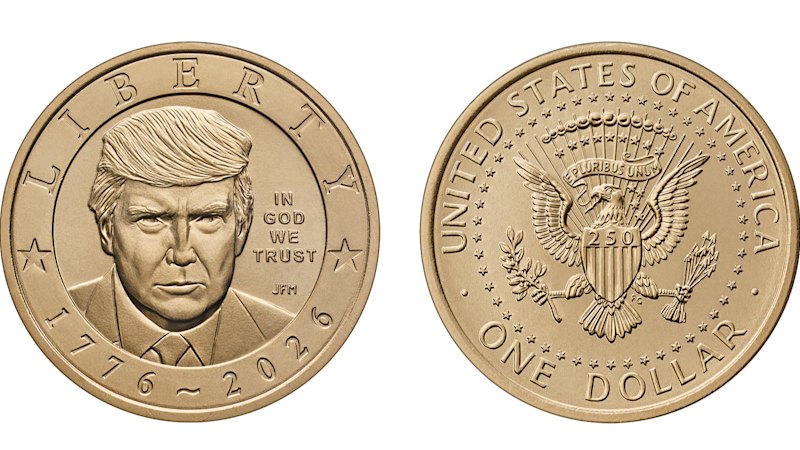
The United States Mint has officially begun striking a new commemorative $1 coin featuring the face of sitting President Donald Trump, bypassing a long-standing federal prohibition against depicting living individuals on American currency.
Announced by Treasury Secretary Scott Bessent on July 15, 2026, the coin is ostensibly part of the national celebrations for America’s 250th anniversary. Critics, however, view the gold-finished dollar as a highly calculated maneuver to reshape federal symbols. The decision has ignited a fierce legal and political debate over the boundaries of presidential self-commemoration and the exploitation of obscure statutory loopholes.
Inside the Mint
The coin rolling off the presses at the U.S. Mint is not quite what was originally envisioned.
Early design proposals reviewed by federal coinage committees featured highly dramatic imagery. One early draft depicting Trump on both sides of the coin had him raising his fist in front of an American flag. A later iteration approved by the U.S. Commission of Fine Arts in January showed him leaning forward over a desk with his fists clenched.
The final coin quietly approved for production is significantly toned down:
- The Obverse (Front): Features a head-and-shoulders portrait of Trump in a suit and tie, sporting a stern expression. It is ringed by the word "LIBERTY" and the commemorative years "1776-2026," with "IN GOD WE TRUST" placed near his likeness.
- The Reverse (Back): Displays the traditional bald eagle from the Great Seal of the United States, keeping the reverse side strictly standard to comply with specific legislative language.
- The Composition: Despite early administrative hopes for a 24-karat solid gold coin, the Treasury confirmed the final release is a base-metal coin with a "gold-like finish". It will be sold in rolls and bags directly to collectors this autumn rather than being pumped into general retail circulation.
The Treasury Department has declined to explain why the final design abandoned the more aggressive, desk-leaning posture in favor of a standard profile.
The Coolidge Precedent and Legal Gymnastics
At the center of this controversy is a seemingly ironclad law. Since the Civil War era, federal statute has barred the likeness of any living person from appearing on U.S. financial instruments. The Presidential $1 Coin Act of 2005 reiterated this, mandating that a president must be deceased for at least two years before their face can grace a dollar coin.
To bypass these hurdles, Treasury lawyers pointed to a bipartisan bill signed during Trump's first term: the United States Semiquincentennial Commemorative Coin Act of 2020.
This specific act authorized the Treasury to issue commemorative coins in 2026 to celebrate the nation's 250th birthday. Legal researchers within the Treasury argued that while the 2020 act explicitly bans any portrait—living or dead—on the reverse side of the coins, it remains silent on the obverse. This silence, they asserted, left a window wide open for the president’s face to appear on the front.
"During the 150th anniversary, there was a Calvin Coolidge coin, so we can put living presidents' images on a coin," Secretary Bessent argued in a recent interview, referring to the 1926 Sesquicentennial half-dollar that featured Coolidge alongside George Washington.
Opponents push back hard on this historical comparison. They note that the 1926 Coolidge coin was authorized by a specific, joint resolution of Congress explicitly designed for that occasion. The 2020 act, by contrast, contained no such explicit directive from Congress to honor the sitting president, making the current administration's interpretation an unprecedented stretch of executive authority.
A Broader Brand Offensive on Federal Systems
The new dollar coin does not exist in a vacuum. It is part of a broader, systemic effort by the administration to stamp the president's name, signature, and likeness onto the physical and financial machinery of the United States government.
In March, the Treasury Department took the unprecedented step of announcing that the president's signature would begin appearing on all newly printed paper currency. Historically, Federal Reserve notes carry the signatures of the U.S. Treasurer and the Treasury Secretary. Removing the Treasurer's signature to make room for the president's autograph represents the first structural change of its kind since 1861.
Simultaneous efforts to introduce a $250 paper banknote featuring Trump's face have stalled in Congress, as changing paper currency designs requires direct legislative amendments that lawmakers have refused to pass.
Beyond currency, the administration has aggressively sought to rename public works, federal sites, and military assets:
- The renaming of Palm Beach International Airport to President Donald J. Trump International Airport.
- An executive push to rename a new class of U.S. Navy battleships.
- The renaming of Southern Boulevard in Florida and the U.S. Institute of Peace.
- Attempts to rename the Kennedy Center, which have faced intense legal challenges from preservationists.
Congressional Backlash and the Monarchical Debate
The deployment of the U.S. Mint for personal branding has drawn sharp condemnation from congressional Democrats and even some independent-minded Republicans.
Sens. Elizabeth Warren, Jeff Merkley, Ron Wyden, and Catherine Cortez Masto have mounted a formal legislative campaign to halt the production of the coins. A bill introduced by Merkley and Cortez Masto seeks to retroactively clarify the 2020 coin act to explicitly ban the depiction of any living person on any commemorative coins struck by the Mint.
"While monarchs put their faces on coins, America has never had and never will have a king," Cortez Masto said in a statement, highlighting the deep-seated American discomfort with putting a active head of state on money.
Even some conservative lawmakers have expressed unease, viewing the move as an unnecessary distraction from serious monetary issues. Kentucky Representative Thomas Massie openly criticized the initiative, warning that the coin serves as a distraction from inflation and currency debasement while predicting that the gold-finished tokens will inevitably spawn a wave of cheap, unofficial imitations sold to unsuspecting collectors.
The administration remains undeterred by the pushback. With the dies already cast and production actively underway, the Treasury is moving quickly to ensure the coins are packaged and ready for sale before the autumn deadline. Whether the legislative opposition can pass a blocking bill before the first shipments leave the Mint remains highly doubtful, leaving the public to decide whether this gold-plated dollar represents a harmless patriotic keepsake or a troubling departure from republican traditions.