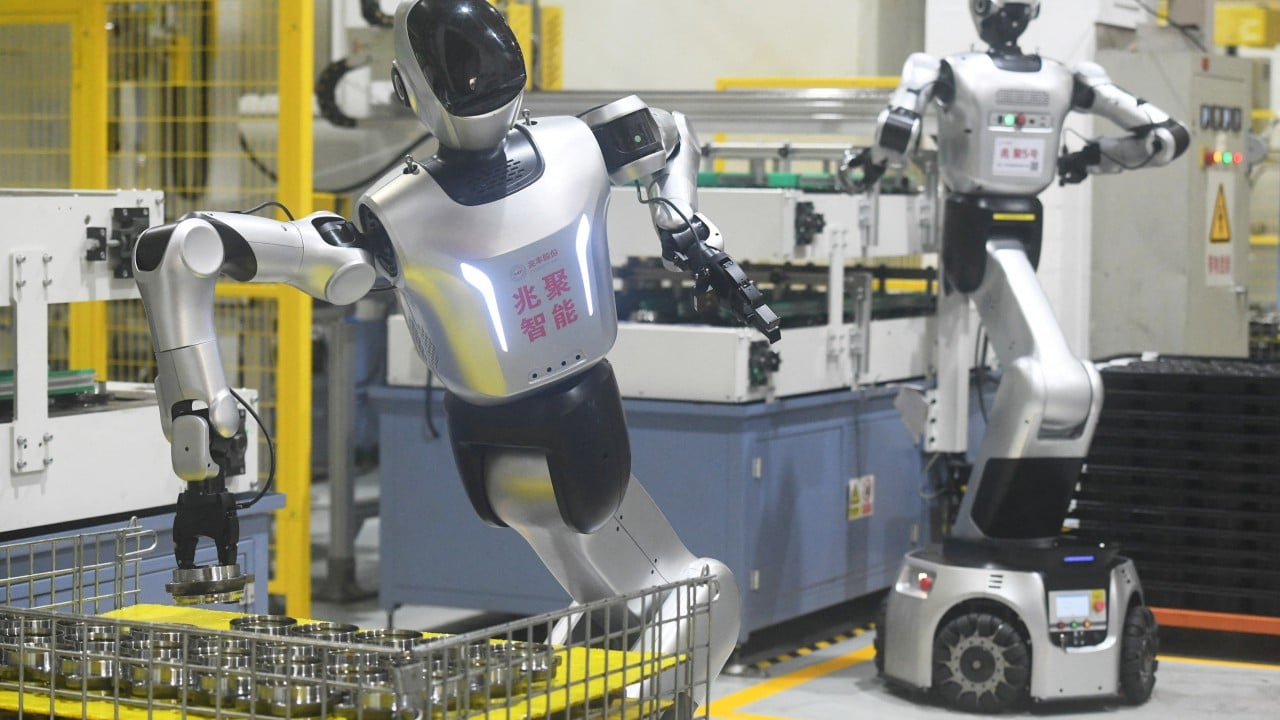
The pundit class has a brand-new favorite talking point. It goes something like this: Washington is shooting American industry in the foot by slapping tariffs, procurement bans, and national security restrictions on Chinese-made robotics, drones, and automated warehouse systems. Their logic sounds tidy on a podcast. American factories need cheap automation to compete with low-wage labor overseas, China makes the cheapest hardware, so blocking those machines means stranding US reshoring efforts on the starting line.
That argument is completely backwards.
If you actually walk factory floors instead of reading think-tank white papers, you quickly realize that slapping cut-rate, foreign-controlled hardware onto broken American supply chains doesn't save manufacturing. It hollows it out permanently. The lazy consensus treats industrial robots like commodity forklifts—dumb steel boxes you buy on price, plug into a wall, and forget about. In reality, modern industrial automation is a networked, software-defined nervous system. Handing the foundational hardware and telemetry layer of your industrial base to a geopolitical rival isn't "pragmatic reshoring." It is strategic surrender disguised as a CapEx discount.
The Commodity Hardware Fallacy
Let’s look at how modern factories actually work. Twenty years ago, an articulated robotic arm was a closed, air-gapped mechanical asset. You programmed a kinematic path on a teach pendant, hit start, and it welded the same door frame ten thousand times until a servo motor burned out. If a foreign manufacturer built that arm, the worst thing they could do was overcharge you for replacement gears.
Today, that mechanical arm is just an edge peripheral attached to a cloud-connected industrial control system. Whether we are talking about autonomous mobile robots (AMRs) navigating a fulfillment center, LiDAR-equipped inspection drones, or vision-guided collaborative robots (cobots), the real product isn't the aluminum chassis. It is the telemetry, the spatial mapping data, and the over-the-air firmware pipeline.
When a facility deploys fleets of low-cost foreign AMRs, those machines continuously ingest high-resolution 3D point clouds of the plant floor. They log throughput bottlenecks, inventory velocity, shift schedules, and physical layout changes. Those data streams frequently route back through vendor-managed cloud diagnostic servers for predictive maintenance and fleet orchestration.
I’ve sat in post-mortem meetings with mid-market manufacturers who bought cheap, imported automation cells because the upfront quote was 40% below Fanuc, ABB, or domestic integrators. Eighteen months later, they realized two brutal truths. First, their proprietary floor layouts and production cadences were sitting on external servers governed by foreign data-access laws. Second, when a firmware update bricked a critical vision sensor, the vendor’s support portal went dark during a holiday week, halting a $40,000-an-hour assembly line. You don't save money on cheap hardware when you lose control of your own uptime and intellectual property.
Why Subsidized Dumping Destroys Ecosystems
The critics complaining about US restrictions also conveniently ignore why certain imported robotics platforms are so cheap. It isn't superior engineering or miraculous supply chain efficiency. It is state-directed industrial policy designed to capture global market share by operating at unsustainable margins until domestic competitors bleed out.
We have seen this exact movie play out across multiple sectors:
- Solar polysilicon and panels: Aggressive state-backed overcapacity crushed Western manufacturers in the early 2010s, leaving the US scrambling to rebuild domestic capacity a decade later through massive subsidies.
- Commercial drones: DJI captured roughly 70% to 80% of the global commercial and prosumer drone market by offering high-spec hardware at prices Western startups couldn't touch without burning venture capital to ash. By the time Washington realized critical infrastructure agencies were flying foreign-made sensors over power grids and military bases, the domestic alternative ecosystem had been starved of scale.
- Telecom infrastructure: Huawei’s subsidized hardware became so deeply embedded in rural wireless networks that ripping and replacing it turned into a multi-billion-dollar logistical nightmare.
If the US allows subsidized foreign robotics and industrial actuators to flood American factories unchecked, the exact same sequence will happen to the domestic automation stack. American startups building next-generation machine vision, tactile grippers, and AI-driven motion control cannot achieve economies of scale if mid-sized US factories default to state-subsidized imports to shave 15% off their initial integration budget.
You Are Asking the Wrong Question About Reshoring
Whenever this debate flares up, the same predictable questions surface from operators and analysts alike. They all share a fatal flaw: they assume hardware purchase price is the primary bottleneck to American manufacturing competitiveness.
"Can US factories compete on cost without cheap foreign robots?"
This question fundamentally misunderstands industrial accounting. In a typical automation deployment, the raw robot arm or mobile base accounts for only 20% to 30% of the total installed cost. The remaining 70% to 80% goes toward systems integration, custom end-of-arm tooling, safety guarding, PLC programming, facility retrofits, and ongoing maintenance.
Cutting the price of the base robot in half reduces your total project CapEx by maybe 10% to 15%. Meanwhile, a single poorly documented software stack or incompatible fieldbus protocol can easily double your systems integration hours. I've seen companies blow millions trying to stitch bargain-basement robotic arms into legacy Rockwell Automation or Siemens architectures because the APIs were half-baked and the English documentation read like a ransom note. Real cost competitiveness comes from integration speed, reliability, and Mean Time Between Failures (MTBF)—not saving ten grand on an actuator.
"Doesn't restricting imports slow down the pace of factory automation?"
In the short term, yes, it creates friction. Procurement teams have to work harder, lead times for certain components stretch out, and CFOs have to approve higher initial line items.
In the long term, friction is the entire point. Without a protected demand signal, private capital will never fund domestic component manufacturing—things like harmonic drives, precision ball screws, high-torque servo motors, and industrial LiDAR sensors. Right now, the global supply chain for precision robotics components is heavily concentrated in Japan, Germany, and China. If the US wants an actual industrial renaissance rather than an assembly-only facade, domestic suppliers need guaranteed purchase orders from American defense, automotive, and logistics buyers. Restrictions force that capital back into the domestic ecosystem.
"Aren't allies like Japan and Europe already supplying the best industrial robots anyway?"
Yes—and notice that US restrictions aren't targeting Fanuc, Yaskawa, Kawasaki, KUKA, or ABB. The "Big Four" legacy robotics giants already dominate high-precision automotive and heavy industrial deployments in North America, and they build substantial engineering and manufacturing footprints right here in the US.
The bans and tariffs are surgical. They target specific high-risk categories: networked drones, port cranes (like ZPMC ship-to-shore cranes running remote cellular modems), autonomous mobile robots, and state-backed entrants attempting to undercut the market in warehouse logistics and light assembly. Framing targeted supply-chain security as a blanket "ban on robots" is pure rhetorical sleight of hand.
The Real Bottleneck Nobody Wants to Fix
If you want to know why American manufacturing struggles to scale automation, stop looking at customs tariffs and start looking at the shop floor.
The biggest obstacle to reshoring isn't a shortage of cheap robots. It is a catastrophic shortage of controls engineers, robotic technicians, and systems integrators who know how to keep automated lines running.
You can drop a warehouse full of brand-new, zero-cost robots onto a factory floor in Ohio tomorrow, and within six months, half of them will be sitting idle behind yellow safety fencing with red fault lights blinking. Why? Because mid-sized American manufacturers run on high-mix, low-volume production schedules. Unlike a massive Shenzhen electronics plant cranking out two million identical smartphone chassis a week, an American contract manufacturer might switch part geometries three times in a single shift.
Traditional industrial automation hates high-mix environments. Reprogramming path trajectories, swapping tooling, and recalibrating vision systems requires specialized engineering talent that most small and mid-sized enterprises (SMEs) simply cannot afford to keep on payroll. According to data from the Association for Advancing Automation (A3), North American robot orders routinely surge and stall not because factories ran out of things to automate, but because the integrator channel is completely maxed out.
Buying cheaper hardware from an adversarial nation does zero to solve the integration bottleneck. In fact, it makes it worse by flooding the market with non-standard software environments that stretch thin engineering teams even further.
What Smart Operators Are Doing Instead
If you run operations, engineering, or supply chain strategy for a North American manufacturer, waiting around for Washington to reverse course on trade policy is a losing strategy. The bipartisan consensus on decoupling critical industrial infrastructure is locked in. Here is how sharp operators are actually winning right now:
Standardize on Open, Hardware-Agnostic Software Layers
Stop letting hardware vendors lock you into proprietary fleet managers and closed control ecosystems. Deploy middleware platforms built on ROS 2 (Robot Operating System) or hardware-agnostic orchestration layers like Viam, Formant, or InOrbit. When your fleet management, telemetry, and path-planning logic live in a vendor-neutral software layer that you control, the underlying robot becomes a swappable commodity. If a vendor gets restricted, goes bankrupt, or hikes maintenance fees, you swap the hardware without rewriting your entire facility's codebase.Invest in AI-Driven Vision and No-Code Tasking Over Cheap Arms
Instead of hunting for discounts on mechanical arms, spend your CapEx on intelligent perception and adaptive control software. Companies like Covariant, Realtime Robotics, and Mujin are solving the real problem: enabling standard, reliable hardware from established allied vendors (like Fanuc or Yaskawa) to handle unstructured, high-mix tasks without weeks of custom motion programming. Paying full price for a bulletproof Japanese arm paired with AI-powered bin-picking software delivers a vastly higher ROI than buying three cheap, rigid arms that break every time a SKU dimension shifts by two millimeters.Adopt Robotics-as-a-Service (RaaS) to Preserve CapEx
If upfront hardware cost is genuinely blocking your automation roadmap, stop buying robots outright. Leverage RaaS models from domestic providers like Locus Robotics, 6 River Systems, or Formic. You shift automation from a massive upfront CapEx gamble into a predictable OpEx line item tied directly to throughput or uptime SLAs. More importantly, you force the vendor to bear the risk of hardware maintenance, software updates, and obsolescence.Demand Full Network Isolation and SBOM Audits
Treat every automated cell on your floor like a potential attack surface. Before signing any purchase order, demand a complete Software Bill of Materials (SBOM) from the vendor. Require all robot controllers, vision cameras, and AMRs to operate on strictly segmented VLANs with zero outbound internet access. If a vendor claims their robot "requires" a persistent external cloud connection just to function, walk away from the deal immediately.
The Uncomfortable Truth About Industrial Sovereignty
There is a real cost to building an independent, secure industrial base. Let’s be brutally honest about the downside of this approach: for the next five to seven years, automating an American factory will remain more expensive and logistically slower than it would be in a frictionless globalized market. Some marginal reshoring projects won't pencil out on a spreadsheet. Some companies will delay upgrades because domestic and allied supply chains are still scaling up capacity.
Accepting that short-term friction is the price of admission for long-term survival.
History is ruthless to nations that outsource the tools that make the tools. You cannot build a resilient manufacturing economy on top of black-box hardware controlled by a strategic competitor who views your supply chain as leverage. The pundits crying over banned robots are obsessed with saving pennies on today's balance sheet while mortgaging the sovereignty of tomorrow's factory floor.
Stop begging for cheap imports. Fix your integration bottlenecks, lock down your network architecture, and build an industrial stack you actually own.