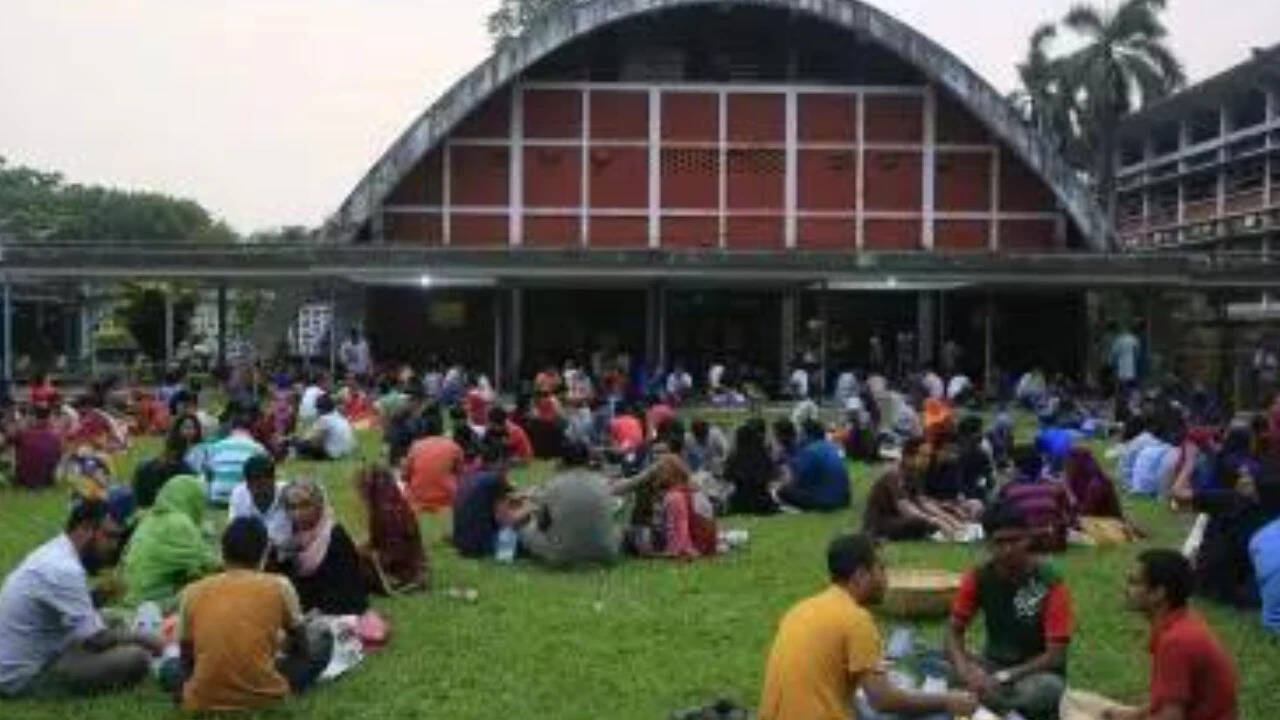
In September 2026, the quiet corridors of Dhaka University turned into a battleground over a set of museum portraits. A handful of frames inside the Dhaka University Central Students Union (DUCSU) archive sparked immediate fury, student protests, physical destruction of property, and a panicked institutional retreat. The trigger was deceptively simple: the sudden appearance of photographs featuring Muhammad Ali Jinnah, the founder of Pakistan, and references to former Jamaat-e-Islami chief Ghulam Azam. To the casual outside observer, it looked like standard campus theatric rage over historical memorabilia.
Look closer, and the incident exposes deep structural fractures in a post-authoritarian South Asian state struggling to define its national identity.
When the DUCSU museum reopened after renovations, curators included historical artifacts documenting different eras of the campus, including items tied to Jinnah's controversial 1948 speech advocating for Urdu as the sole state language. Within hours, student leaders smashed the frames, dragged the portraits across the concrete floor, and plastered alternative imagery—such as photographs of Ghulam Azam being humiliated by crowds in 1981—across the entrance. The university administration scrambled to form inquiry committees, caught flat-footed in a political climate where every single symbol is treated as an existential threat or a calculated provocation.
The underlying crisis at Dhaka University is not about framed pictures. It is about an ongoing war over historical memory in a country that recently threw off a long-standing regime, leaving a dangerous vacuum where various political factions are fighting to write the definitive narrative of the nation's genesis.
The Anatomy of a Campus Flashpoint
To understand why a portrait of a long-dead Pakistani leader can instantly paralyze a major university, one must understand the sacred geography of Dhaka University. Historically, this institution was the incubator for Bengali nationalism. It was the cradle of the 1952 Language Movement and the staging ground for the intellectual resistance that culminated in the 1971 Liberation War.
For decades, the official state narrative rested on a specific foundation centered around the War of Independence and the legacy of secular nationalism. When the previous political order collapsed, it created a sudden opening for multiple groups—ranging from radical student wings to resurgent right-wing factions—to test the boundaries of what is permissible in public spaces.
The inclusion of Jinnah and Azam materials in the archive was defended by some student union representatives as an objective archival choice meant to document every chapter of history, including the opposition to Bengali autonomy. But in practice, historical neutrality is a luxury that fragile transitional democracies cannot afford. To the students whose peers fought and died to break away from Pakistan in 1971, displaying Jinnah without immediate, explicit condemnation is not archiving. It looks like rehabilitation.
An archivist operating in a stable democracy might argue that historical records should include figures who opposed the nation's founding. Bangladesh in 2026 is not operating under normal conditions. The wounds of the 1971 genocide, perpetrated by the Pakistan military and local collaborators like the Razakars, remain raw. When figures associated with that dark history reappear in a student union building without sufficient contextual framing, it triggers an immediate immune response from the student body.
The Weaponization of Memory
The reaction of the student groups was swift and brutal. By tearing down the portraits, stomping on them, and replacing them with historical evidence of public disgrace—like the famous photograph of Ghulam Azam being beaten with shoes—the protesters engaged in a counter-ritual of purification.
This is the core mechanism of revolutionary periods. When institutional authorities lose their monopoly on legitimacy, physical spaces become battlegrounds for symbolic dominance.
The university administration's response laid bare a profound lack of institutional backbone. Instead of clearly articulating a curation policy or standing by the museum's educational mandate, the authorities immediately buckled under pressure, setting up multiple investigative committees and distancing themselves from the renovation choices. This appeasement strategy rarely works. It signals to every radical faction on campus that aggressive disruption is the most effective tool for policy change.
The controversy also exposed deep divisions among student political organizations. Left-leaning student groups, nationalist factions, and Islamist-affiliated student wings are currently locked in a fierce zero-sum game for ideological supremacy. Each faction accuses the other of trying to smuggle revisionist history back into the mainstream curriculum.
The Danger of Institutional Paralysis
The fallout at Dhaka University carries severe implications for the broader intellectual landscape of the country. When universities become paralyzed by fear of offending the political sensibility of the week, open academic inquiry dies.
History is messy. It contains figures who were villains to the Bengali nation, yet studying their actions and the mechanisms of their opposition is vital for understanding how authoritarian systems consolidate power. However, when the administration outsources its curation standards to mob dynamics and street-level ultimatums, nuanced historical analysis becomes impossible. Either history is sanitized into state-approved propaganda, or it becomes a minefield of explosive symbols where no one dares to research or teach difficult truths.
The university should be the one place where society can confront its traumatic past with rigorous, clinical precision. Instead, Dhaka University's recent museum fiasco shows an institution running away from its own shadows.
Until the university leadership establishes transparent, ironclad guidelines for historical preservation—and defends them against populist outrage from any political direction—campuses will remain vulnerable to constant destabilization. Every portrait hung on a wall will be scrutinized not for its educational value, but as a potential declaration of ideological war.
The frames at the DUCSU archive may be empty or replaced now, but the underlying panic remains entirely unaddressed. A nation that cannot calmly confront the physical tokens of its own painful genesis is bound to watch history repeat itself in the very halls meant to study it.