The wind off the English Channel doesn't care about modern politics. It blows cold, salty, and relentless, carrying the exact same bite it did eighty-odd years ago when thousands of terrified young men tumbled out of landing craft into a hail of lead. Today, Omaha Beach is a place of profound, heavy silence. The sand is soft. The waves lap gently against the shore. Yet, when you stand near the monuments, looking out over the endless rows of white marble crosses at the American Cemetery, you can almost hear the echoes of the past.
For decades, this sacred ground in Colleville-sur-Mer, France, served a singular purpose. It was a monument to shared sacrifice. It stood as a physical manifestation of a time when nations set aside their differences to crush a global nightmare.
Then came the anniversary. And with it, a shift that left many onlookers feeling a sudden, sharp chill that had nothing to do with the ocean breeze.
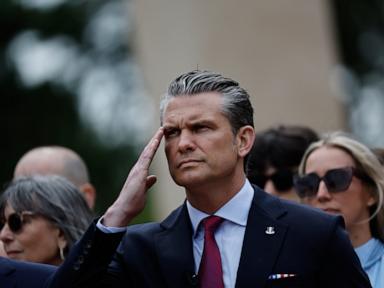
Pete Hegseth, the former Fox News host turned political figure, stood in Normandy and looked at the same bluffs the Allied forces scaled in 1944. But where generations of leaders saw a historical triumph of liberation, Hegseth saw a modern warning track. He chose this specific backdrop—a place built on the blood of international cooperation—to deliver a speech that recontextualized the entire landscape of Western identity. He didn't just honor the dead. He invoked the language of borders, immigration, and what he termed an ongoing "invasion."
The contrast was jarring. It was a deliberate collision of historical reverence and contemporary culture war.
Echoes on the Bluffs
To understand why this moment reverberated so loudly across the Atlantic, you have to look at the setting itself. Normandy is not just a destination for history buffs or tourists ticking boxes on a European itinerary. It is a secular cathedral.
Imagine an elderly veteran sitting in a wheelchair on the grass, his medals clinking softly as he shivers. He remembers the water turning red. He remembers the boy next to him, who never made it past the tank traps, crying out for his mother. For that veteran, and for the millions who visit each year, D-Day represents the ultimate defense of freedom against tyranny. It is an outward-facing story. It is about crossing an ocean to save people you have never met.
Hegseth turned that story inward.
Standing before an audience gathered to remember the breaking of nations, he pivoted sharply to the internal anxieties plaguing the West today. He spoke of demographic shifts. He spoke of weakened borders. By using the word "invasion"—a term intrinsically tied to the military operation of June 6, 1944—to describe civilian migration patterns in the 21st century, he flipped the script.
The linguistic choice was calculated. It weaponized the memory of a literal military assault to sound the alarm on a cultural and political shift.
The Words We Choose
Language has weight. In a place like Normandy, every syllable drops like an anchor.
Consider what happens when the terminology of total war is applied to peacetime policy debates. When a military invasion occurs, the response is simple: total mobilization, violence, and the destruction of the enemy. It is a matter of survival. By overlaying that specific, high-stakes framework onto the complex, bureaucratic reality of global migration, the conversation changes instantly. It ceases to be a debate about economics, infrastructure, or humanitarian duty. It becomes a battle for existence.
That was the underlying current of Hegseth's address. He wasn't just giving a speech; he was re-anchoring the conservative movement's core grievances to the most revered military milestone in American history.
The reaction from historians and attendees was split by a predictable, yet painful, ideological chasm. To his supporters, Hegseth was speaking an uncomfortable truth on a grand stage, drawing a direct line from the bravery of the greatest generation to the modern fight to preserve Western civilization. To his critics, the speech was a desecration. It was viewed as an attempt to hijack a universal symbol of anti-fascist unity and mold it into a partisan tool for isolationism and anti-immigrant sentiment.
The debate isn't just about what happened in France. It is about who owns the narrative of our past.
A Divide in the Soil
The true friction lies in how we view our obligations to history.
One philosophy views the sacrifices of D-Day as a permanent commitment to global engagement. It suggests that because those men died to liberate Europe, America and its allies must remain deeply intertwined, defending democracy wherever it is threatened and keeping doors open to those fleeing oppression. It is a expansive view of history, one that looks out at the horizon from the Normandy cliffs and sees a connected world.
The other philosophy, channeled by Hegseth on that windy day, looks at those same graves and sees a legacy under siege from within. This perspective argues that the freedom bought at such a high price is being squandered by open borders and globalist ideals. From this viewpoint, the ultimate way to honor the dead is to fortify the homeland, to pull back, and to protect the specific culture they left behind.
This isn't a minor disagreement over policy. This is a fundamental divergence on the meaning of America itself.
As the sun began to set over the English Channel, casting long, dark shadows across the rows of crosses, the crowd dispersed. The politicians and commentators moved on to the next news cycle, taking their arguments back to the television studios and legislative chambers.
But the graveyard remained. The thousands of white stones stayed perfectly aligned, silent witnesses to a shifting world. The tide came in, washing away the footprints of the day's visitors from the sand below, leaving the beach completely blank, waiting for whatever history decides to write upon it next.