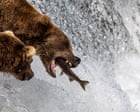
Millions of office drones are sitting in ergonomic misery watching fat bears eat salmon in Alaska, pretending they are participating in nature conservation.
Let us get one thing straight. Nobody is watching the Katmai National Park bearcam because they care deeply about ursid biology. They are watching because staring at a 900-pound brown bear inhale sockeye salmon for six hours straight is the only socially acceptable form of psychological dissociation left to the corporate workforce. Learn more on a similar topic: this related article.
The media narrative surrounding the annual Fat Bear Week phenomenon is aggressively lazy. Articles pop up every autumn treating the livestream like a heartwarming community victory garden. We are told it is a wholesome window into the wild, a testament to conservation triumphs, a digital campfire bringing humanity together to celebrate chunky wildlife.
It is a coping mechanism. Additional analysis by Vanity Fair delves into similar views on this issue.
The Comfort of the Apex Predator
To understand why the bearcam prints massive traffic numbers while productivity metrics tank in October, you have to look at the psychological decay of the modern knowledge worker.
Most people do not hate their jobs because they are hard. They hate their jobs because they are frictionless and weightless. You spend forty hours a week pushing pixels around a screen, generating slide decks that nobody reads, and attending meetings that could have been text files. At the end of the day, you have nothing physical to show for your existence. You cannot point to a single tangible thing and say, I made that, it exists, it has mass.
Enter the brown bear.
A grizzly bear at Brooks Falls is the absolute antithesis of a mid-level project manager. The bear does not brainstorm. The bear does not pivot. The bear stands in a rushing river, intercepts a high-protein swimming fish, and devours it with terrifying, unapologetic finality. There is cause and effect. There is effort and immediate caloric reward.
When you watch Bear 747—affectionately nicknamed Chunk—block every competitor from the prime fishing spot through sheer gravitational dominance, you are watching a masterclass in direct action. You are vicariously experiencing consequences that actually matter. If the bear misjudges the current, it goes hungry. If you misjudge a spreadsheet cell, someone sends a passive-aggressive Slack message. The human brain, evolved for predator-prey dynamics and immediate survival pressures, treats the bearcam as a sensory pacifier for an environment it was never designed to inhabit.
The Conservation Myth and the Illusion of Participation
Let us dismantle the feel-good fiction that streaming a bear makes you an environmental steward.
Explore.org and the National Park Conservancy love to frame these livestreams as public engagement tools for wildlife protection. They want you to feel like your eyeballs are contributing to the preservation of the Bristol Bay watershed.
This is brilliant marketing masking a passive illusion.
Watching a screen does not protect a habitat. In fact, hyper-fixating on charismatic megafauna through a high-definition webcam creates a distorted, Disneyfied view of ecology. Millions of viewers root for Bear 435, Holly, or vote in the bracket style tournament like it is fantasy football, treating wild animals as characters in a reality television franchise.
When the season ends, the cameras turn off, and the viewer goes right back to supporting the very supply chains, land-use policies, and consumer habits that compress these exact ecosystems year after year. It is vicarious environmentalism. You consume a digital proxy of nature so you do not have to feel guilty about your actual ecological footprint. You eat your takeout from a plastic container while cheering for a bear eating a wild fish in a pristine national park, completely blind to the irony.
The Workplace Productivity Black Hole
Management consultants love to talk about employee engagement initiatives, wellness apps, and mindfulness seminars. They spend millions trying to figure out why retention is dropping and burnout is climbing.
They are looking everywhere except the second tab of their employees' browsers, where the live feed from Brooks Falls is running on mute.
Look at the data from peak salmon run season. Traffic spikes during standard working hours, specifically between 10 AM and 3 PM. Why? Because that is the exact window when the existential dread of corporate life hits its peak.
Imagine a scenario where a middle manager walks past a cubicle and sees an employee watching a spreadsheet. Total indifference. Walk past that same cubicle and see a massive brown bear named Grazer defending her cubs from a rival male, and the manager assumes it is an educational distraction. It is not educational. It is a mass psychological strike. It is workers collectively checking out of the optimization loop to watch a creature that operates entirely outside the church of continuous improvement.
The bear does not have KPIs. The bear does not log billable hours. The bear puts on three hundred pounds of fat, sleeps for half the year, and wakes up with zero unread emails. It is the ultimate fantasy of deceleration.
Why Your Digital Nature Addiction is Backfiring
If you are using the bearcam as a mental health break, fine. We all need to zone out. But do not lie to yourself about what is happening.
The danger of digital wilderness consumption is that it replaces the real thing with a sterile, curated substitute. You get the dopamine hit of watching a wild animal without ever having to smell damp moss, deal with mosquitoes, or accept the genuine risks of a natural environment. It is junk food for the biophilia hypothesis.
When you sit indoors staring at a solar-powered camera mounted in Alaska, you are retreating further inside the digital terrarium. You are outsourcing your connection to the physical world to a corporation streaming pixels across fiber-optic cables.
The fix is not to cancel the bearcam. The fix is to admit that you are using a 1,000-pound apex predator as a security blanket because modern work has decoupled your input from any meaningful output.
Close the tab. Go outside. Touch something that doesn't have a power button. Let the bears fish in peace.
Stop waiting for a digital animal to teach you how to live a real life. Put the mouse down and walk away from the screen.