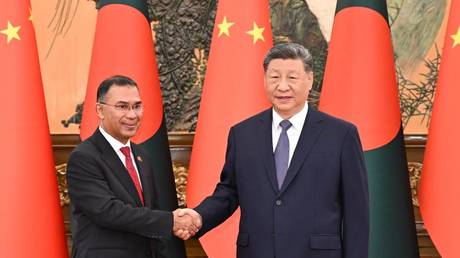
China is doubling down on its economic corridor through Bangladesh. The real objective is not just trade facilitation, but securing an alternative land route to the Indian Ocean that bypasses the highly vulnerable Strait of Malacca. While state media frames the corridor as a mutual win for regional connectivity, the underlying mechanics reveal a high-stakes geopolitical play. For Bangladesh, accepting billions in infrastructure loans brings immediate capital but introduces long-term fiscal stress and structural dependencies that could mirror the complications seen in Sri Lanka and Pakistan.
This is not a sudden burst of diplomatic generosity. It is a calculated piece of geographical engineering.
The Malacca Dilemma Drives the Dollar Flow
To understand why Beijing is pushing so hard into the Bay of Bengal, one has to look at a map of global oil transshipments. China imports roughly 80 percent of its oil through the narrow Strait of Malacca, a maritime chokepoint that could easily be blockaded during a geopolitical conflict. Beijing needs a backdoor.
The proposed economic corridor through Bangladesh provides exactly that. By linking China’s landlocked southwestern provinces—specifically Yunnan—directly to ports in the Bay of Bengal, Beijing establishes a pipeline and rail network that completely avoids Southeast Asian waters.
The strategy relies on a classic infrastructure-lend model. Chinese state-owned enterprises supply the labor, steel, and engineering expertise. Bangladesh signs the promissory notes. The immediate benefit to Dhaka is obvious, as the country desperately needs updated highways, deep-sea ports, and reliable power grids to sustain its garment-exporting economy. But the financial plumbing behind these projects favors the lender far more than the borrower.
Dhaka Highwire Act Between Two Giants
Bangladesh occupies some of the most sensitive geopolitical real estate on earth. It is surrounded on three sides by India, a nation deeply suspicious of Chinese encirclement. For years, Dhaka has managed a delicate balancing act, accepting security cooperation from New Delhi while absorbing investment from Beijing.
That balance is getting harder to maintain. India views the expansion of a Chinese-backed economic corridor on its eastern flank as a direct threat to its sphere of influence. New Delhi has responded by offering its own credit lines and pushing for transit rights through Bangladesh to connect its own isolated northeastern states.
Dhaka is playing these two giants against each other, trying to extract the best possible terms from both. It is a dangerous game. If Bangladesh leans too far toward Beijing, it risks alienating its closest geographical neighbor and vital security partner. If it backs away from Chinese capital, its infrastructure modernization grinds to a halt.
The Hidden Costs of Sovereign Debt
The terms of Chinese infrastructure loans are rarely fully transparent. They often feature higher interest rates than those offered by multilateral institutions like the World Bank or the Asian Development Bank. More importantly, they frequently carry shorter grace periods and require the employment of Chinese contractors rather than local firms.
Consider the structural vulnerabilities this creates. When a recipient nation struggles to service the debt, Beijing does not typically write off the principal. Instead, it negotiates equity swaps or long-term leases on the assets themselves. This is how a commercial port can quickly transform into a strategic asset with dual-use military potential, irrespective of the host country's original intentions.
The Reality on the Ground Contradicts the PowerPoint Slides
Step away from the diplomatic signing ceremonies and look at the actual construction sites. The corridor faces massive execution bottlenecks that cannot be solved simply by throwing more money at them.
Bangladesh has one of the highest population densities in the world. Acquiring land for major rail lines and four-lane highways is an absolute nightmare. Projects routinely face multi-year delays because of bureaucratic red tape, local protests, and legal disputes over land ownership. These delays cause costs to spiral, making the initial financial projections obsolete before the first bucket of concrete is poured.
- Land Acquisition: Bureaucratic friction delays projects for years.
- Cost Overruns: Extended timelines double the initial interest burden on sovereign loans.
- Asymmetrical Trade: The corridor increases the flow of Chinese goods into Bangladesh far faster than it helps Bangladeshi exports reach China.
The economic corridor is designed as a two-way street, but the traffic flows overwhelmingly in one direction. China is looking for new markets for its industrial overcapacity. Bangladeshi manufacturers, outside of the low-margin ready-made garment sector, simply do not have the scale or the competitive edge to penetrate Chinese domestic markets. The trade deficit between the two nations is already massive, and this infrastructure will likely widen it.
The Mirage of Instant Industrialization
The prevailing argument from proponents of the corridor is that it will transform Bangladesh into a global manufacturing hub. The theory suggests that as labor costs rise in China, factories will naturally migrate south to take advantage of Bangladesh’s abundant, cheap workforce.
This view ignores how modern supply chains actually operate. Automation has changed the calculus. Cheap labor alone is no longer enough to attract high-value manufacturing. Factories require flawless logistics, an uninterrupted power supply, a highly skilled technical workforce, and legal protections that guarantee contract enforcement. Bangladesh still ranks poorly on international indices for ease of doing business.
Building a state-of-the-art highway does not automatically fix a corrupt customs department or an outdated banking sector. Without deep structural reforms inside Dhaka's regulatory framework, the corridor risks becoming a multi-billion-dollar transit route that serves Beijing's strategic needs while leaving the local economy holding the bill.
The true measure of this corridor's success will not be found in the ribbon-cutting photos or the aggregate dollar amounts announced by diplomats. It will be measured by whether Bangladesh can maintain its sovereign fiscal independence while the concrete cures.


