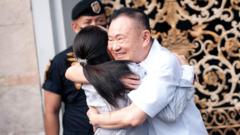
The humidity in Bangkok doesn't just sit on your skin; it weights your lungs. On a sweltering February morning, a black van eased through the gates of a sprawling mansion known as Chan Song La. Inside sat a man who has haunted the Thai psyche for two decades. Thaksin Shinawatra. He was wearing a neck brace and a sling, a fragile image of a titan who once moved markets and shifted the very tectonic plates of Southeast Asian politics.
He had spent years in self-imposed exile, dodging a prison sentence that loomed like a shadow. Then, in a twist that would make a soap opera writer blush, he returned. He was whisked from the airport to a hospital suite, and eventually, to parole. To his critics, the neck brace was a prop in a long-running play about impunity. To his supporters, it was the battle-worn armor of a hero finally coming home. In similar news, read about: Strategic Calculus of the May 2026 Sino-American State Visit.
But the real question isn't whether Thaksin is free. It is whether the ghosts he summoned have finally been laid to rest.
The Ghost in the Machine
To understand why a 74-year-old billionaire’s morning commute matters, you have to understand the rift. Imagine a village split by a river. On one side, the urban elite, the military, and the royalists who believe in tradition and hierarchy. On the other, the rural farmers and the working class who felt invisible until Thaksin handed them a microphone and a healthcare card. The Washington Post has analyzed this critical issue in extensive detail.
For twenty years, Thailand has been caught in a cycle of protest, coup, and election. Thaksin was the catalyst. He was the first politician to realize that if you give the "little people" a stake in the economy, they will give you their souls. He didn't just win elections; he demolished the competition.
The establishment panicked. They saw his popularity as a threat to the very foundations of the Kingdom. So, they removed him. Twice. Once by a tank-led coup in 2006, and later by proxy when his sister, Yingluck, was ousted in 2014. Yet, even from luxury hotels in Dubai, Thaksin remained the sun around which Thai politics orbited. Every vote was a referendum on him.
Consider the "Red Shirts." These weren't just activists; they were a movement fueled by the belief that their voice finally mattered. When they marched, the city trembled. When the "Yellow Shirts" counter-protested, the city bled. The stakes weren't just policy papers or tax rates. They were about identity. Who does this country belong to?
The Marriage of Convenience
Then came the 2023 election. A new force emerged: Move Forward. This wasn't the Thaksin brand of populism. This was something sharper, younger, and far more radical. They didn't just want to help the poor; they wanted to rewrite the rules of the monarchy and the military.
Suddenly, the old enemies found themselves in a dark room, staring at a common threat. The establishment realized that the man they had spent twenty years trying to destroy was now the only one who could save them from the kids with the orange banners.
A deal was struck. It was silent, whispered in the corridors of power, but the results were loud. Thaksin returned on the very day his party, Pheu Thai, formed a government with the very military parties that had once ousted them. It was a marriage of convenience that left many voters feeling like the wedding guests at a funeral.
"It felt like a betrayal," says Sunai, a hypothetical street vendor in Chiang Mai who has worn red shirts to every protest since 2010. "We fought for him. We went to jail for him. Now, he’s shaking hands with the men who ordered the crackdown? It’s like watching your father hug the man who burned your house down."
This is the invisible cost of the current peace. It is a peace built on a compromise that leaves the soul of the movement feeling hollow. The "Thaksin Era" was defined by a clear battle line. Now, that line has been blurred into a smudge of gray.
The Shadow Cabinet
Is the Thaksin era over? Technically, he holds no office. He is a paroled convict. But in Thailand, the title on the door rarely matches the power in the room.
When the current Prime Minister, Srettha Thavisin, visits Chan Song La, the optics are unavoidable. It looks less like a diplomatic visit and more like a regional governor reporting to the emperor. The power has shifted from the parliament house back to the private residence.
But there is a flaw in this restoration. Thaksin is a man of the early 2000s. His brand of politics—big projects, cash injections, and charismatic leadership—is facing a digital-age challenge. The younger generation isn't looking for a godfather; they are looking for a structural overhaul. They don't want a "benevolent" billionaire. They want a system where billionaires aren't the only ones who matter.
The tension now isn't between Red and Yellow. It's between the Past and the Future. Thaksin, once the ultimate disruptor, has become the ultimate insider. He is the guardian of the status quo he once sought to upend.
The Weight of the Sling
Walking through the streets of Bangkok today, you see a city that is tired. People are weary of the cycles of rage. They want the economy to move. They want the tourists back. They want to forget the smell of tear gas.
But the silence is deceptive.
The Thaksin era might not be over, but it has mutated. It has moved from the streets into the shadows. The man in the neck brace knows that his survival depends on his ability to keep the lid on the pressure cooker. If he fails to deliver the economic miracles he once promised, or if he leans too hard into his role as the power broker, the younger generation will not wait for a coup to remove him. They will simply move past him.
History is a heavy thing in this part of the world. It clings like the heat. We see a man standing on a balcony, waving to a crowd that is smaller than it used to be. He is older. He is frailer. He has his freedom, but it came at a price that his younger self might not have been willing to pay.
The story of Thailand is no longer just about one man. It is about a nation trying to decide if it can ever truly grow up, or if it is destined to remain a child caught in the middle of a messy, multi-decade divorce.
The van pulls away. The gates close. The humidity remains.
Thaksin is home. But the country he returned to is not the one he left. The fire he started is still burning, but he is no longer the one holding the match. He is just another man trying to stay dry in a storm that he helped create.