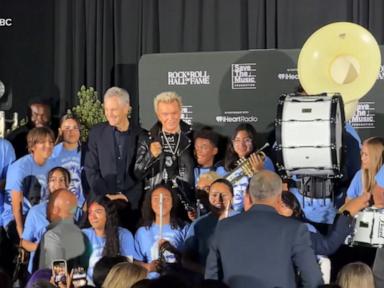
The afternoon air in the school courtyard smelled of old asphalt, damp autumn leaves, and the unmistakable, low-humming anxiety of a Tuesday afternoon period that nobody wanted to sit through. Inside the music room, the acoustic environment was a battlefield of out-of-tune brass, battered clarinet cases with missing latches, and the quiet resignation of teenagers trying to figure out if art still mattered in a world obsessed with spreadsheets and survival.
Then the door swung open. Also making news in related news: Why Everyone Has the Meghan and Thomas Markle Story Completely Backward.
There was no preamble. No polite knock. Just the sudden, heavy scrape of boot leather against linoleum, followed by a silhouette that belonged to a different decade, a different voltage entirely. The platinum-spiked hair caught the fluorescent glare overhead. The leather jacket creaked with every movement. A snarling, crooked smirk broke across a face etched by decades of stadiums, screaming amplifiers, and the relentless, beautiful violence of rock and roll.
Billy Idol had arrived. Additional insights on this are detailed by Associated Press.
For the kids clutching their battered Yamaha flutes and scratched electric guitars borrowed from older siblings, time didn’t just slow down; it fractured. Most of these students had only ever known this man as an ethereal pixel on a glowing screen, a ghost of MTV past haunting their parents' vinyl crates or late-night YouTube rabbit holes. To see him standing there, breathing the same chalk-dust air, was an exercise in cognitive dissonance.
He didn't walk in as a corporate benefactor holding a oversized cardboard check for the cameras. He walked in like a veteran returning to the front lines, carrying the salvation they didn't know they were desperate for: gear. Boxes and cases piled high, stamped with logos of high-end manufacturers, filled with gleaming red electric guitars, crisp snare drums, and amplifiers that hummed with untapped kinetic energy.
Consider what happens to a teenager when someone hands them a real instrument. Not a plastic controller for a video game, not a sterile application downloaded onto a cracked phone screen, but a living, breathing piece of wood and steel that vibrates against your ribs when you strike a chord. It’s an initiation. It’s a declaration that your noise, your raw, unpolished frustration, has a right to exist in the world.
Music education in public schools has been systematically hollowed out for decades. Budgets bleed dry at the first sign of a fiscal shortfall. Art and rhythm are treated as optional luxuries, the first things to be thrown overboard when the ship starts taking on water. We tell kids to innovate, to think critically, to find their voices, while simultaneously stripping away the physical tools required to articulate those voices outside of rigid academic parameters.
When a kid loses access to a saxophone or a drum kit, they don't just lose a grade. They lose a language.
Billy knows this. You don't survive the transition from the British punk underground of the late seventies—sweaty toilets, safety pins, and spit-soaked floors—to global arena stardom without understanding that music isn't an elective. It’s an emergency exit. It’s the way you scream back at a universe that tells you to sit down, be quiet, and color inside the lines.
When he stepped up to the front of the classroom, leaning against a stack of amplifiers, he didn't give a speech about the importance of extracurricular activities. He didn't quote a study on cognitive development or standardized test scores.
He just laughed. A low, gravelly sound that broke the ice instantly.
"Alright," he said, his voice carrying that distinct, sneering British cadence that defined an entire subculture. "Let's see what you lot can do with these."
The transformation in the room was instantaneous. The slouching shoulders straightened. The eyes that had been glazed over by geometry equations suddenly sharpened, locking onto the glossy mahogany bodies of the new guitars.
This is what philanthropy looks like when it is stripped of PR polish and corporate handshakes. It was personal. It was an exchange of fire between generations.
Generosity on this scale isn't just about the physical retail value of the equipment, though a room full of professional-grade gear is nothing to sneeze at for a cash-strapped district. The real value is psychological. It’s the profound, jarring realization that someone who has lived at the absolute apex of cultural power looked down the line and decided to look back at them.
In that classroom, surrounded by peeling paint and posters of the periodic table, a message was being delivered without a single word of lecture: You are seen. Your sound matters. Keep playing.
We live in an era that relentlessly commodifies youth culture while simultaneously ignoring the young people trying to create it. Algorithms feed them pre-packaged nostalgia, telling them what to like, how to dress, and which songs should soundtrack their fifteen-second videos. Originality is flattened into a continuous, looping scroll.
Breaking that cycle requires a disruption. It requires someone to kick the door open and hand you something heavy, loud, and expensive, and say, "Here. Make some trouble with this."
As the afternoon light dipped below the horizon, casting long, dramatic shadows across the school gymnasium floor, the room erupted. It wasn't polished. It wasn't a pristine studio recording. It was chaotic, loud, and utterly glorious. A half-dozen kids plugged into their new amps, hammering out clumsy, beautiful power chords that shook the dust from the ceiling tiles.
Billy stood in the corner, nodding along to a rhythm only he could fully map, wearing the expression of a man who knew exactly what those vibrations could do to a young life. He wasn't looking back at his own glory days. He was handing the match over to the next generation, watching to see who would be brave enough to strike it.
The final chord faded, hanging in the air like smoke, long after the last string stopped trembling.