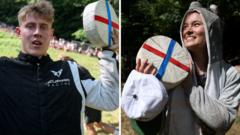
The annual descent of Cooper’s Hill in Brockworth, Gloucestershire, is frequently categorized as an eccentric manifestation of British folklore. This assessment miscalculates the structural reality of the event. The race represents an elite, high-velocity gravity descent governed by complex principles of classical mechanics, human biomechanics, and micro-topography.
The 2026 iteration crystallized a fundamental shift in the competitive dynamics of the sport: the optimization of downhill velocity through strategic falling. When German competitor Tom Kopke secured his third consecutive men’s downhill victory by narrowly defeating 23-time champion Chris Anderson near the finish line, the outcome was not dictated by chance. It was the direct result of kinematic efficiency under extreme environmental variables.
The Physics of the Incline: Gravity vs. Friction
The operational theater of Cooper’s Hill consists of a 200-yard (182-meter) course characterized by an average 1:2 gradient, yielding an angle of inclination that approaches 50 degrees at its vertex. To evaluate the forces acting upon a human competitor, the system must be analyzed using a standard inclined plane model where weight ($W = mg$) is resolved into two perpendicular components.
- The Downforce Vector ($W \parallel = mg \sin\theta$): This force acts parallel to the slope, driving the competitor downward. At a 50-degree incline, $\sin(50^\circ) \approx 0.766$, meaning approximately 76.6% of the competitor's total body mass is converted directly into downward acceleration.
- The Normal Force Vector ($W \perp = mg \cos\theta$): This force acts perpendicular to the slope. At 50 degrees, $\cos(50^\circ) \approx 0.643$. The diminished normal force radically reduces the maximum available static and kinetic friction ($f = \mu N$), making conventional bipedal locomotion mechanically impossible after initial velocity is achieved.
The objective of the event is to chase an 8-pound (3.6-kilogram) wheel of Double Gloucester cheese produced by veteran cheesemaker Rod Smart. Because the solid wheel of cheese possesses a much higher mass-to-surface-area ratio and low rolling resistance, it rapidly reaches terminal velocity on the slope, exceeding speeds of 70 miles per hour (112 kilometers per hour). Human competitors cannot match this velocity via running; instead, victory depends on minimizing deceleration caused by unplanned structural impacts with the terrain.
The Micro-Topography Bottleneck and Track Dynamics
The 2026 race conditions presented unique friction coefficients due to a distinct meteorological sequence. Heavy spring rainfall initially saturated the soil matrix of the hill, expanding the clay particles and softening the upper layer. A subsequent heatwave elevated temperatures near 30 degrees Celsius on the May bank holiday. This thermal exposure baked the topsoil, generating a bifurcated track profile: a hard, compacted base layer topped with variable, moisture-retaining organic matter.
This specific geology creates a systemic risk profile for competitors. When a runner attempts to maintain bipedal stride, their footwear penetrates the soft outer layer and strikes the unyielding, baked earth beneath. This sudden alteration in the coefficient of kinetic friction ($\mu_k$) induces an immediate torque across the competitor's center of mass. The lower extremities stop instantly while the upper torso maintains forward momentum, initiating a violent forward rotational pitch.
The 2026 results demonstrated that local track knowledge no longer guarantees absolute dominance over this terrain bottleneck. Every single downhill race in 2026 was claimed by non-British international competitors:
- First Men’s Race: Tom Kopke (Germany)
- Second Men’s Race: Niels Wennemars (Netherlands)
- Third Men’s Race: Otto Linkogle (United States)
- Ladies Downhill Race: Alix Heugas (France)
The sweep indicates a broader cross-cultural assimilation of the mechanical principles required to navigate the slope. Rather than fighting the inevitable transition from bipedal running to chaotic rolling, international victors systematically embraced a philosophy of controlled tumbling.
Biomechanical Analysis of Winning Strategies
To evaluate how Kopke defeated the most decorated racer in the history of the sport, Chris Anderson, one must examine the transition phases of the descent. The race can be structurally deconstructed into three distinct phases:
Phase 1: The Inertial Break (0–20 Yards)
At the crest, competitors must overcome static inertia. The standard local technique involves a low-profile launch to minimize the initial drop height. Anderson’s historical edge relied on an explosive bipedal start to gain immediate separation. In 2026, however, the elevated track hardness increased the impact force of each stride, causing structural instability earlier in the run. Kopke minimized this by lowering his center of gravity immediately upon crossing the threshold, transitioning into a controlled slide before uncontrolled tumbling could dictate his trajectory.
Phase 2: The Mid-Slope Stabilization (20–150 Yards)
Once a competitor loses bipedal stability, they enter a state of multi-axis rotation. The body becomes a kinetic projectile subject to unpredictable topography. Kopke's post-race analysis revealed a conscious strategy: identifying softer, unbaked patches of grass in the middle section of the hill to absorb the impact forces, allowing him to regain brief moments of traction to orient his body forward.
Conversely, attempting to stay upright on a 1:2 baked-earth gradient introduces severe lateral instability. The ankle joint is forced into extreme dorsiflexion and inversion, leading to mechanical failure of the joint capsule or an immediate high-velocity trip. By utilizing the terrain to cushion his falls rather than resisting them, Kopke maintained a more consistent velocity vector along the vertical axis of the hill.
Phase 3: The Velocity Sprint (150–200 Yards)
As the gradient flattens near the base of Cooper's Hill, the normal force increases, and bipedal locomotion becomes viable again. The transition from rolling back to sprinting dictates the final outcome. Kopke executed this transition with superior efficiency, utilizing his rotational momentum to drive himself back onto his feet precisely as the hill leveled out, overtaking Anderson just before the finish line.
The Cost Function of Extreme Gravity Descent
The primary constraint of the Cooper’s Hill race is the high probability of physiological damage. Because the event has operated without an official organizing body since safety concerns prompted the cancellation of the official competition in 2010, participants assume all operational risks.
The medical liabilities can be quantified through the historical record of Chris Anderson, whose 23 victories over a 17-year span incurred a high physiological cost function:
Total Wins: 23
├── Major Orthopedic Trauma: 1 Broken Wrist, 1 Broken Ankle
├── Internal Organ Trauma: 1 Bruised Kidney
└── Neurological Impact: 1 Severe Concussion (Loss of Consciousness)
The underlying mechanism of injury is the dissipation of kinetic energy ($E_k = \frac{1}{2}mv^2$). When a 180-pound (81-kilogram) competitor tumbles at speeds approaching 30 miles per hour (48 kilometers per hour), the kinetic energy equals approximately 7,300 Joules. Upon collision with a hard, baked-earth topography, this energy must be absorbed by the human skeletal structure and soft tissues.
If the impact duration is short, the peak force experienced by the bones exceeds the threshold for structural fracture. This mechanical reality was illustrated in the women's category by historical precedents like Delaney Irving's 2023 victory, accomplished while completely unconscious due to a mid-slope head strike. In 2026, women's champion Alix Heugas optimized for this risk by entering the race with zero formal training, adopting a strategy of complete compliance with gravitational forces—"winging it"—to avoid the rigid muscle bracing that frequently exacerbates fractures during high-impact tumbles.
Structural Projections for Future Competitions
The outcome of the 2026 event establishes a definitive baseline for the evolution of gravity racing. The complete displacement of domestic competitors in the downhill categories by international athletes signifies that the historical advantage of geographical proximity has been neutralized by cross-disciplinary athletic adaptation. For example, the second men's downhill race winner, Niels Wennemars, descends from a family of elite Dutch speed skaters, suggesting that high-velocity lower-limb coordination and lateral core stability are highly transferable assets to this environment.
To maintain competitive parity in future cycles, athletes must abandon reliance on raw bipedal acceleration. The optimization path requires treating the descent as a continuous fluid-dynamic problem where the human body acts as a low-resistance cylinder. Training regimens must prioritize:
- Rotational Vestibular Adaptation: Developing the capacity to maintain spatial awareness during high-velocity multi-axis tumbling to enable precise foot placement during the Phase 3 transition.
- Eccentric Quadriceps Force Production: Conditioning the lower extremities to withstand the massive decelerative forces encountered when transitioning from a 50-degree slope to flat ground.
- Impact Dispersal Mechanics: Training🥋 to drop the shoulder and roll sequentially across the latissimus dorsi and gluteal muscle groups, maximizing the time component of the impulse equation ($F\Delta t = \Delta p$) to reduce peak impact forces below the bone fracture threshold.
The future of dominance at Cooper's Hill belongs to those who can mathematically integrate their descent path with the micro-topographical variances of the hill, treating the terrain not as an obstacle to be run over, but as a chaotic system to be systematically navigated.