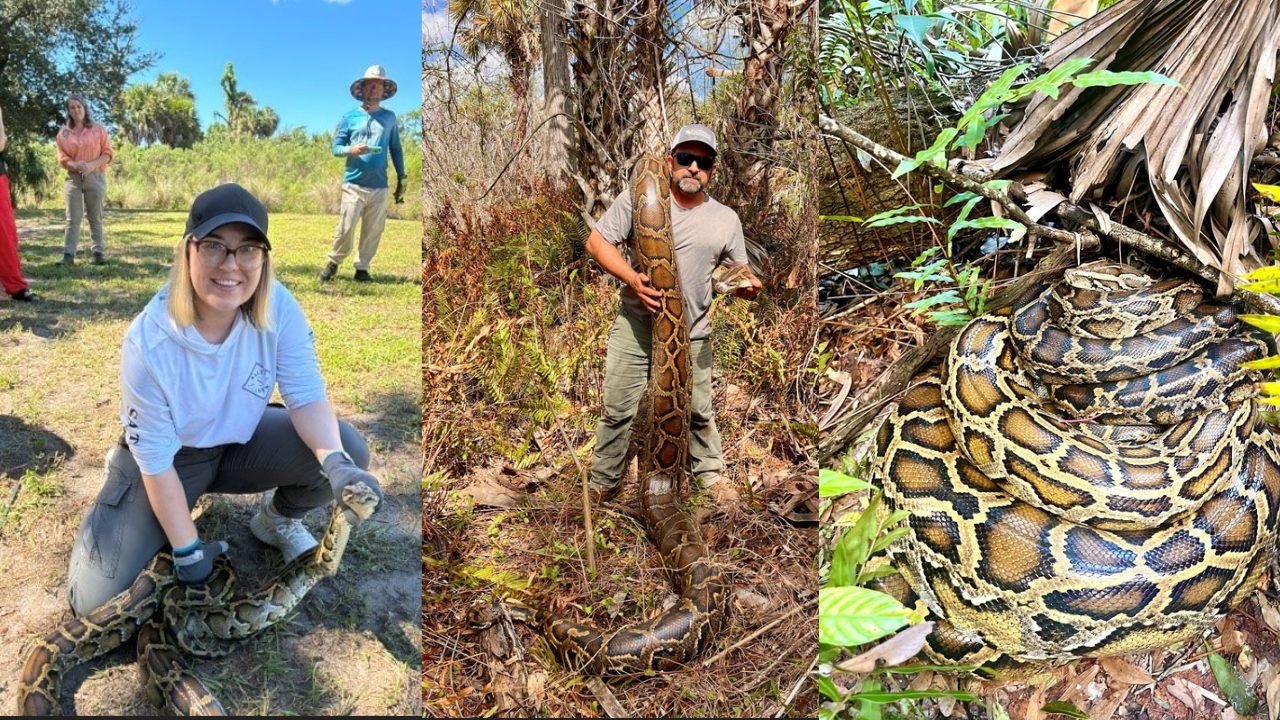
The traditional framework for invasive species management in the Florida Everglades relies on visual detection—an approach that operates at an unsustainable cost-to-acquisition ratio. Burmese pythons (Python bivittatus) possess crypsis mechanisms fine-tuned over evolutionary time, yielding a detection probability estimated at less than 1% during standard visual surveys. Deploying human searchers across thousands of square miles of marshland constitutes an information asymmetry problem: the search space is vast, the target density is low, and the target's thermal and visual signature is virtually indistinguishable from the background matrix. To invert this dynamic, eradication programs have scaled the deployment of "scout" or "Judas" pythons—implanting radio transmitters into wild-caught males to exploit the biological imperative of mate-seeking behavior during the breeding season.
The Information Asymmetry of Crypsis
To evaluate the efficiency of invasive python removal, eradication efforts must be analyzed through a search-cost model. Visual searching represents a high-input, low-yield methodology. A human hunter walking a levee or navigating a skiff spends dozens of hours per single capture event, with efficiency degrading further as the search area expands into inaccessible interiors.
The underlying failure of manual search vectors stems from three environmental factors:
- Substrate Complexity: The Everglades flora—comprising dense sawgrass (Cladium jamaicense), buttonwood thickets, and mangrove roots—creates structural complexity that breaks up the continuous outline of large constrictors.
- Thermoregulatory Behavior: Pythons optimize their body temperature via microhabitat selection rather than open basking during peak ambient temperatures, rendering airborne infrared detection largely ineffective through dense canopies.
- Low Movement Rates: Outside of mating cycles, adult pythons exhibit prolonged sit-and-wait predation strategies, reducing the motion cues that human observers rely on to spot wildlife.
The scout snake system bypasses the visual detection bottleneck by replacing human spatial search with biological navigation. Rather than searching for an unseen organism in a two-dimensional grid, managers track an organism that actively homes in on reproductive scent trails across three dimensions.
The Three Pillars of the Judas Telemetry Framework
The Judas methodology operates as an information force multiplier. By leveraging male pythons equipped with surgical transmitters, researchers exploit the species' pheromonal communication networks. The framework relies on three operational pillars:
[Target Acquisition & Surgery] ──> [Spatial Tracking & Mapping] ──> [Aggress Targeted Removal]
          │                                  │                                 │
  Biocompatible VHF/GPS              Directional Antennas              Eliminate Breeding Females;
   Surgical Implants                 & Spatial Clustering               Preserve Male Scout Signal
1. Surgical Modification and Biocompatibility
Scout candidates are captured from the wild, evaluated for size and vigor, and surgically implanted with Very High Frequency (VHF) radio transmitters or GPS-enabled tracking units. The transmitter must be anchored intra-abdominally to prevent migration within the coelomic cavity or expulsion through the GI tract. Weight constraints are critical: the package must remain under 5% of the animal's total body mass to ensure normal movement and metabolic function.
2. Spatial Clustering and Aggregation Dynamics
During the reproductive window (typically late fall through early spring), reproductive females emit sex pheromones that travel through air and water currents. Implanted males act as biological sensors, processing chemical gradients far below human detection thresholds. When a scout male stops moving and remains stationary in a localized cluster for multiple days, the probability of an aggregation event—where multiple males converge on a single receptive female—approaches certainty.
3. Selective Harvest Protocol
When tracking teams locate the stationary scout via directional antennas or satellite coordinates, they extract all associated wild individuals from the breeding ball while leaving the scout male intact. Removing the large reproductive female eliminates the primary reproductive engine of that immediate micro-habitat, while sparing the scout male permits continuous telemetry throughout the remainder of the mating season.
The Cost Function of Telemetry vs. Visual Removal
A comparative analysis of removal methodologies reveals stark differences in resource allocation and capture yield.
Manual hunting requires continuous labor expenditures: fuel, vehicle maintenance, hourly wages, and bounty payouts. The cost per snake captured via visual survey scales non-linearly as population density declines, because remaining individuals become statistically harder to locate.
Telemetric tracking shifts the capital expenditure upfront. The initial costs include surgical supplies, veterinary labor, transmitter hardware, and receiver equipment. Once deployed, however, the marginal cost per capture drops significantly. A single tagged male can lead research teams to multiple breeding aggregations per season, frequently revealing large, high-fecundity females that would otherwise remain hidden within remote tree islands.
Visual Search:   [High Labor Input] ──> [Low Yield]  ──> [Rising Cost per Unit]
Telemetry:       [Upfront Hardware] ──> [High Yield] ──> [Decreasing Cost per Unit]
The fundamental metric of success in invasive species control is not total individuals removed, but total reproductive capacity eliminated. Visual searching disproportionately yields smaller sub-adults basking near road edges. Telemetry disproportionately yields large breeding females buried deep in the marsh interior—the precise demographic driving population growth.
Structural Bottlenecks and Environmental Constraints
While biologically sound, the deployment of scout pythons operates under severe operational constraints that prevent it from functioning as a standalone eradication tool.
First, the system is strictly bounded by seasonality. Outside the breeding window, male pythons revert to solitary hunting and thermoregulation. Their movement patterns become stochastically distributed across the landscape, eliminating the aggregation behavior that makes them useful tracking vectors. For roughly half the year, scout snakes provide minimal utility for locating other individuals.
Second, spatial access introduces logistics friction. When a scout snake enters protected wilderness zones, deep mudflats, or dense mangrove swamps, tracking teams must utilize airboats, helicopters, or foot marches through treacherous terrain. The physical cost of recovery can exceed the budget allocated for the tracking unit.
Third, signal degradation remains a technological hurdle. Water attenuates VHF radio signals significantly. If an implanted python dives into a deep solution hole or submerges under dense mats of peat, the transmitter signal drops precipitously, leading to temporary loss of the tracking vector.
Operational Execution: Scaling Telemetry Deployments
To maximize the return on telemetry networks, wildlife management programs must transition from opportunistic tagging to structured spatial grids.
Instead of releasing tagged pythons randomly across access points, deployment strategies must utilize historical spatial data to calculate optimal release nodes. Scouts should be distributed in a staggered matrix around known thermal refugia and high-density corridor zones.
Furthermore, integrating real-time GPS telemetry with satellite-uplink capability eliminates the need for manual daily radio-tracking. Automated alerts triggered when a male scout's movement drops below a defined velocity threshold allow rapid-response teams to intercept breeding clusters immediately, reducing field hours and maximizing capture efficiency during peak reproductive windows.