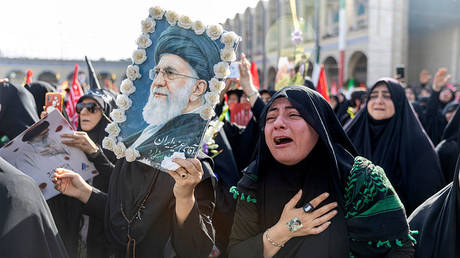
The asphalt in Tehran does not melt under the sun; it softens under the weight of millions of boots.
From a distance, looking down from the Alborz mountains, the city looked as though it had been flooded by an ink-black sea. It was a dense, undulating mass of humanity that choked the wide avenues, spilled into the side streets, and left no bare concrete visible for miles. Western intelligence briefs had spent months painting a picture of a regime on its deathbed, a fragile house of cards waiting for a light breeze to blow it over. Capital cities across the globe watched their screens, expecting a quiet, perfunctory ceremony for a fallen leader.
Instead, they got an earthquake.
To understand what happened on those streets, you have to look past the political grandstanding and look at the faces in the crowd. Look at an old man from the rural outskirts of Mashhad, his hands calloused from decades of farming, standing shoulder-to-shoulder with a tech-savvy university student from Tehran who uses a VPN to bypass state firewalls every single day. They do not agree on internet censorship. They do not agree on economic policy. But on this morning, they stood in the same suffocating heat, breathing the same dust, weeping for the same casket.
This is the blind spot that routinely misleads outside observers. It is easy to confuse internal dissent with systemic collapse.
The Arithmetic of Miscalculation
For decades, the standard playbook for analyzing Iran has relied on a clean, comfortable binary. On one side, you have an oppressive, out-of-touch leadership. On the other, a progressive, rebellious population yearning for a Western-style democracy. It is a compelling narrative. It makes for excellent television.
It is also dangerously incomplete.
When a society is viewed strictly through the lens of its most vocal dissidents, the quiet gravity of its traditional base is entirely lost. Nations are not merely collections of political opinions; they are bound by deep historical memory, religious conviction, and a fierce, almost fierce sense of sovereignty. When a collective trauma strikes—such as the sudden death of high-ranking state figures—the reaction is rarely a rush toward revolution. More often, it triggers an ancient, tribal reflex to close ranks against an uncertain world.
Consider the sheer mechanics of the gathering. Organizing a march of a few thousand people requires immense logistical effort. Moving millions of citizens onto the streets cannot be achieved solely through state coercion. You cannot force a grieving mother to stand in the sun for eight hours at bayonet point just to fill a camera frame. The grief was tangible, heavy, and undeniably real.
The mistake lies in assuming that every person mourning on those streets approves of every action the state takes. They do not. But the shared identity of a nation under siege often overrides internal grievances when the outside world is watching.
The Geography of Grief
Step inside the crowd for a moment. The air smells of rosewater, sweat, and cheap diesel exhaust. The sound is a rhythmic, hypnotic thud—thousands of palms striking chests in unison, a traditional cadence of mourning that dates back centuries.
A young woman stands near a concrete barrier. Her headscarf is pushed back slightly, a quiet nod to the shifting cultural norms of the capital. She carries no signs, sings no state slogans. When asked by a passing reporter why she is there, she does not speak of geopolitics or foreign policy.
"They want us to disappear," she says, her voice barely audible over the chanting. "This is to show we are still here."
To her, the funeral was not a political endorsement. It was an act of survival. In her mind, a weak Iran invites foreign intervention, and foreign intervention looks like the ruins of Kabul or the wreckage of Baghdad. The memory of the devastating eight-year war with Iraq in the 1980s still haunts the collective consciousness of the country. Nearly every family has a photograph of a young uncle or brother who never came home from the front lines. The primary desire of the average citizen is not abstract political reform; it is stability. It is the prevention of chaos.
When external analysts predict the imminent fall of the state, they fail to account for this deep-seated fear of what comes next. The massive turnout was a physical manifestation of that anxiety. It was a message sent not just to Washington or London, but to the citizens themselves: we are still a country.
The Mirage of the Monolith
The illusion of a weak Iran is often sustained by looking only at economic indicators. The currency fluctuates, inflation squeezes the middle class, and sanctions make daily life an exhausting struggle for basic goods. By all conventional logic, a population under such economic duress should be ripe for total revolt.
But economic pain does not always break a population; sometimes, it hardens it.
The mistake is treating the nation as a monolith that can be managed through spreadsheets and policy papers. When pressure is applied from the outside, it rarely fractures the core. Instead, it compresses it, fusing disparate factions together under a shared sense of victimization. The millions who marched through Tehran, Tabriz, and Qom were a vivid demonstration of this compression.
The assumption that the state has no genuine domestic support is a comforting myth, but it remains a myth. The sea of black-clad mourners did not just bury a leader; they buried the theory that the country's social fabric is frayed beyond repair.
The crowded avenues eventually cleared. The black banners were taken down, and the buses carried the rural mourners back to their provinces. Tehran returned to its daily rhythm of heavy traffic and economic worry. The underlying tensions, the economic hardships, and the deep generational divides remain entirely unresolved. The internal friction will inevitably return.
But the memory of those packed streets remains beneath the surface. It serves as a reminder that beneath the political noise lies a complex, resilient, and stubborn reality that cannot be easily dismantled by external expectations or wishful thinking.



