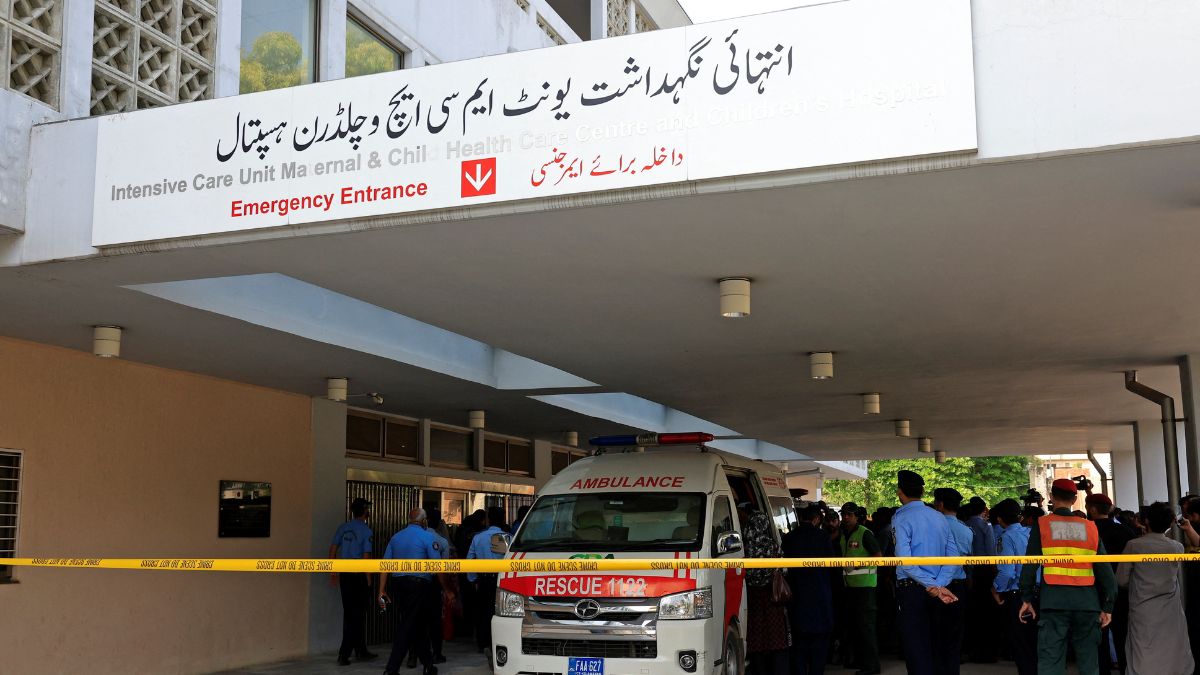
Every single time a hospital ward catches fire and infants perish, the public playbook never changes. The outrage machine spins up. Politicians offer hollow condolences and demand immediate safety audits. Fire marshals point to frayed wiring, outdated extinguishers, or absent smoke suppression grids. The public nods along, satisfied that the villain has been identified and punished.
This is comforting. It is also entirely useless.
Focusing exclusively on physical infrastructure after a neonatal ward disaster is a lazy institutional reflex designed to protect bureaucracy rather than patients. When fourteen newborns died following a fire in the gynaecology and neonatal ward at an Islamabad hospital, the immediate commentary focused predictably on regulatory compliance, electrical faults, and emergency response times. While faulty wiring and substandard building materials matter, treating these tragedies as mere engineering problems completely misses the systemic organizational rot that allows them to happen in the first place.
The Equipment Fallacy
I have spent decades examining high-consequence operational environments. When facilities fail catastrophically, investigators almost always uncover a long chain of deferred maintenance, budget diversions, and regulatory capture. Yet, the dominant narrative insists that if we simply buy newer smoke alarms or install better sprinkler systems, safety will follow.
This is a dangerous delusion.
Imagine a scenario where a hospital installs state-of-the-art suppression technology across every square foot of its neonatal unit, yet leaves the operational culture entirely unchanged. Staffing ratios remain dangerously low. Chain-of-command protocols are murky, leaving junior nurses paralyzed when quick decisions are required. Maintenance logs are pencil-whipped by administrators more concerned with passing external audits than ensuring functional readiness.
When the next spark flies, that expensive sprinkler system will do nothing to solve the human bottlenecks. Equipment does not save lives. Trained, empowered personnel operating within rational systems save lives. If the nurses cannot unlock emergency exits because keys are locked in an administrative office, your fire suppression rating is irrelevant. If night-shift staffing is cut to the bone to pad an annual budget, your state-of-the-art alarms will merely alert an empty hallway.
Dismantling the Regulatory Mirage
People look at safety certifications as holy writs. If a hospital possesses a government health and safety certificate, the public assumes infants inside are protected.
This assumption ignores how regulatory compliance works in the real world.
In many developing healthcare ecosystems, regulatory bodies are chronically underfunded, toothless, or prone to bureaucratic capture. Inspections become theatrical exercises. Checklists are ticked off in exchange for favors or small bribes, and facilities operate year after year past their design lifespans. Relying on paper compliance as a proxy for actual safety is like wearing a raincoat made of tissue paper because the label says waterproof.
True institutional safety is adversarial. It requires an internal culture that actively looks for ways the system is about to break, rather than hoping for the best until disaster strikes. When leadership treats safety as a legal box-ticking exercise instead of an ongoing operational discipline, catastrophe is not an accident. It is an inevitability.
The Human Cost of Administrative Cowardice
Let us talk about the accountability vacuum. When a neonatal ward burns, attention targets the low-level staff on duty or abstract concepts like "infrastructure deficits." Rarely do we see hospital executives face genuine professional ruin for systematically underfunding life safety systems over a decade.
Administrators balance budgets by trimming fat. Too often, they view maintenance budgets, backup generator testing, and redundant power supplies as fat rather than muscle. They gamble with other people's children to keep profit margins stable or state subsidies intact. When the gamble loses, the executives issue somber press statements, launch internal investigations that lead nowhere, and quietly collect their bonuses.
This dynamic rewards negligence. If the downside of cutting safety corners is a manageable public relations crisis every ten years, sociopathic institutional optimization dictates that you keep cutting.
What Actually Works
If we want to stop reading headlines about infants lost to preventable hospital fires, we have to abandon our obsession with post-hoc scapegoating and superficial hardware upgrades.
First, mandate total financial and operational transparency for life-safety infrastructure. Hospital boards must carry personal, civil, and criminal liability for deferred maintenance on critical life-support and fire-suppression systems. If you set the budget that defunded the backup generators, you own the fire.
Second, restructure neonatal ward architecture away from centralized, high-density wards toward decentralized, modular pods. Piling dozens of vulnerable newborns into a single large room with a single primary exit path is a medieval design choice disguised as modern medicine. Smaller, compartmentalized pods limit the blast radius of any localized failure, whether it is an electrical short or an oxygen leak.
Third, radically redesign emergency response authority. In a crisis, seconds count. If a floor nurse has to get three signatures from a hospital administrator before activating an emergency evacuation protocol or cutting power to a faulty wing, the system is designed to fail. True operational resilience pushes decision-making down to the people standing in the room with the patients.
Stop waiting for politicians to fix the hospitals they underfunded. Stop buying the lie that a new coat of fire-retardant paint changes a broken culture.
The next ward fire is already burning in the spreadsheets of executives who decided safety was too expensive.