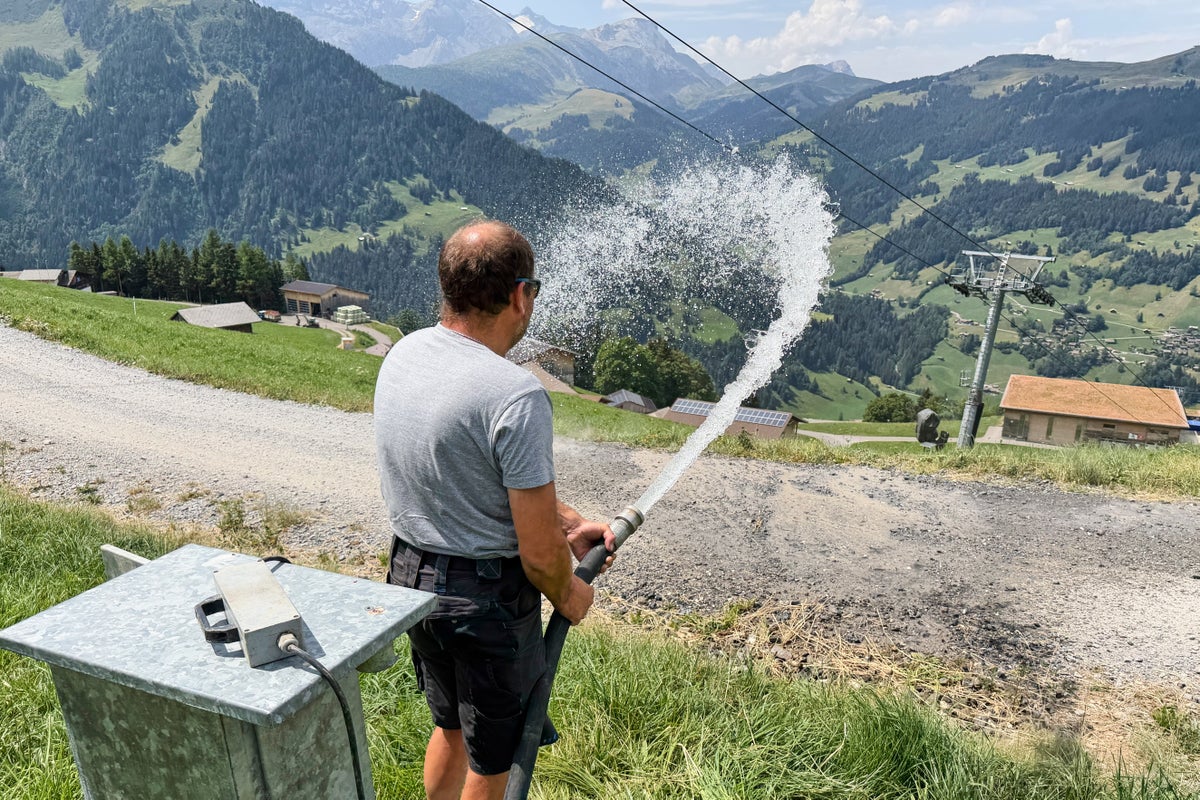
The headlines write themselves because lazy journalism requires zero oxygen. You see the recurring panic porn every single summer. A wildfire sweeps through a dry mountain corridor. Photos emerge of snowmaking infrastructure sitting idle next to scorched pines. Puzzled anchors point to industrial hydro-pneumatic blowers and ask why ski resorts are not blasting millions of gallons of artificial powder onto blazing forests to save the slopes.
It sounds intuitive to anyone who has never set foot inside a resort pump house. Snow is frozen water. Wildfires hate water. Point the snow gun at the fire, crank the PSI, and watch the inferno vanish behind a blizzard of man-made slush. You might also find this connected article interesting: Why Living in Big Sur Means Constantly Battling the Edge of Collapse.
Except the entire premise is built on a fundamental misunderstanding of fluid dynamics, capital expenditure, and how physics actually operates under thermal loads that exceed two thousand degrees Fahrenheit.
I have spent two decades walking the cat tracks of major North American operations, auditing capital expenditure sheets, and watching boards of directors panic over climate narratives while missing operational reality entirely. I have seen operations blow millions of dollars on high-altitude hydrant retrogrades that solved the wrong problem while leaving actual vulnerabilities wide open. As reported in latest reports by Lonely Planet, the effects are significant.
The lazy consensus says that ski resorts are sitting on dormant firefighting megastructures just waiting for a switch to flip. The reality is far uglier, far more expensive, and entirely disconnected from what the mainstream media wants you to believe.
The Physics Problem Nobody Wants To Calculate
Let us start with the core hardware. A standard high-output fan gun or internal-mix stick uses anywhere from one hundred to three hundred gallons of water per minute. That sounds like a decent volume until you calculate what a high-intensity crown fire actually demands in terms of sustained suppression.
A moderate-to-severe wildfire releases thermal energy measured in gigawatts. To meaningfully cool a burning timber stand, you do not need a fine atomized spray designed to freeze in mid-air during a sub-zero January night. You need massive, heavy, un-atomized volume dropped directly onto the fuel bed to saturate duff layers down to the mineral soil.
Snow guns are engineered for the exact opposite outcome. They atomize water into microscopic droplets specifically to maximize surface area-to-mass ratio. This ensures maximum evaporation rates in cold, dry air so the remaining moisture freezes before it hits the ground.
Now, take those tiny, high-surface-area droplets and project them into the convection column of an active wildfire.
Before a single drop of that artificial mist touches the flames, the ambient thermal radiation flashes the water into steam instantly. You have not suppressed the fire. You have just built a localized atmospheric sauna that superheats the surrounding canopy, feeds the convection current with vaporized moisture, and accelerates the spread rate.
I watched a regional general manager try to run a line of low-E fan guns as a makeshift perimeter defense during a dry-lightning blowup three seasons back. Within four minutes, the intake hoses melted because nobody factored in radiant heat shielding for the supply lines. The electrical cables fused into useless black spaghetti. The pumps cavitated because the intake pressure dropped the second the municipal grid brownout hit.
It was an expensive, embarrassing lesson in why you do not use specialized winter toys as improvised fire engines.
Follow The Money Trail Behind The Hydrant Hype
If snow cannons are terrible firefighting tools, why do resort PR teams keep feeding reporters vague quotes about utilizing snowmaking networks for summer emergency mitigation?
Insurance premiums.
Boardrooms are sweating through unprecedented property and casualty rate hikes. Underwriters look at forested leases in drought-stricken mountain zones and see ticking time bombs. To keep policies from doubling, risk management committees look for any narrative that proves they are actively hardening the asset.
Mentioning that you have a high-pressure pump station and miles of buried ductile iron pipe sounds like a private municipal water utility ready for action. It plays well in slide decks presented to actuaries in Hartford.
But look at the architecture of those systems.
Snowmaking pipes are laid out along specific gravitational vectors and gradient lines to maximize gravity-fed drainage when winter ends. They are engineered to blow water down the mountain from a high-altitude reservoir or pump station to lower elevations.
Wildfires rarely burn in neat, downhill corridors following the exact path of a beginner ski run. When a fire crests a ridgeline, your pump house is often sitting on the wrong side of the divide. The hydrants are positioned fifty feet off the trail edge, buried in brush that acts as kindling.
Imagine a scenario where a wildfire approaches from the western valley, pushing against prevailing winds. Your snowmaking water source is fed from an upper alpine catchment sitting on the eastern shoulder. To pump water backward against the slope toward the threat, you need massive secondary booster pumps that run on grid power.
Guess what fails first when a wildfire approaches a mountain town? The power grid.
Once the local substation trips offline, your multi-million-dollar snow cannon defense network becomes a very expensive collection of heavy metal lawn ornaments. Unless your resort has invested in redundant, diesel-backed industrial generator capacity specifically isolated for the pump network—an expense that eats five years of winter profit margins—the system is dead before the flames cross your boundary line.
What The Experts Get Wrong About Forest Fuel Management
The conversation around mountain safety usually devolves into a simplistic argument about suppression technology. We look for gadgets. We want a machine, an app, or a smart valve to solve a systemic ecological failure.
The truth is that forest health has nothing to do with whether your snow guns can shoot water sideways. It has everything to do with eighty years of misguided fire suppression that turned healthy, open-canopy subalpine forests into dense, overcrowded tinderboxes.
Historically, low-intensity natural fires swept through these ecosystems every decade, clearing out underbrush and leaving mature conifers spaced widely apart. Then humans built luxury hotels, high-speed detachable quads, and base-area condominiums right in the middle of these ecological fire corridors. We stopped letting fires burn. We hoarded every dry branch.
Now, when a spark hits, the forest floor holds half a century of accumulated ladder fuels—deadfall, dense saplings, and dried pine needles stacked ten inches deep.
Resorts that actually survive wildfire seasons do not rely on gimmicks like weaponizing their snowmaking systems. They do the brutal, unglamorous work of mechanical thinning.
They hire crews to clear twenty-foot defensible space buffers around lift towers. They prune lower branches off mature timber so surface fires cannot climb into the canopy. They use prescribed burns during wet shoulder seasons to reset the biological clock of the timber stand.
This is not sexy. You cannot put a picture of a chainsaw crew on an Instagram marketing campaign designed to sell ski passes for the upcoming winter. It does not get picked up by national news networks looking for dramatic B-roll of snow machines blasting water into smoke.
But it works.
The Real Cost Of Resort Greenwashing
When operators pretend their winter infrastructure doubles as an emergency wildfire defense grid, they engage in a dangerous form of operational greenwashing. They give local communities a false sense of security.
Town councils look at the resort's sprawling network of blue fire hydrants and assume the mountain is an island of safety. They cut back on regional mutual-aid funding for wildland-urban interface crews because they assume the local ski area can take care of itself.
That is how communities burn.
If you run a mountain operation, your job in the summer is not to figure out how to jury-rig a TechnoAlpin fan gun into a makeshift sprinkler. Your job is to rip out the dead beetle-kill pine within striking distance of your terminals, clear the brush away from your lift line right-of-ways, and coordinate directly with local forestry divisions to ensure your access roads are wide enough for a Type 6 engine to turn around without burning to the rims.
Stop looking for high-tech shortcuts to solve problems created by poor ecological management and sheer human hubris.
The next time you see a news segment claiming ski resorts are deploying snow cannons to fight the flames, remember what is actually happening behind the camera. It is a desperate public relations stunt masking a profound lack of structural preparedness.
The mountains do not care about your marketing budget, and no amount of artificial snow is going to save a forest you refused to clean up yourself.