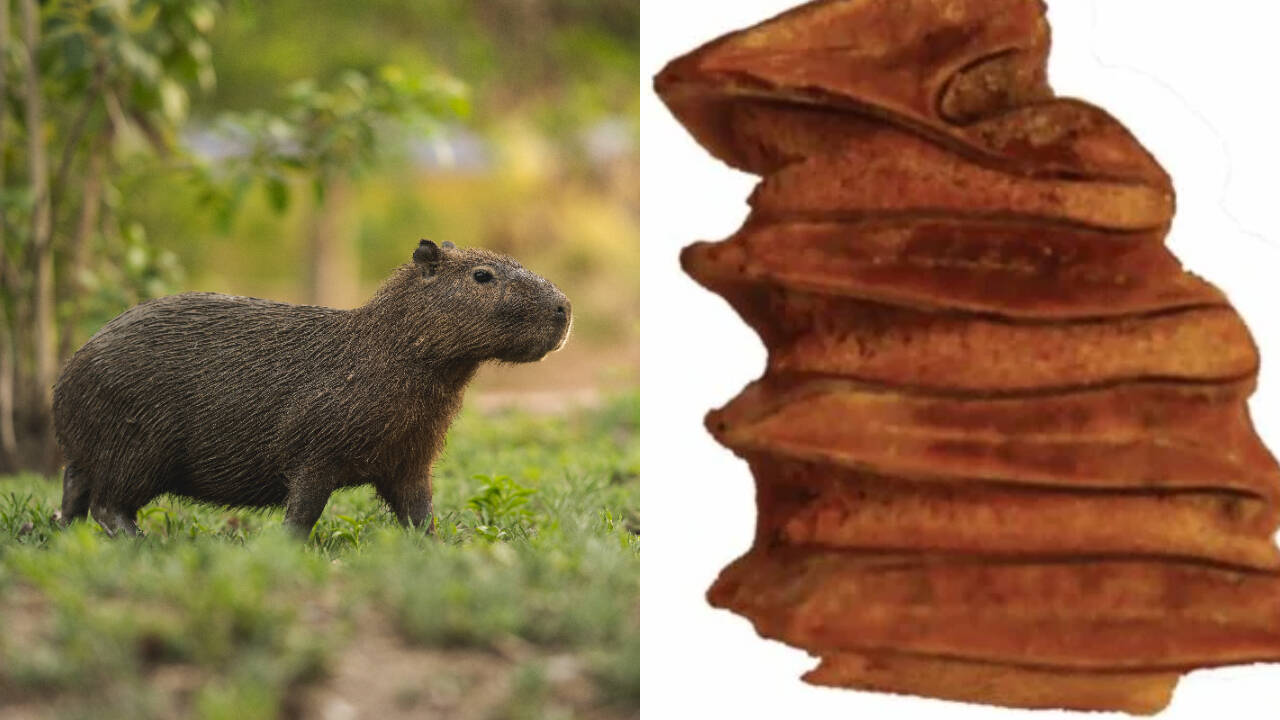
The driest place on Earth once hosted giant rodents. A nine-million-year-old capybara tooth unearthed in the heart of the Atacama Desert shatters our assumptions about South America's prehistoric climate history, exposing an environment that was radically wetter, greener, and far more complex than the parched salt flats we see today.
For decades, geologists treated the Atacama as an ancient, unchanging monument to aridity. Hyper-arid conditions were thought to have locked the region in a state of perpetual thirst for tens of millions of years. Then came the fossil. Discovered by researchers combing through remote sedimentary layers, a single molar belonging to an ancient relative of the modern capybara forced a complete revision of paleoclimatic models. Capybaras do not survive in bone-dry salt flats. They require permanent freshwater bodies, lush vegetation, and extensive wetland habitats to sustain their massive frames. Finding their remains in northern Chile means that during the late Miocene epoch, the Atacama featured thriving river networks and broad wetlands fed by heavy rainfall from the Andes.
Understanding this discovery requires looking closely at how deserts form and evolve over deep geological time. The modern Atacama owes its extreme dryness to a combination of factors: the cold Humboldt Current offshore, the rain shadow cast by the towering Andes mountain range, and a persistent atmospheric high-pressure system. Together, these elements choke off moisture from both the Pacific Ocean and the Amazon basin. Yet, nine million years ago, this climatic machinery operated under entirely different rules.
Tectonic uplift fundamentally altered the geography of the South American continent. As the Andes rose higher, they intercepted moisture-laden winds differently, starving the western slopes of precipitation while altering atmospheric circulation across the entire Southern Hemisphere. At the same time, global temperatures were shifting, and oceanic currents fluctuated in ways that directly impacted continental weather patterns. The capybara tooth acts as a biological data point, proving that the modern hyper-arid state of the Atacama is a relatively recent geological development rather than an eternal baseline.
Paleontologists and climate scientists are now racing to re-examine sedimentary basins across northern Chile to map the exact timeline of this drying process. Every layer of earth tells a story of shifting ecosystems, where forests and wetlands slowly gave way to hyper-arid barrens over millions of years. This transition was not a smooth, linear decline. It was likely punctuated by wet pulses, prolonged droughts, and dramatic ecological shifts as the topography of the Andes continued to evolve.
This finding carries profound implications for how researchers model future climate scenarios. Earth's climate system possesses tipping points that can transform lush environments into dust bowls over geological timescales—or conversely, revive arid regions through shifts in global circulation. While human-driven climate change operates on a vastly accelerated timeline compared to Miocene tectonic shifts, the underlying physical principles remain constant. Small changes in mountain elevations and oceanic temperatures can trigger massive regional transformations.
The Atacama Desert guards its secrets beneath layers of sun-baked gravel and toxic salt crusts. Every so often, a single tooth pushes back the curtain on a lost world where giant rodents waded through prehistoric swamps, a stark reminder that the landscapes we consider permanent are merely temporary chapters in a planetary history still being written.