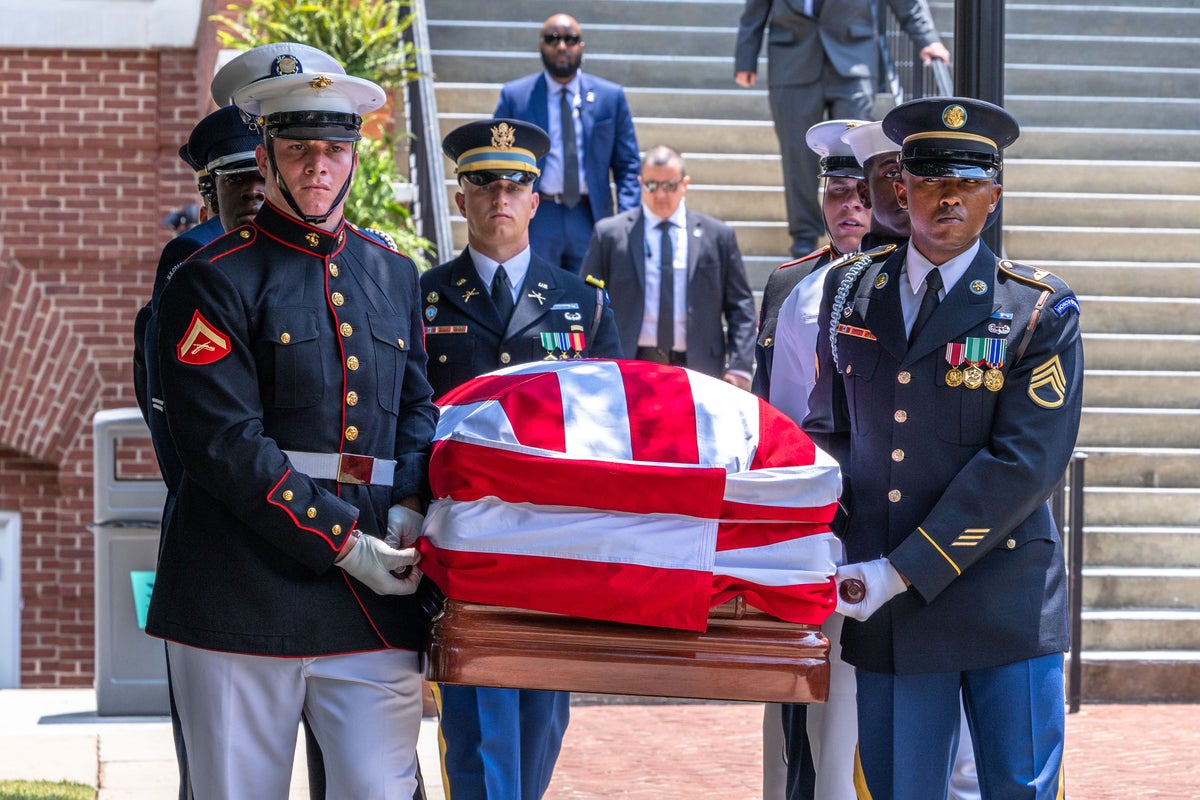
The air over Columbia on a July morning carries a weight that has nothing to do with the summer humidity. It settles on the brickwork of the South Carolina Statehouse, pools in the shade of the grand oaks, and hovers quietly above Main Street. A horse-drawn caisson moves through this heavy air, its rhythmic hoofbeats measuring out a slow, final cadence.
Behind it walk the family, the lawmakers, the local sheriffs, and the ordinary citizens who measured their lives by a man they simply called Lindsey.
For more than three decades, the name Lindsey Graham belonged to the marble halls of Washington, to roaring television studios, to tense committee rooms where the fate of nations hung on a pointed question. But power in the capital is a fickle, transient tenant. When the jet engines quieted and the marble dust settled following his sudden death on July 11 from an aortic tear at age seventy-one, the abstract national figure evaporated. What remained was a boy from Pickens County who grew up smelling of cheap carpet and cigarette smoke in his parents' billiard room.
He had just returned from a dizzying, relentless loop across oceans. Turkey, a NATO summit, a high-stakes diplomatic tightrope walk in Ukraine negotiating punishing sanctions against Russian aggression. That was the rhythm of his final days—hyper-focused on global architecture, yet tethered by an invisible umbilical cord to every small-town mayor and police chief across the Palmetto State.
Consider what happens when a life of such fierce contradiction comes to a sudden halt.
In Washington, a day earlier, the cathedral walls echoed with presidential eulogies. Presidents and foreign dignitaries spoke of a legislative titan, an indefatigable dealmaker who could scream across a committee table one minute and share a conspiratorial laugh the exact next. They framed him as a pillar of American foreign policy, a hawkish architect of defense.
But politics, stripped of its theater, is local. It is visceral.
When the flag-draped casket arrived at the South Carolina Statehouse—where his political journey first took root in 1993—the scale shifted from empires to neighborhoods. A dozen law enforcement officers stood at rigid attention. Overhead, four F-16 jets from the McEntire Joint National Guard Base tore across the pale sky in a sudden, thunderous missing-man formation, their afterburners writing a temporary scar of white smoke against the blue.
It was loud. It was theatrical. It was entirely fitting for a man who lived his entire adult life inside the combustion chamber of American public life.
Inside the cavernous First Baptist Church in downtown Columbia, where his formidable predecessor Strom Thurmond was mourned twenty-three years prior, a 130-member choir raised hymns that seemed to push against the stained glass. The pews were a cross-section of a state caught in transition. Republican governors and Democratic state representatives sat shoulder to shoulder. Old rivals, fierce combatants in legislative trenches, and lifelong confidants gathered not to parse his voting record or debate his foreign-policy interventions, but to remember the texture of his character.
Trey Gowdy captured it best, stripping away the senatorial titles to describe a kid born, as he put it, with a plastic fork in his mouth. Not silver. Plastic.
That origin story mattered. It dictated why Graham never built an ivory tower for himself in South Carolina. He knew the location of every local diner, every roadside stop, and every single Chick-fil-A across the state's sprawling interstate network. He knew the names of county councilmen whose votes wouldn't register on a national seismograph for a hundred years. Through political action committees and sheer relentless legwork, he ensured that down-ballot local candidates—the cogs that keep a party breathing at the municipal level—had the resources to fight their grassroots battles.
He cared about the plumbing of politics. Not just the shiny architecture.
Governor Henry McMaster stood at the pulpit and voice cracked with raw, unfiltered grief, ending his remarks with a simple, aching declaration of love for a departed friend. There was no guarded political calculation in that moment. Just the hollow echo of absence.
Death forces a brutal arithmetic upon the living. It reorganizes the board overnight. With Graham's sudden passing, a Senate seat that had seemed permanently anchored entered a state of rapid flux, with temporary appointments and sudden electoral ambitions spilling into public view. The machinery of government does not pause for mourning; bills advance in late-night votes as a final nod to a fallen colleague, and political alliances shift like sand in a tide.
Yet, as the procession left Columbia and wound its way more than a hundred miles northwest toward the rolling green hills of Pickens County for a private family burial, the noise of Washington began to fade.
The national commentators would move on to the next crisis, the next committee hearing, the next legislative showdown. The talking points would evolve. The Senate would find a new dealmaker to pace its carpeted cloakrooms.
Back home, though, the legacy looks different. It looks like a small-town lawyer who accidentally walked into the history books, a fixture of Sunday television who never forgot the smell of the pool hall, and a relentless voice that spanned from the turbulent floor of the House in the 1994 revolution to the quiet, tree-lined roads of upstate South Carolina.
The jets have landed. The caisson has stopped.
The boy from Pickens County is finally home.
For a closer look at the emotional farewell and the historic tributes paid to the late senator, you can watch the South Carolina final farewell ceremony for Senator Lindsey Graham, which captures the solemn State House procession and the full memorial service at First Baptist Church.