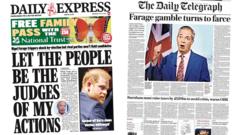
Walk past any newsstand in Britain on a rainy morning and you catch a snapshot of a national knife fight. Headline writers don't just report news. They actively construct national drama, frame political careers, and occasionally collapse a campaign before lunchtime.
Take a look at how the press handled recent political maneuvers. On one side, you have broadsheets blaring "Let the people judge" like a rallying cry for public accountability. On another rack, a tabloid declares Nigel Farage's latest political gamble a descent into farce. The contrast is sharp, intentional, and brutally effective.
Understanding this split isn't just about reading the news. It's about knowing who controls the narrative when politicians decide to throw dice with the public.
The Strategy Behind Front Page Battles
British newspapers remain unmatched in their ability to set the tempo of political debate. When a political figure makes a sudden tactical play, press rooms don't sit back and neutrally record it. They instantly divide into camp, referee, and Executioner.
Look at the phrasing chosen by headline editors. "Let the people judge" frames a political move as a brave, democratic act. It invites the voter into the decision-making process, implying confidence from leadership. It suggests that despite controversy, the ultimate court is the public ballot box.
On the flip side, calling a campaign move a "farce" cuts completely different. It paints calculated ambition as chaotic amateur hour. Once that word sticks in the public head, every subsequent speech or press release gets read through that lens.
That contrast reveals how paper editors operate. They aren't just summarizing speeches. They are setting up the emotional sandbox for the entire week.
Why Political Gambles Backfire Under Fleet Street Lights
High-stakes political moves usually rely on momentum. A candidate launches a surprise campaign, changes parties, or calls for an unexpected vote to catch opponents flat-footed.
When it works, it looks brilliant. When it stumbles, the press destroys it in real time.
Why do these gambles turn into messy spectacles so fast?
First, shock value wears off in about six hours. Once the initial surge of breaking news passes, journalists start asking basic, annoying questions about logisitics, policy depth, and motives. If the answers sound thin, the story turns from "bold strategy" to "desperate ploy."
Second, British tabloids hate a vacuum. If a political candidate doesn't control every detail of their rollout, columnists fill the space with brutal commentary. A single awkward photo or a bungled broadcast interview gives commentators all the material they need to stamp "disaster" across the front page.
Finally, voter fatigue sets in quickly. People know when they are being manipulated for headlines. When a political move feels engineered purely to grab attention rather than address real issues, the public reaction cools down fast. The press simply reflects that cynicism back onto the front cover.
How Voters Read Between the Lines
Most people don't read every article inside the paper. They look at the front page while waiting for a train or scrolling through social media summaries. Editors know this, which is why front-page real estate is fought over so fiercely.
When you analyze how readers consume these headlines, a few clear patterns show up:
- Confirmation bias drives paper selection. Readers who trust a populist candidate buy the paper framing him as a victim of the establishment. Readers who dislike him buy the paper calling his campaign a circus.
- Punchy emotional verbs beat balanced facts every single time. Words like "gamble," "farce," and "clash" sell papers because they promise conflict.
- The morning paper shapes the evening broadcast. Television producers and radio hosts take their cues from print headlines, multiplying the initial front-page framing across every media platform by afternoon.
This ecosystem creates a feedback loop. Politicians make risky moves to grab headlines, the media over-dramatizes those moves to sell copies, and the public becomes increasingly skeptical of both sides.
Navigating Today's Headlines Without Getting Misled
If you want to understand what's actually happening in British politics beyond the tabloid theatre, you have to change how you consume the morning papers.
Stop taking front-page verbs at face value. When a headline tells you a campaign is a farce, ask what specific failure occurred, or if the editor just dislikes the candidate. When a headline urges you to "let the people judge," check whether the politician is actually answering hard questions or just dodging scrutiny.
Compare three different front pages every morning. Look at how a left-leaning paper, a right-leaning daily, and an independent outlet cover the exact same event. The truth almost always lives in the gaps between their headlines.
Watch the broadcast follow-ups instead of just reading print quotes. Unedited video clips and live radio cross-examinations show you whether a politician is actually handling pressure or unravelling under questioning.
The front page will always prefer high drama over quiet facts. Recognizing the show for what it is remains your best defense against headline spin.


