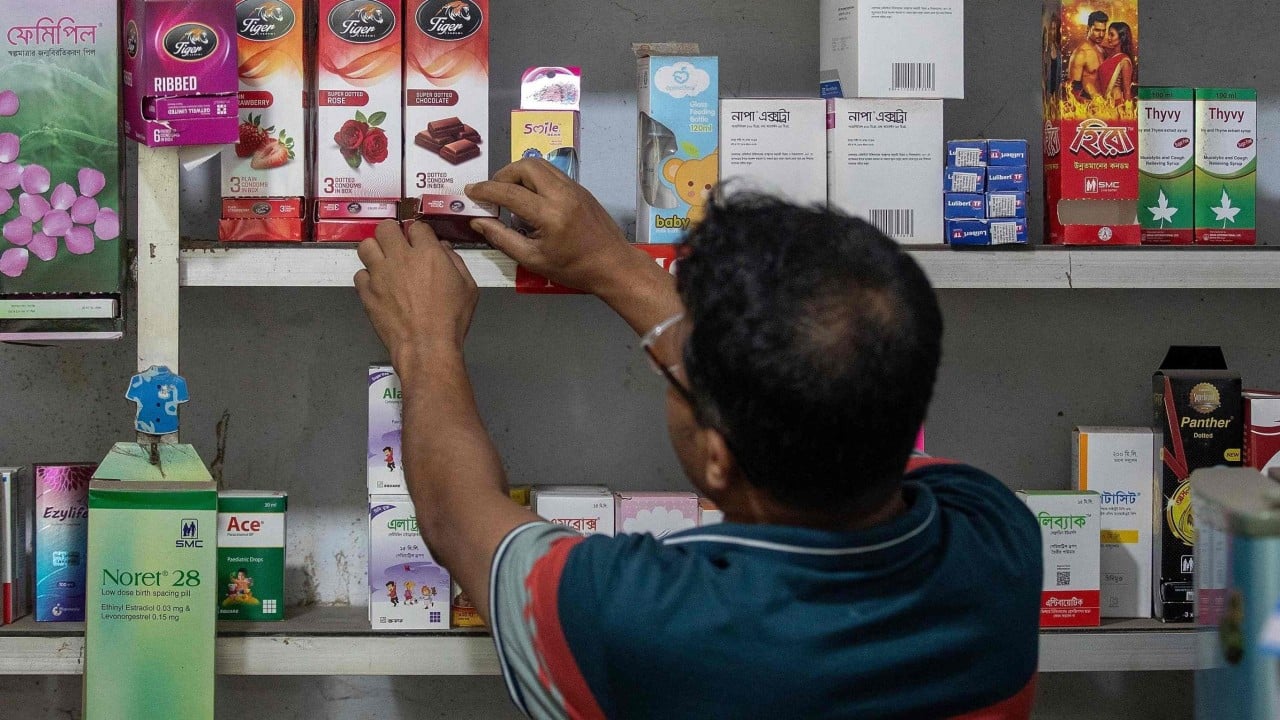
In a small, stifling room in rural Sylhet, Rabia counts the days. She doesn't use a calendar; she uses the fading light against the mud walls of her home. She is twenty-four years old, and she already has four children. Her body feels like a well that has been drawn from too many times, the bucket scraping against dry stone. She knows she cannot afford a fifth. Not emotionally, not physically, and certainly not financially.
The solution to her anxiety is a small strip of pills or a simple injection. In the grand ledger of global logistics, these are pennies. They are lighter than air. Yet, for Rabia, they might as well be on the moon.
The crisis of family planning in Bangladesh is often framed through the lens of "delivery pains," a clinical term that sanitizes a desperate reality. When we talk about supply chain management, we aren't talking about boxes on trucks. We are talking about the gap between a woman’s autonomy and a warehouse shelf gathering dust.
The Ghost of the Last Mile
Imagine a pipeline. At the start, it is gushing with resources—international aid, government budgets, and bulk shipments of contraceptives. But as the pipe stretches across the delta, through the monsoon-flooded plains and into the remote corners of the Chittagong Hill Tracts, it begins to leak. By the time it reaches the village health clinic, it is often bone dry.
This is the "Last Mile" problem. It is the most expensive, most difficult, and most human part of the journey.
In many districts, the stock-out rate for basic contraceptives has climbed to alarming levels. According to recent data from the Directorate General of Family Planning, the availability of injectables and pills has fluctuated wildly. One month, the shelves are full. The next, a woman travels three hours by rickshaw and boat only to be told by a sympathetic but empty-handed worker to "come back next month."
But biology does not wait for a procurement officer in Dhaka to sign a three-part form.
Consider a hypothetical health worker named Salma. She is the face of the system. Every morning, she adjusts her sari, packs her bag, and walks until her feet ache to visit the women in her assigned block. Salma is an expert in persuasion. She has spent years dismantling taboos and explaining the benefits of birth spacing.
But today, Salma’s bag is empty.
When she sits with a young mother who is finally ready to take control of her reproductive health, Salma has to admit she has nothing to offer. The trust she built over months evaporates in a single heartbeat. The woman looks at her with a mixture of confusion and betrayal. The system didn't just fail to deliver a product; it failed to deliver a promise.
The Paperwork Shackle
Why does the chain break? The reasons are mundane, which makes them all the more tragic. It is rarely a lack of medicine in the country. Instead, it is a tangle of bureaucratic inertia and antiquated tracking.
For years, the system relied on manual record-keeping. Ledgers were filled out by hand in flickering lamplight. These reports would then travel upward through layers of local, sub-district, and district offices. By the time the central warehouse realized a specific village was out of stock, the crisis was already weeks old.
Digitalization was supposed to be the savior. The e-LMIS (Electronic Logistics Management Information System) was introduced to provide real-time data. On paper, it is brilliant. In practice, it faces the harsh reality of rural infrastructure.
A computer is useless without electricity. A database is a void without an internet connection. In many areas, the "digital" transition means health workers are now doing double the work—logging data on paper and then struggling to upload it to a glitchy server via a weak mobile signal.
The friction is lethal.
When the flow of data stalls, the flow of supplies stops. Procurement cycles in Bangladesh are notoriously rigid. If a budget isn't cleared or a tender is contested, the entire machine grinds to a halt. The result is a "bullwhip effect." A small delay in Dhaka creates a massive void in the provinces.
The High Cost of Silence
The stakes are not merely statistical. They are measured in the mortality rates of mothers and the stunted growth of children born into families that cannot sustain them.
Bangladesh was once the poster child for successful family planning. In the 1970s, the fertility rate was nearly seven children per woman. Through a Herculean effort of grassroots mobilization, that number was brought down to 2.3. It was a miracle of public health.
But progress is not a one-way street. It is a treadmill. If you stop running, you slide backward.
The stagnation we see today is a warning light on the dashboard. When contraceptives are unavailable, the rate of "unmet need" rises. This leads to an increase in unsafe abortions, which remain a leading cause of maternal death in the region.
It is a cruel irony. A country that has made such strides in textiles, technology, and economic growth is being held back by its inability to move a two-ounce packet of pills from a city to a village.
We often think of logistics as a cold, mathematical field. We think of spreadsheets and transit times. But in the context of family planning, logistics is an act of empathy. To ensure a product is on the shelf is to tell a woman like Rabia that her future matters. It is to acknowledge that her ability to choose when and if to have a child is the foundation of every other right she possesses.
The Invisible Laborers
The burden of these delivery pains falls disproportionately on the poor. In the bustling pharmacies of Dhaka, those with money can buy what they need. The supply chain for the wealthy is robust because it is fueled by profit.
The public supply chain, however, is fueled by political will.
There is a specific kind of exhaustion that comes from working within a broken system. The field workers—mostly women—are the ones who have to look their neighbors in the eye and apologize for the government’s failures. They are the shock absorbers for a clunky, distant bureaucracy.
They tell stories of "stock-outs" that last for three months. They talk about having to prioritize which women get the remaining supplies. Imagine having to choose which of your neighbors is "more at risk" of an unwanted pregnancy because you only have five doses left for a village of fifty.
This isn't just a logistical failure. It’s a moral one.
Reimagining the Flow
Fixing this doesn't require a scientific breakthrough. It requires a shift in how we value the "Last Mile."
Instead of top-down mandates, the system needs to be responsive from the bottom up. This means empowering local clinics to manage their own small-scale procurement when the central system fails. It means investing in the unglamorous infrastructure: temperature-controlled storage in rural hubs, reliable motorcycles for distributors, and truly offline-capable digital tools for health workers.
But more than that, it requires a recognition that family planning is not a "secondary" health concern. It is the primary engine of development.
When a family can plan, they can save. When they can save, they can educate. When they educate, the cycle of poverty begins to crack. Every pill that fails to reach its destination is a missed opportunity to lift a family out of the dirt.
The light in Rabia’s room is dimming now. She finishes her chores and sits by the doorway, looking out at the path that leads to the main road. She is waiting for Salma. She is hoping that today, the bag will be heavy. She is hoping that the chain, for once, has held together long enough to reach her.
The tragedy is that the pills are sitting in a warehouse three hundred miles away, locked behind a door that no one has the key to, while a woman stares at the horizon and prays for a miracle that should have been a certainty.