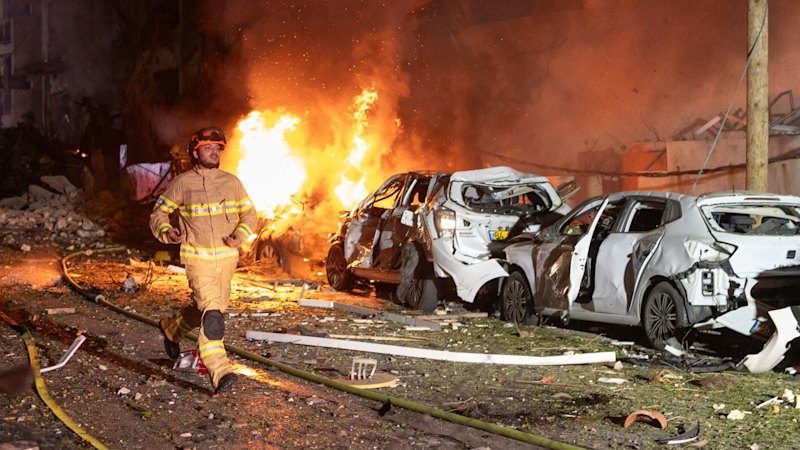
The shadow war between Israel and Iran has moved out of the darkness and into the open, fundamentally altering the security architecture of the Middle East. When Iranian missiles streak across the Levantine sky, the immediate concern is often the casualty count or the structural damage on the ground. However, the true crisis lies in the exhaustion of defensive stockpiles and the unsustainable economic disparity of modern aerial warfare. For every $100,000 drone or $1 million ballistic missile Tehran launches, the defending coalition spends ten times that amount to knock it out of the air. This is not just a military confrontation; it is a war of industrial attrition that the West is not currently positioned to win.
The Mirage of Total Defense
Military analysts often point to interception rates of 90 percent or higher as proof of security. This is a dangerous misunderstanding of how saturation attacks work. Iran’s strategy does not require every missile to hit a target. Instead, they utilize a "layered swarm" approach designed to force the defender into making impossible choices.
By launching a mix of slow-moving Shahed loitering munitions, cruise missiles, and high-speed ballistic projectiles, Iran forces the Israeli Defense Forces (IDF) and their allies to activate multiple tiers of defense simultaneously. The Iron Dome handles the low-level threats, David’s Sling takes the mid-range, and the Arrow system engages targets in the upper atmosphere.
The problem is the magazine depth.
While Iran has spent decades building an underground network of "missile cities" capable of churning out thousands of airframes, the production of interceptors like the RIM-161 Standard Missile 3 (SM-3) or the Arrow 3 is slow and incredibly expensive. We are witnessing a scenario where a $20,000 fiberglass drone can successfully "kill" a $4 million interceptor simply by existing in the same airspace. When the interceptors run out, the 91st missile gets through. That is the only one that matters.
The Red Sea Laboratory
The Houthi rebels in Yemen, acting as a proxy for Iranian kinetic interests, have turned the Red Sea into a live-fire testing ground for these tactics. For over a year, they have used Iranian technology to disrupt global shipping, proving that you don’t need a blue-water navy to hold the world’s economy hostage.
Western navies have responded with significant force, but the cost-benefit analysis is grim. US destroyers have been forced to use sophisticated missiles to take out drones that are essentially lawnmowers with wings. This has depleted the US Navy’s inventory of specific munitions that would be required in a larger conflict, such as a potential face-off in the Pacific.
Iran has watched this carefully. They have seen that Western industrial bases are currently unable to replace high-end munitions at the rate they are being expended. The "uncertainty" mentioned by casual observers is actually a very certain realization among defense planners: the era of cheap, mass-produced precision weapons has arrived, and the defense hasn't caught up.
The Failure of Regional Deterrence
For years, the working theory was that economic sanctions would cripple Iran’s ability to modernize its military. This was a massive miscalculation. Instead of stopping production, sanctions forced Iran to become self-reliant and masters of "good enough" technology. They don't need the exquisite sensors of a Lockheed Martin jet; they just need a GPS chip from a commercial delivery drone and a basic rocket motor.
Deterrence has also failed because the threshold for a response has shifted. When Iran launched a direct strike from its own soil against Israel in April 2024, it broke a decades-old taboo. The world waited for a catastrophic escalation that would reset the board. It didn't happen. Instead, we entered a cycle of "calibrated" strikes—attacks designed to save face and show strength without triggering a total regional collapse.
This calibrated warfare actually favors Iran. It allows them to test their systems against the world’s most advanced defenses in a controlled environment. Every failed Iranian strike provides data. They learn the radar signatures of the F-35, the response times of the Aegis combat system, and the blind spots in regional sensor arrays. They are paying for a world-class education with hardware they consider disposable.
The Economic Burden of the Shield
The fiscal reality of these airstrikes is staggering. In a single night of defense, Israel and its partners can burn through $1 billion to $1.5 billion. To put that in perspective, the Iranian side of the ledger for that same night likely totals less than $100 million.
This gap is a weapon in itself.
In a prolonged conflict, the defender’s economy takes the hit first. Taxpayer funds that should go toward infrastructure, education, or domestic stability are diverted into a bottomless pit of one-use interceptors. Meanwhile, Iran’s decentralized production model, which uses "shadow" factories often hidden under civilian infrastructure, remains relatively insulated from high-cost economic shocks.
Why the Iron Dome is Not Enough
- Saturation Limits: Every radar system has a maximum number of targets it can track and engage.
- Reload Time: Static batteries are vulnerable during the window when they are being reloaded with fresh canisters.
- Geographic Gaps: No defense system can cover 100 percent of a nation’s territory against a 360-degree threat.
The Geopolitical Shift Toward the East
We cannot ignore the role of Russia and China in this equation. The Iranian missile program has benefited from a symbiotic relationship with Moscow, particularly after the invasion of Ukraine. Iran provides the drones that Russia needs to overwhelm Ukrainian air defenses, and in exchange, Tehran gains access to Russian cyber warfare tools and advanced satellite intelligence.
China remains the primary customer for Iranian oil, providing the hard currency necessary to keep the missile assembly lines running despite Western banking bans. This creates a "Sanction-Proof Bloc" that operates outside the reach of the US Treasury Department.
The airstrikes in the Middle East are a symptom of a larger breakdown in the post-WWII international order. The rules that used to govern state-on-state violence are being rewritten by actors who realize that the West is weary of "forever wars" and is currently struggling with internal political polarization.
The Vulnerability of Energy Infrastructure
While the world watches military bases, the real targets are the desalination plants and oil refineries. The Middle East is a region where life is sustained by fragile, centralized infrastructure. A single successful strike on a major water treatment facility in the Gulf could cause a humanitarian crisis more severe than any conventional bombing run.
Iran knows this. Their "Axis of Resistance"—consisting of Hezbollah in Lebanon, militias in Iraq, and the Houthis—creates a ring of fire around these critical nodes. If Iran feels its survival is at stake, it will not target soldiers; it will target the lights, the water, and the fuel.
This is the leverage they hold over the global economy. If the Strait of Hormuz is closed or the Saudi refineries are hit again, the price of oil doesn't just go up; it breaks the global supply chain. This threat remains the ultimate "check" on Western military intervention.
Rebuilding the Defense Logic
The current path is unsustainable. To counter the Iranian missile threat, the West must move away from the "interceptor-for-missile" model and toward something more cost-effective.
Directed energy weapons—lasers—are the obvious answer, but they have been "five years away" for the last twenty years. While Israel is making progress with its Iron Beam system, it is not yet ready for mass deployment. Until a laser can take out a drone for the cost of the electricity used to fire it, the math remains in Tehran's favor.
Intelligence must also shift focus. Instead of trying to stop the missiles in flight, the emphasis must be on the supply chain. This means aggressive, often clandestine operations to disrupt the flow of dual-use components before they ever reach an Iranian port. It means recognizing that a shipment of hobbyist-grade servos or carbon fiber is just as much a "weapon" as a crate of TNT.
The uncertainty in the world today isn't about whether more strikes will happen. They will. The uncertainty is whether the global community has the stomach to admit that the old methods of containment have failed. We are no longer dealing with a rogue state; we are dealing with a sophisticated, technologically capable adversary that has found the "cheat code" to modern warfare: quantity has a quality all its own.
Governments must now prioritize the hardening of civilian infrastructure and the rapid expansion of domestic munition manufacturing. If a nation cannot replenish its defensive magazines faster than an enemy can build cheap drones, that nation has already lost its sovereignty. The time for diplomatic hand-wringing is over; the era of the high-volume, high-frequency missile threat is the new permanent reality.