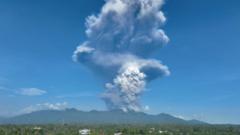
The headlines are predictable. They are always predictable. "Three dead after volcano erupts on Indonesian island." The copy follows a scripted path: a sudden explosion, a panicked evacuation, and a mourning community.
Mainstream media loves the "unpredictable disaster" narrative. It sells ads. It triggers a reflexive sympathetic response. But it’s fundamentally dishonest.
Stop calling these events "unexpected." Stop treating them like anomalies. Indonesia sits on the Ring of Fire. It is the most volcanically active region on the planet. When a stratovolcano on a remote island like Lewotobi Laki-laki or Ruang decides to vent, it isn't a freak accident. It’s a statistical certainty.
The real story isn't the eruption. The real story is the catastrophic failure of modern risk management and the stubborn refusal of the global travel industry to acknowledge that some places are simply too dangerous for human settlement. We are witnessing a collision between ancient geology and modern negligence.
The Myth of the Unpredictable Eruption
Most news outlets frame volcanic eruptions as bolts from the blue. They aren't.
Seismologists at the Center for Volcanology and Geological Hazard Mitigation (PVMBG) in Bandung are some of the most experienced in the world. They track tiltmeters, gas emissions, and harmonic tremors. They usually see the "heartbeat" of a volcano speeding up weeks before a major event.
The "surprise" isn't a lack of data. It’s a lack of infrastructure to act on it.
When three people die in an Indonesian eruption, they didn't die because the volcano was "angry." They died because of:
- Housing Density: People live on the slopes because the soil is fertile. The very ash that kills them also feeds their crops. It’s a literal death pact with the land.
- Communication Latency: While we have 5G in Jakarta, the "last mile" of emergency alerts in the outer islands is often a wooden drum or a WhatsApp message that arrives too late.
- The "Normalcy Bias": After living near a smoking mountain for thirty years without a blowout, the human brain stops perceiving the threat.
If you build your house on a giant pressure cooker, don't act shocked when the lid pops.
Geopolitical Negligence disguised as Sympathy
We spend billions on climate change summits while ignoring the immediate, tectonic threats that actually wipe out villages today.
Indonesia has 127 active volcanoes. Millions of people live within the "Red Zone" (KRB III). This is the area where pyroclastic flows—clouds of superheated gas and rock traveling at 200 mph—will incinerate everything in their path.
The lazy consensus says we need better sensors. The contrarian truth? We need forced relocation.
But relocation is expensive. It’s politically unpopular. It’s "easier" for a government to offer prayers and a few thousand dollars in aid after a burial than it is to move 50,000 people to a different island. We are subsidizing death by allowing these high-risk settlements to persist under the guise of "cultural preservation."
The Travel Industry’s Dirty Little Secret
Let's talk about the tourists.
Travel influencers post "epic" photos of Mount Bromo or Ijen, encouraging people to hike to the craters for the "perfect shot." They don't mention that the sulfur dioxide levels can spike in seconds, or that a phreatic eruption (steam blast) can turn the air into a furnace without a second's warning.
The travel industry treats volcanoes like theme park attractions. They aren't. They are geological engines.
Every time a tourist dies on a volcano, the media blames "bad luck." It’s not bad luck. It’s a failure of the industry to provide accurate risk assessments. If a hotel is built in a lahar path, that’s not a "scenic view"—it's a liability.
The Physics of Failure
Standard news reports focus on "ash." Ash sounds like the stuff in your fireplace. It sounds soft.
Volcanic ash is actually crushed glass and rock. It’s heavy. It’s abrasive. It doesn't just "fall"; it coats lungs and collapses roofs.
The Math of a Roof Collapse
Consider a modest house with a 100-square-meter roof.
- A 10cm layer of dry volcanic ash adds about 10,000 kilograms of weight.
- If it rains—which it often does in Indonesia—that weight doubles or triples as the ash turns to sludge.
- Most rural structures are designed to hold the weight of a few monkeys, not a fleet of SUVs.
The three people who died in this latest eruption likely didn't die from lava. Lava is slow. You can walk away from lava. They died because their "shelter" became their tomb.
The False Hope of Technology
AI and machine learning are being touted as the "solution" to volcanic forecasting.
I have seen tech companies pitch "Early Warning AI" that monitors satellite thermal imagery. It sounds great in a boardroom in San Francisco. It is useless in the North Sulawesi jungle when the power is out and the local government hasn't maintained the sirens.
We don't need "synergy" between sensors and the cloud. We need concrete. We need bunkers. We need paved evacuation roads that don't wash away in the first monsoon rain.
The obsession with high-tech fixes ignores the low-tech reality: if you can't get people five kilometers away from the vent in under twenty minutes, all the data in the world is just a digital record of their demise.
Why We Keep Losing
The reason these deaths continue is that we have commodified the danger.
Volcanoes are "cool." They are "majestic." They are "unpredictable."
As long as we treat them as mysterious acts of God rather than predictable geological processes, we will continue to fail the people living near them. We need to stop the "thoughts and prayers" cycle.
We need to start talking about the Economic of Hazard Zones. If an area has a 10% chance of a catastrophic event every decade, it should not be a residential area. Period.
The Hard Truth
If you choose to live on a volcano, you are gambling. If a government allows you to live there, they are the house, and the house always wins.
The death of three people in Indonesia isn't a "tragedy" in the sense of an unavoidable misfortune. It is an indictment of a global system that values land rights and tourism dollars over the cold, hard reality of plate tectonics.
The volcano did exactly what a volcano is supposed to do. It released pressure. It's the humans who failed to move out of the way.
Stop reading the obituaries and start looking at the maps. The danger isn't hidden. It’s written in the soil, the rock, and the history of every island in the archipelago. If you’re standing in a Red Zone and the ground starts to shake, you didn't run out of luck. You ran out of time.